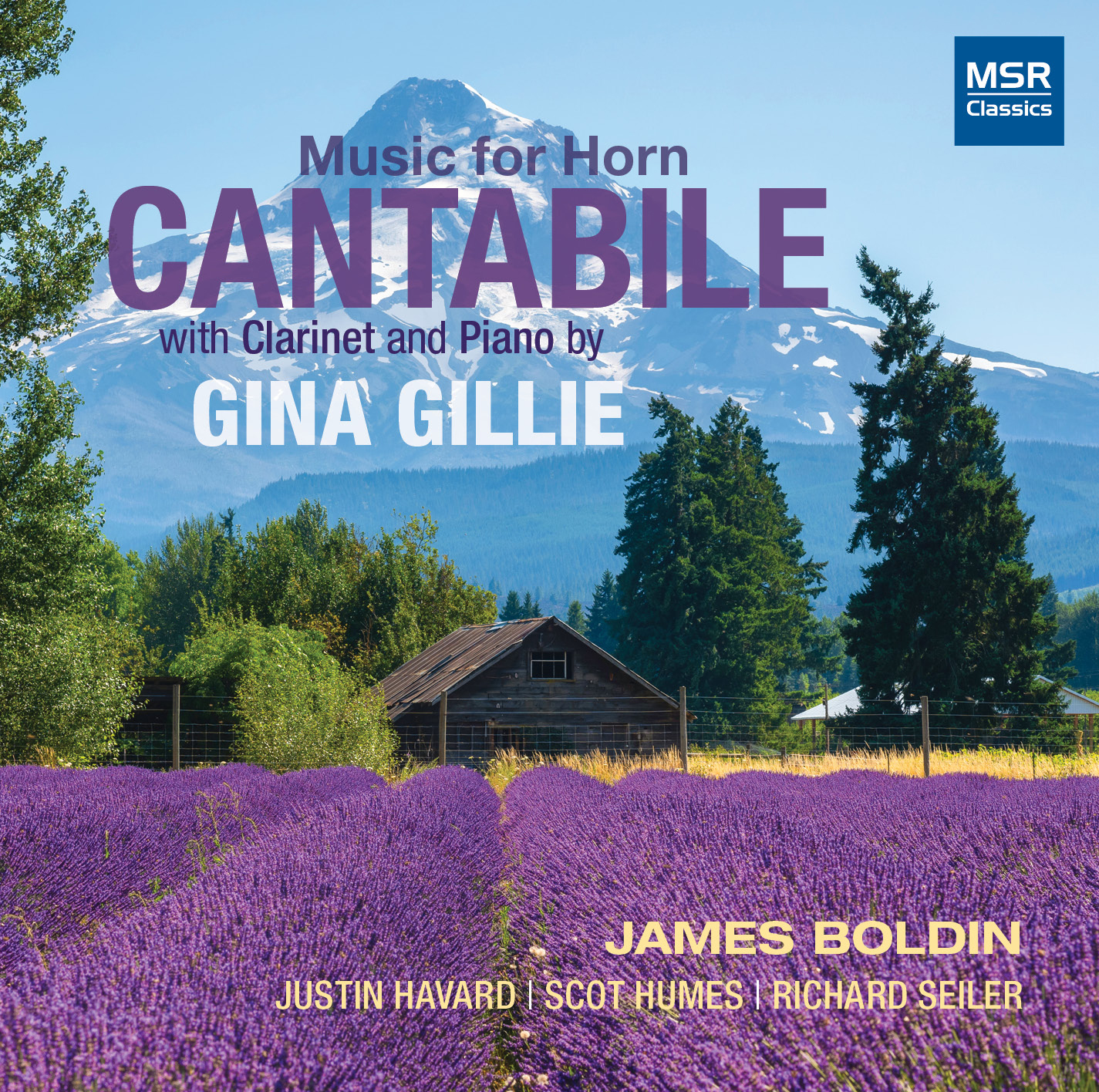
This past summer I had the opportunity to record an album of works by Gina Gillie, a composer and horn player who is becoming increasingly familiar in the horn world! The recording is titled Cantabile: Music for Horn with Clarinet and Piano by Gina Gillie, and it is available through MSR Classics at their website, on Amazon, and other outlets. Here’s a short quote from the liner notes:
I met Gina Gillie in 2004 while we were graduate students at the University of Wisconsin-Madison. Even then, it was clear that Gina was an exceptional musician with a creative gift. In the years since, she has turned what was then a burgeoning interest in composition into a growing library of works, many of which are recorded here for the first time. As both a horn player and vocalist, Gina has always been able to tap into the special singing quality of the instrument. It is fitting that the title of this album is Cantabile, as no matter the style or instrumentation, Gina’s compositions always sing. My deepest gratitude goes to my collaborators for their inspiring work, and to Gina’s and my former teacher, Douglas Hill, for encouraging our musical dreams. Thank you also to the ULM School of Visual and Performing Arts and the family of Emy-Lou Biedenharn for their support of this project.
That pretty much sums up the project, but for anyone interested here is a complete list of the pieces we recorded.
SONATA for Horn and Piano I. Allegro moderato II. Melodie III. Rondo
ESCAPADE for Horn and Piano
SONG FOR THE LOST for Horn and Piano
REVERIE for Horn and Piano
ROMANCE for Wagner Tuba and Piano
THREE PAINTINGS for Clarinet, Horn and Piano I. Highland Castle II. Lavender Fields III. Conneaut Rag
All but one of them – the Sonata, which was commissioned and recorded by Steven Cohen for his fantastic album Cruise Control – are world premiere recordings, and I think listeners will really enjoy them! I and two of my colleagues, Scot Humes and Richard Seiler, commissioned the final work on the album, Three Paintings. It’s a fun piece and a wonderful addition to the clarinet, horn, and piano repertoire. I also want to recognize Paul Eachus, who recorded, edited, and mastered this album. He is a fantastic musician and engineer. We were also lucky to have Gina Gillie here for the recording sessions to offer her expert advice and amazing ears. Thanks Gina! And finally, several of the works on this album – Reverie, Escapade, and the Sonata – are available through WaveFront Music, and the rest are available directly from the composer. If you like them, and I think you will, buy the music and program them yourself on an upcoming recital.
The horn community is full of creative and productive individuals, and it can be difficult to keep track of all the wonderful books, articles, recordings, compositions, and other contributions out there. Recently, Dr. Ricardo Matosinhos sent me an advance copy of his new recording, Hornscapes, for review. The album was recorded in Mindezell, Germany as part of the “Ring of Engelbert Schmid Horn Soloists” series. Ricardo is active as a performer, composer, teacher, and author (of horn-related articles and children’s books), and is well-known for his solo horn works and his series of jazz-inspired and other etude books published by Phoenix Music Publications.
His playing – and that of his collaborator Isolda Crespi – is agile and expressive, combining technical brilliance with satisfying phrasing. These works are fresh and fun, showing off the best of what the horn (and Wagner tuba on two of the compositions) can do.
The complete program notes and a nice promotional video are available online: https://ricardomatosinhos.com/index.php/en/blog/781-hornscapes-en. The subtitle of this recording is “Music for Horn Composed by Horn Players,” and 6 of the 10 works on this album were composed by Matosinhos. Ricardo is an incredibly creative musician, both as a performer and composer. His compositions span everything from Neo-romantic to Jazz and modern extended techniques. Works by Fernando Morais, Emma Gregan, Kerry Turner , and Jeffrey Agrell fill out the rest of the recording.
The Morais is a fantastic opener for an album, lively and attention-grabbing. Australian horn player Emma Gregan’s works are always enjoyable, and her Rose-Coloured Glasses for horn and piano is no exception. Kerry Turner’s Abide with Me is a substantial ten-minute tour de force of modern horn-playing techniques, commissioned by Matosinhos for his doctoral research.
The next several works are by Matosinhos, who carries on a long tradition of horn-player composers. These works are as varied as they are fun and interesting, and any one (or more) of them would make exciting additions to a recital program. It’s worth noting that several of Ricardo’s compositions, including his etudes, make use of multiphonics, which he has honed to an incredibly high level. Having heard Ricardo perform live, I can say that yes, his multiphonics sound just as good in person as they do on the recording!
In this, and everything else on this album, Ricardo sets a very high standard to which we can all aspire. Also worthy of mention are the two works for Wagner tuba, which are welcome additions to a growing repertory of solo music for the instrument. If you’re accustomed to hearing the Wagner Tuba in an orchestral or operatic context, you are in for a suprise! Matosinhos’s Wagner tuba playing is exciting, at times bombastic and at others lyrical and delicate.
Jeffrey Agrell’s Gallimaufry Suite finishes out this fine recording. This virtuosic multi-movement work makes extensive use of the low register, and is quirky and fun to listen to. Bravo to Ricardo Matosinhos, and everyone else involved, on this new recording!
This fall I was fortunate to be able to go on a brief recital tour, performing the same program three times in one week at the University of Louisiana Monroe, Arkansas State University, and the University of Central Arkansas. Videos from the final performance at UCA can be found at the end of this post. THANK YOU to my collaborator, Justin Havard, as well as our hosts Juli Buxbaum and the Arkansas State University Horn Studio and Brent Shires and the University of Central Arkansas Horn Studio. It’s been a while since I did a strictly horn and piano recital, and this program was tremendously fun to put together and perform. I’m pretty happy with these videos, although I set the camera up a little too close, resulting in a more direct sound than the hall actually had. It was a lovely, resonant space. Here’s the list of works, along with the videos and some program notes sourced largely from the composers’ websites and publishers of their music.
Lauren Bernofsky (b. 1967), Two Latin Dances
Lauren Bernofsky’s catalog includes solo, chamber and choral music as well as larger-scale works for orchestra, film, musical, opera, and ballet. Her music has been performed across the United States, Europe, and Asia, as well as in Australia, New Zealand, Greece, Iceland, Norway, Brunei, Kenya, and South Africa. She holds degrees from the Hartt School, New England Conservatory, and Boston University. Her philosophy of composition is simple: music should be a joy both to play and to hear. Bernofsky’s works have been commissioned by the Harford Ballet, the Bloomington Symphony Orchestra, the Delmar Trio, Jeffrey Curnow (Philadelphia Orchestra), and many others. Her works are published by Boosey & Hawkes, The FJH Music Company, Balquhidder Music, Fatrock Ink, Hal Leonard, Grand Mesa Music, Alfred Publishing, Wingert-Jones, Carl Fischer, and Theodore Presser, and can be heard on the Polarfonia, Albany, Music to My Ears, Blue Griffin, MSR Classics, and Emeritus labels. – Information from laurenbernofsky.com. Commissioned by trombonist Natalie Mannix, Two Latin Dances is a beautifully evocative and sizzling work based on Bossa Nova and Tango rhythms. While at first sounding as two distinct movements, the characteristic dances gradually intertwine to create a uniquely integrated and ever-building whole. This arrangement for horn and piano by the composer.
Edith Borroff (1925-2019) , Sonata for Horn and Piano
Edith Borroff received her education at Oberlin Conservatory, the American Conservatory of Music, and the University of Michigan. She became the contemporary music critic for the Ann Arbor News in 1966. She authored the book Three American Composers (Pub. Univ Press of America, 1986) which traces the power shift from the apprentice/conservatory system of training composers to the university system, which took place in the United States from 1925 to 1975. In addition to her renown as a composer, Dr. Borroff taught at several colleges and universities, including SUNY-Binghamton, where she spent the bulk of her career. Her areas of research centered on 17th-century French chamber music, American and contemporary music, music education, and pre-history. Borroff authored numerous books including the first history of music to include African-American composers. Edith Borroff’s papers are housed in the Newberry Library in Chicago, and include her writings, musical compositions, correspondence, research materials, and lectures as musicologist and composer. – Information from composers.com/composers/edith-borroff The Sonata for Horn and Piano is idiomatic for both instruments, and the four movements (Rhapsody, Scherzo, Sarabande, and Estampie) move backwards in time, representing musical periods from the Medieval to Romantic eras. The composer describes the movements as differing in mood as well as form and the writing is tonal and melodic. The lush first movement is contrasted with the light, jocular second. The stately Sarabande is followed by the 14th-century round dance, Estampie. Borroff’s Sonata was premiered by Nancy Becknell, horn with Borroff, piano at Northwestern University in 1955. Cynthia Carr, horn recorded the work with Julie Nishimura, piano on Images: Music for Horn and Piano by Women Composers (self-produced). – Notes by Lin Foulk Baird,linfoulk.org
Shanyse Strickland (b. 1991), When I’m Older
Shanyse Strickland is a multi-instrumentalist, vocalist, composer, and arranger. While French horn is her primary instrument, Strickland plays a variety of brass and woodwind instruments. Originally from Akron, OH, her musical journey began on wind instruments as a flutist, then she switched to French horn and eventually a host of other brass instruments including trumpet and trombone. While pursuing her undergrad at Youngstown State University, she played trombone and flute for the reuniting Ohio Players under the direction of the band’s piano player and songwriter Billy Beck. In Pittsburgh, she was the flute feature for a local group called the Level Up Band and performed in a variety of genres including neo soul, jazz, and R&B from the past and present. Strickland was the winner of the 2016 Jazz Solo Competition at the International Horn Symposium where she performed in front of jazz composer and hornist David Amram and a host of other jazz hornists. Her commissioned piece Afrofuturism premiered at the 2023 Music by Women Festival and also won an Urgent Art Fund grant through SPACES. Strickland has been commissioned by the Seattle Symphony horn section, The University of Texas brass faculty, DC Strings, and many musicians around the country. When I’m Older – part of the recently published collection Lift: Solos for Horn by Black Composers – is a composition for the aspiring horn player to explore new horizons of performance as they dream about what it will be like to achieve their goals in the music world. Exploring all the elements that make us fall in love with the horn, this piece makes room for the performer to demonstrate flexibility in articulation, sing wonderful melodic lines, and find the ebb and flow of natural rhythmic drive. There are three sections: the vision, wishful destiny, and the dream. – Notes by the composer.
Anthony Plog (b. 1947) Horn Sonata
Anthony Plog has had a rich and varied international career in music – as a composer of operas, symphonic music, and chamber works; as an orchestral musician, soloist, and recording artist – and as a brass teacher and coach at some of the great music conservatories internationally and now online to students around the world. His music has been performed in over 30 countries, and he has been the recipient of numerous grants and commissions. After beginning his career writing extensively for brass, he now works in many different musical forms. He has composed three children’s operas, the first of which (How the Trumpet Got Its Toot) was premiered by the Utah Opera and Symphony. He completed a major tragic opera (Spirits) based on a Holocaust theme and recently finished a new opera about a drone operator suffering a nervous breakdown (The Sacrifice). Other new works include an oratorio about the first major environmental battle in the United States (God’s First Temples), in versions for orchestra, symphonic band, and soprano song cycle; and a cantata using the stories of women who have recovered from sex trafficking, prostitution, and drug abuse (Magdalene). Plog lives and works in Freiburg, Germany. – Information from anthonyplog.com/about/biography Plog’s Horn Sonata was commissioned through a consortium led by Matthew C. Haislip of Mississippi State University. The sonata is written in two parts, each comprising two movements attacca. The composer skillfully varies passages that highlight the sonority and singing character of the horn with more virtuosic and agitated passages. He maintains a dramatic dynamism throughout the entire work, thanks in part to a piano part that not only punctuates and accompanies, but also plays its own full role. – Information from editions-bim.com
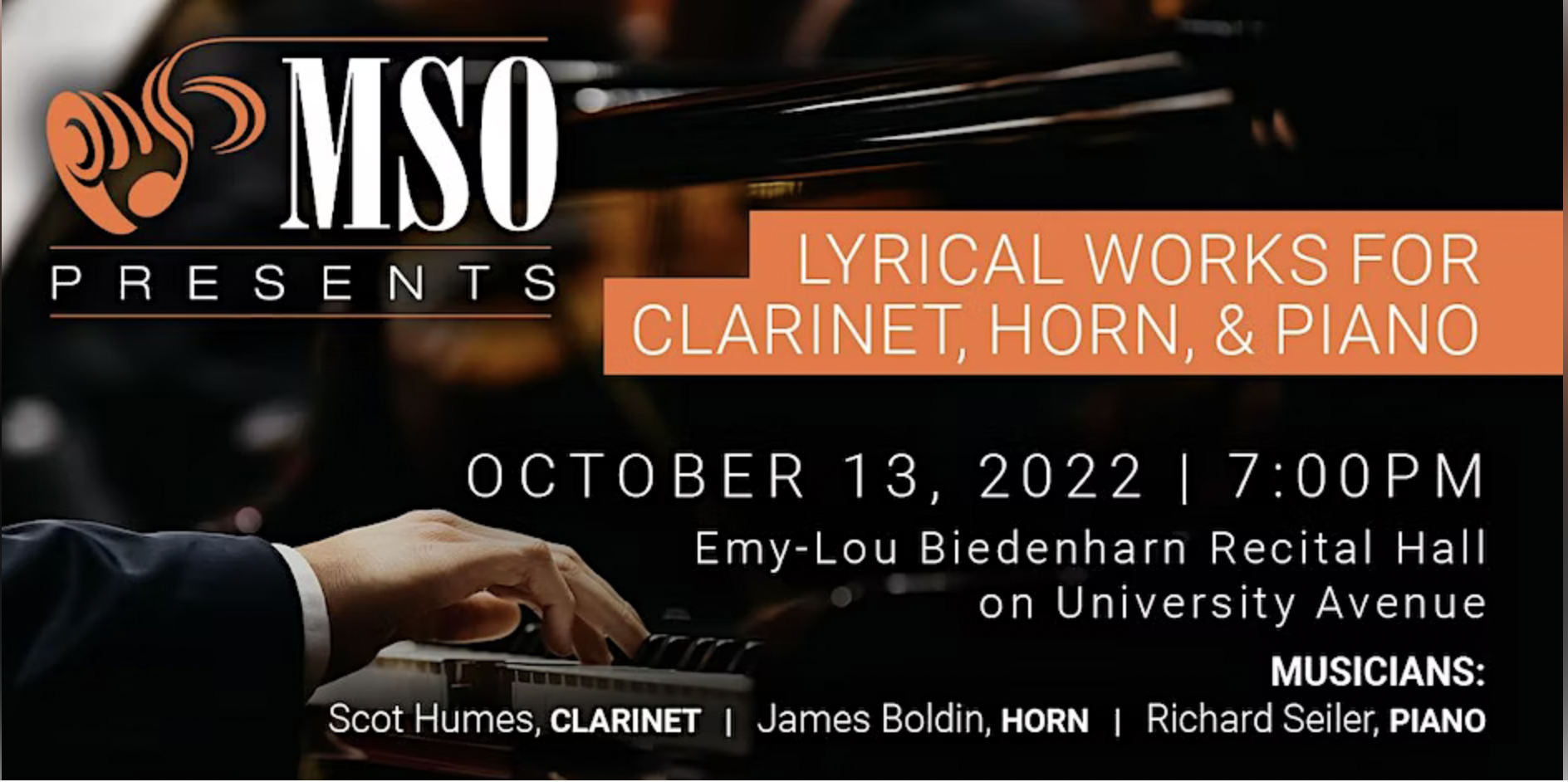
Here are some videos from a recital a few months ago, “Lyrical Works for Clarinet, Horn, and Piano” on October 13 on the ULM campus. Presented as part of our local orchestra’s chamber music series, this was a fun concert to program and put together with my colleagues Scot Humes on clarinet and Richard Seiler on piano.
Carl Reinecke, Trio in B flat-major Op. 274 for Clarinet, Horn, and Piano Gina Gillie, Three Paintings for Clarinet, Horn, and Piano *World Premiere George Rochberg, Trio for B-flat Clarinet, F Horn, and Piano
The only work I’d performed before was the Rochberg, way back in 2006 on a doctoral recital at the University of Wisconsin-Madison. Of particular interest is the world premiere of Gina Gillie’s trio, a work we commissioned. If you don’t know any of Gina’s music I highly recommend you check it out! Program notes for these works are included after each video. I hope you enjoy listening, and best wishes for peaceful conclusion to 2022 and a prosperous beginning to 2023!
Trio in B flat-major Op. 274 for Clarinet, Horn, and Piano, Carl Reinecke (1824-1910)
German composer, pianist, conductor, and music teacher Carl Reinecke directed the Leipzig Gewandhaus Orchestra, taught at the Leipzig Conservatory, and composed prolifically in a variety of genres. Edvard Grieg, Leoš Janáček, Isaac Albéniz, and Max Bruch were among his many successful students. Reinecke began his musical training on the violin, but soon turned his attention to the piano, and embarked on numerous concert tours across Europe. He held positions in Cologne and Copenhagen before settling in Leipzig in 1860 for the remainder of his career. Regarded as an extremely versatile and influential musician, Reinecke composed numerous operas, symphonies, concertos, and chamber works, including the charming Trio, Op. 274, which dates from around 1905. Having retired from his teaching position at the Leipzig Conservatory in 1902, Reinecke devoted his final years to composition. This four-movement work draws upon Reinecke’s lifetime of musical experiences, and is reminiscent of Mendelssohn, Brahms, and Schumann, all of whom he knew personally.
Three Paintings for Clarinet, Horn, and Piano, Gina Gillie (b. 1981)
Commissioned in 2021 by James Boldin, Scot Humes, and Richard Seiler
This three-movement work is a programmatic piece that, while it is not based on any specific paintings, is meant to evoke images of what could be a classic painting in the mind of the listener. Each movement is set in a particularly distinct regional setting, the locations of which were chosen for stylistic contrast. The first movement, “Highland Castle,” sets the scene of an old Scottish castle standing stoically amongst a grey landscape. The castle is no longer occupied, but observers can imagine the revelry and energetic Celtic music that might have once animated the scene. The horn begins by playing into a piano with a depressed damper pedal, thus causing sympathetic vibrations to sound like an echo that can be heard across the landscape. The melody is set in the Dorian mode, a common tonality for Celtic folk tunes. While the melody is original, it is meant to sound like it could be an old tune from centuries ago. Recollections of festivities past are conjured as the tempo picks up into a dance with a lopsided meter (6+4/8).“Lavender Fields” evokes images of pastoral fields in France where the purple flowers stretch down puffy rows and the pace of life feels slower. Set in the style of French impressionist music, and specifically influenced by Fernande Decruck, this movement encourages the listener to bask in the wash of lovely sound and lush harmonies.“Conneaut Rag” is influenced by a very American style of music from the early 1900s –Ragtime. The movement was written while the composer was visiting her in-laws in Conneaut, Ohio. The feeling of Mid-western Americana inspired the style of this movement. Again, the melody is original, but it draws on the rich history of the tradition of ragtime in order to give the listener a sense that it could possibly be from a bygone era.
Trio for B-flat Clarinet, F Horn, and Piano George Rochberg (1918-2005)
After serving as Director of Publications for the Theodore Presser Company, American-born composer George Rochberg taught at the Curtis Institute and the University of Pennsylvania. He also held appointments as a guest composer at numerous universities and contemporary music festivals throughout the United States. His works for stage, orchestra, chamber ensemble, voice, and solo instruments earned him two Guggenheim fellowships, two grants from the National Endowment for the Arts, and several commissions from major American symphony orchestras, including the Pittsburgh Symphony and the New York Philharmonic. A well-known author on contemporary music, Rochberg’s writings were published in 1984 as The Aesthetics of Survival: A Composer’s View of Twentieth-Century Music. Initially a serialist composer, Rochberg rejected serialism in favor of a combination of chromatic and tonal elements after the death of his son. His Trio, originally published in 1948 and revised in 1980, is largely tonal and makes use of traditional sonata form elements in the first and third movements. The first movement begins with an extended horn cadenza, and presents all of the thematic material for the movement. A lively allegro follows this opening, with cadenzas for both piano and clarinet coming at various points in the movement. A slower second movement explores the color potentials of the horn, clarinet, and piano combination, gradually growing in intensity and tempo. Short cadenzas again feature each of the instruments, and the movement closes in much the same way as it began. The finale opens with alternating adagio and allegro sections, but eventually settles into a jaunty triple meter dance. As in the first movement, Rochberg demonstrates his skill at manipulating motivic material, treating motives in inversion and fugally. After reaching an almost unbearable level of tension, the Trio drives to its conclusion in a suddenly faster coda.
Week 3 of my work with the Caruso Routine has gone well (Read about Week 1 and Week 2). Week 3 did not add any new exercises, but continued with the Six Notes and Lips/Mouthpiece/Horn. The basic mechanics of the exercises are starting to feel more comfortable and more or less automatic now. I’m looking forward to Week 4, which adds the Harmonic Series exercises. Rather than add these to the beginning of my daily routine, I’m going to swap out a similar pattern in my routine for these. I’m curious how they will work in the context of my regular routine. According to the suggested Practice Calendar, Weeks 4 through 8 are the same, I’m assuming to build further consistency on these basic patterns before expanding the routine further. More updates to come!
This post will wrap up my First Solos for the Horn Player project, which I began back in March. It’s been a fun and productive creative outlet, and while I did not record all of the solos in the collection (to abide by Fair Use), these recordings are representative. If you don’t know First Solos for the Horn Player by Mason Jones it’s well worth checking out, especially for undergraduate students. See the end of this post for a complete list of the recordings, with YouTube links.
For the final selection we have an aria by the early 19th-century Italian opera composer Vincenzo Bellini. This is a very brief solo, but could work well on a recital when combined with other similar compositions.
List of Recordings from First Solos for the Horn Player, Arrangements by Mason Jones)
As mentioned in this post, I think my Solo Training for Horn book can be used as a source of effective warm-up and daily practice routine materials. See the link below for a free sample routine drawn from a small portion of the contents in Solo Training. The exercises are based (some closely, some more loosely) on the following works:
Sonata, Op. 17 – Ludwig van Beethoven
Concerto No. 1, Hob. VIId:3 – Franz Joseph Haydn
Concerto, K. 495 – Wolfgang Amadeus Mozart
Morceau de Concert – Camille Saint-Saëns
Adagio and Allegro, Op. 70 – Robert Schumann
This brief packet addresses the traditional topics you would find in most warm-ups:
First notes
Legato/Staccato Playing
Scales/Arpeggios
High Range/Low Range
Lip Trills/Flexibility
Stopped Horn
But the bonus is that all of the exercises can be clearly related back to major solo works in the horn’s repertoire. If you’re looking for an alternative warm-up routine to add to your toolbox, feel free to download the PDF, and let me know what you think in the comments or an email.
AND, if you find this material interesting and/or useful, please do check out the entire book, available on the Mountain Peak Music website. It contains much more material than this 15-page sample, as the entire book is over 100 pages.
Our spring semester is in full swing, and we have lots of great events happening in the brass area over the next few months. Here is a representative, though not exhaustive, list.
February 3-4: Scott Hartman Residency Professor Hartman has been on the faculty of Yale University since 2001, and was a member of the Empire Brass for many years. He will be on our campus for a few days, holding several master classes and other sessions, culminating in a recital on February 4. The ULM brass faculty will be joining him on a couple of pieces.
February 17-18: Composer-in-Residence, Douglas Hedwig I first encountered the music of Douglas Hedwig through the New Music on the Bayou Festival, and have really enjoyed getting to know his many works for brass. Hedwig is a former member of the trumpet section of the Metropolitan Opera Orchestra, and is also an accomplished composer. My colleagues and I will be performing two large works by him during his residency (details taken from the composer’s website):
A Certain Slant of Light (2015): Five-movement, 17 minute work for brass quintet, organ & percussion (1 player). Inspired by the poem by Emily Dickinson. Commissioned by St. Paul’s Episcopal Church, Chattanooga, TN. Premiered on May 4, 2015. Published by Carl Fischer Music, NYC.
Four Third Streamsfor Wind Quintet (2018). Premiere, January 27, 2019
March 10: Trio Mélange RecitalI really enjoy performing with this ensemble, and our recital this spring will include several new works for soprano, horn, and piano. More information in a future post!
March 21: Louisiana Horn DayThis is the first of what we hope will become an annual event in Louisiana, to foster interest in the horn and to promote membership in the International Horn Society. In addition to a recital and master class presented by our Guest Artist (Dr. Stacie Mickens, Associate Professor of Horn at the University of North Texas), the day will also include Contributing Artist performances, exhibits, and a mass horn choir.
March 31: Brass DayRight on the heels of Horn Day is our annual Brass Day, which continues to be a very popular event. This year the Dallas Brass will be joining us as Guest Artists, along with a college student brass ensemble and a high school student brass ensemble. Both groups will have the opportunity to perform with the Dallas Brass on their evening concert. If you are a brass player in the Northeast Louisiana area (or beyond), you do not want to miss this free event!
In addition to the above, there will be numerous other noteworthy performances by our ULM ensembles and various regional orchestras. I hope everyone has a healthy and productive spring!
Word of Barry Tuckwell’s (1931-2020) passing spread quickly throughout the horn playing community, and was met with sadness as well as a number of heartfelt and touching reminiscences. His incredible career as an orchestral musician, soloist, and recording artist has been justifiably lauded by such diverse outlets as The New York Times and The International Horn Society. Like Philip Farkas, Barry Tuckwell had an immeasurable impact on generations of horn players, and he will be missed greatly. I only heard him perform live once, in the late 90’s during one of his last solo tours. Like many, though, I became familiar with Tuckwell’s artistry through his numerous recordings, which span a huge range of horn literature.
His publications were also widely circulated, though some are now out of print. See the list below, as found on his Honorary Member page on the International Horn Society’s website.
Horn (Yehudi Menuhin Music Guides)
Fifty First Exercises for Horn
Playing the Horn; A Practical Guide
Great Performer’s Editions (Telemann, Beethoven, etc.)
Mozart Concertos for Horn
Tuckwell was also an avid proponent of new music, with an extensive catalog of works written for and because of him. The following list (with recording links where available) can be found in a chapter of Douglas Hill’s book Collected Thoughts on Teaching and Learning, Creativity, and Horn Performance (Warner Brothers Publications, 2001). The chapter is aptly titled “New Music for and Because of Barry Tuckwell,” and is well worth reading in its entirety. Here is the introduction to the chapter:
In 1996, Johnny Pherigo, editor of The Horn Call: Journal of the International Horn Society, invited me to write an article that would review the compositions written specifically for the soon-to-retire, world famous horn soloist Barry Tuckwell. A number of these wonderful compositions were favorites of mine already, so to learn of the others was a welcome opportunity. What follows is a revised version of the original, which was based upon an extensive interview with Maestro Tuckwell and a visual and, in most cases, aural review of each composition. The body of works discussed stands as representative of the finest solo horn writing of the late-twentieth century. p. 170
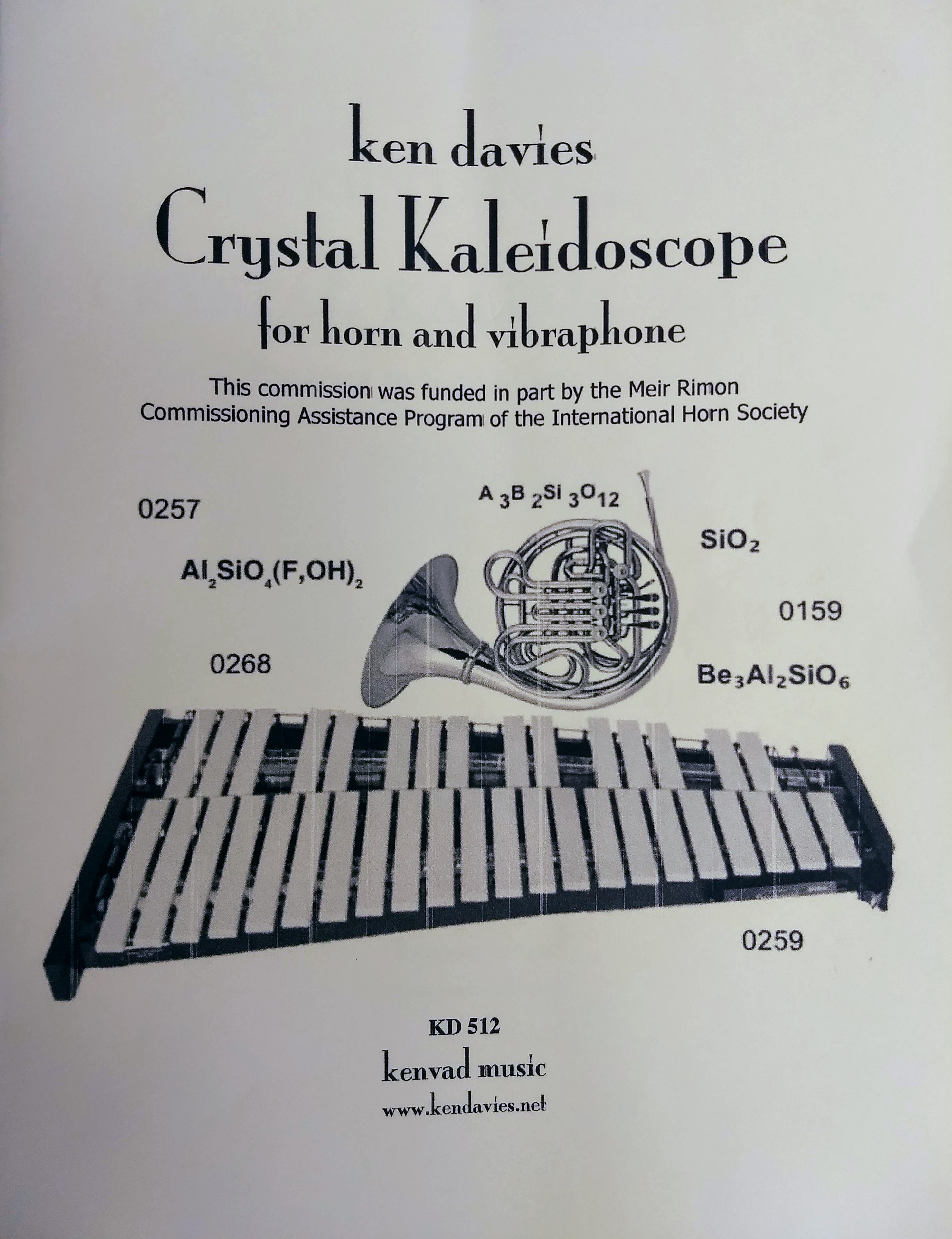
In addition to the Dana Wilson song cycle performance mentioned in my earlier post, I’ll be performing another brand new work in April at the Society of Composers, Inc. Region VI Conference at Texas A&M University—Commerce. The composition is by Ken Davies, and is entitled Crystal Kaleidoscope for horn and vibraphone. My colleague Mel Mobley and I commissioned it with assistance from the International Horn Society’s Meir Rimon Commissioning Assistance Fund. This is a fantastic initiative by the IHS, and well worth applying for and supporting! As of this writing, the fund is on hiatus from January 2019 through December 2019. Be on the lookout, however, for future funding opportunities.
Getting back to Crystal Kaleidoscope, Ken Davies is a very fine composer, and the works I’ve performed by him have been interesting and rewarding to play. The horn and vibraphone combination is pretty unique, and there are only a handful of other works in the repertoire for horn and mallet percussion, let alone this specific instrumentation. The first one that comes to mind is HornVibes: Three Duos for Horn and Vibraphone, by Verne Reynolds. For more information on this and other works for horn and mallet percussion, refer to Dr. Casey N. Maltese’s A Performance Guide of Selected Works for Horn and Mallet Percussion, D.M.A dissertation, the University of Miami, 2011. In my estimation, Crystal Kaleidoscope holds up very well when compared to the Reynolds, though it is quite different. Here is the composer’s note:
Look into the kaleidoscope. See the variously shaped colored crystals, their reflections producing continuous changing patterns. Each crystal has a unique structure, shape, and color—its own symmetrical, ordered, three-dimensional aggregation of atoms or molecules.
As the title suggests, this work is based on “crystals.” Though the sectional sub-titles may be whimsically named for gemstones, the musical crystals are pitch sets consisting of a few notes which are spun out into transformed patterns of melodic and harmonic variety. While the theorist/musicologist may want to delve into set analysis, I hope that others may simply enjoy the aural ride along the surface, letting the notes, chords, and timbres provide a worthy repeatable listening experience.
The writing is fun and challenging, but not unreasonably so, with lots of rhythmic and melodic interplay between horn and vibraphone. As the composer implies in his preface, there are some complex compositional operations at work, but the melodies and timbres are interesting enough in and of themselves without deep analysis. As I’ve found in other works by him, Ken likes to throw in periodic references to other styles such as funk and jazz. For instance, this short line for the horn in the final movement, “Crystal Collage,” has a pretty fun groove to it. Tempo is quarter note=92-104 or faster.
If this post has piqued your interest in the music of Ken Davies, take a look at his website for a complete list of his many works. Here is a short list of works with horn, taken from his website.
Brain Fantasies for horn and two-channel audio
Sensuous Images for horn and pre-recorded soundscape

 In addition to the Dana Wilson song cycle performance mentioned in my
 James Boldin's Horn World