Recording Project Update: First Edits and Beyond

2013-04-10 11.28.43Here’s another brief update on my Koetsier recording project (read the previous one here). As of my last update I was still working on liner notes and waiting to dig in to some first edits of the pieces. I’m happy to report that I’ve completed the liner notes, coming in at 1954 words (2000 words was the maximum). Rather than include lots of biographical information on Koetsier – which is already available online here – I chose instead to focus on specific information about each piece. Hopefully listeners will find this material helpful and interesting. For cover art we’ve licensed a very nice painting by artist Markus Bleichner. Visit http://www.artshop77.com/ to see some examples of his work.

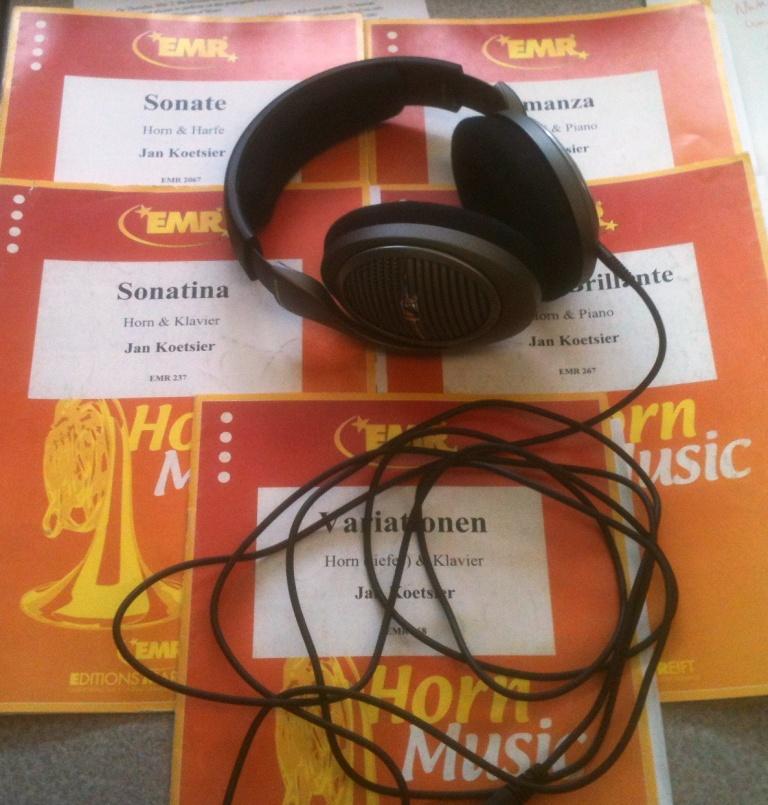
As for the first edits, I’m quite pleased so far. To put these edits together in the first place required that I go through approximately 37GB of sound files and choose the desired takes for each piece. We had notes from the sessions, but I still needed to listen to everything to be sure that the takes were correct. This took about ten hours of really intense listening, broken up over several days of course. The easiest method I found was to load all of the material into an iTunes playlist. This made it easy to compare several takes back to back. Even so, I could only work for about two hours before my ears started to play tricks on me. Sometimes I’d find myself wondering “did I nail that lick, or not?” If I wasn’t sure I would take a break and come back later after my ears (and brain) had rested. I don’t have expensive monitors, so I listened using a pair of Sennheiser HD 518 headphones (shown above, with some increasingly more tattered scores). Great headphones can cost several hundred to even thousands of dollars, but for the money I think the HD 518s are some of the best around.  Are they as good as some of the more expensive models – probably not – but they’re pretty close! After compiling a detailed list of takes, measure numbers, and other information, I sent it off to the engineer for the editing work. I’ve been listening closely to these edits, both for overall impressions as well as for places where another take needs to be substituted for musical or technical reasons. Thinking back over the process so far, it would probably have been much more convenient to build in a few extra days after the session to do the editing on-site. This wasn’t really a possibility with this project because of when my sessions were scheduled – the week before Christmas – but it would have made the back and forth conversations about editing decisions much faster. Right now I have to wait for the engineer to upload an edit to Dropbox, and then he has to wait for me to download, listen, and write coherent comments about it. All of this is happening while both of us are juggling other professional commitments. The process works, but is a little cumbersome.

The next step is to continue to listen critically and try to get the best possible takes for every single measure of each piece. This may require a few more rounds of editing, but in the end it will be worth it. I’m also beginning to think about mastering, and the kind of sound I want for the CD. In general I prefer a more direct (vs. distant) horn sound, which should work well for the material on this recording.  To be continued…

Recordings from Black Bayou Brass Recital, March 27, 2013

To kick off the week here are some samples from our faculty brass trio recital at the end of March. The program went very well, and we got lots of great comments afterwards.  If you want to hear complete works you’ll have to come check out one of our performances!  If you want to read more about the program, check out this post.  Here are the excerpts.  Just double-click on the title in the playlist to hear a specific tune. Enjoy!

Jean-François Michel:  Suite for Trumpet, Horn and Trombone, Movement 1, Ouverture

Mel Mobley, Coloring with Water, *Premiere

Anthony Plog, Trio for Brass, horn cadenza at end of Movement 2, and Movement 3

Astor Piazzolla/arr. Anna Suechting, Libertango

Spring Break!

On spring break this week. Updates will resume on April 8th.


Wednesday Review: Horn Fundamentals, by Bruno Schneider

Most horn players today are fortunate to have a wide variety of quality practice materials available to them. Using the internet, one can readily find dozens of great methods, etudes, and other exercises to purchase (for a list of some of them, see this article). One recent addition to these materials is Bruno Schneider‘s Horn Fundamentals, published by Editions Bim. Schneider is a well-known name among horn players, having performed extensively throughout the world as a soloist, chamber musician, and clinician. His collection contains many familiar patterns, as well as some new ones (or new approaches to familiar patterns). You might ask “Why buy another collection of the same old exercises?” – a valid question – and here are a few reasons. 1) As a teacher, I consider it part of my job to be aware of as many new publications as possible. I don’t buy every new publication that comes out, but rather try to go for a good sampling of what’s currently available. 2) Often what seems like “the same old exercises” really isn’t, either because of actual changes to the material or because of an updated or different pedagogical approach. 3) Having a variety of materials gives us options as players and teachers. Even if you are very satisfied with your current materials, you never know when you might come across your next favorite exercise. There are plenty more reasons, but hopefully this is sufficient to prove my case. At the very least, if you’re a professional musician and/or teacher you can deduct them on your taxes! Getting back to the matter at hand, here’s a summary of the contents in Horn Fundamentals.

  • Preface: I love this quote. “Efficiency in technical development requires patience, creative imagination, and a dedication to the ultimate goal of technical perfection…” (p. 2)
  • Flexibility: Lots of basic patterns using the harmonic series, covering a three-octave range.
  • Fast Flexibility: Builds on the materials from the previous section, but with faster and more difficult patterns. One interesting update to these otherwise familiar exercises is the inclusion of fingerings for E-flat alto as well as the customary F and B-flat.
  • Scales: Tw0-octave major and minor scales with a variety of articulations for comprehensive study. The most interesting thing to me about this chapter is that the scales are notated using the Grand Staff. It seems like such a simple thing, but I’ve rarely seen the concept of bass clef notation for horn players approached in this way. In using these particular exercises with a few younger students I noticed that they seemed to grasp the idea of bass clef much more quickly.
  • Intervals: Diatonic, chromatic, slurred, and tongued.
  • Articulations: Another very interesting set of exercises, focused mainly around developing finger dexterity and articulation clarity on short diatonic patterns.
  • Chromatic Exercises: Designed to help stabilize the mid-low range, and work through any embouchure breaks.
  • The Start of Sound: These are both accuracy exercises and long tone studies. Schneider notes that “The start of the note is a touchy moment which needs to be mastered in all dynamics throughout the entire register. The impulse which one gives before attacking the note is determining and corresponds to the pick up gesture of the conductor.” (p. 58) Articulation variations are included as well.
  • Exercises to Play Loud: Aimed at improving forte dynamics and beyond, these exercises are anything but subtle. Although not explicitly stated, it would be advisable to take short breaks between these exercises, and/or to play only a couple of them per practice session.

The typesetting is very clean, with plenty of space between staves and exercises. My only criticism is that it would be nice to have spiral binding so that the book lays flat on a music stand. Annotations are in French, German, and English. The price is fairly reasonable, especially for 76 pages of great exercises. If you’re looking to switch out some or all of your daily exercises, or if like me you just enjoy  studying and comparing different practice materials, Horn Fundamentals is a worthwhile addition to your library.

Intonation Exercises for One Horn

In lieu of a Kopprasch video this week I have some quick intonation exercises that can be played by one horn. To create this exercise I used Sibelius notation software, and then exported the file as audio (see below). The player should begin playing in mm. 4, then go back to mm. 1, and so on throughout the exercise. The well-known pattern, “horn fifths”,  goes through every key via the circle of fifths. The audio file will provide a pitch reference to gauge intonation and make adjustments. There are lots of other possibilities for creating your own custom intonation exercises and drones. Feel free to edit this one or come up with your own!

Download the printable exercise here:   Intonation Exercises for One Horn

Listen to the audio file here:

Download the audio file here: Intonation Exercises for One Horn (audio)

One caveat: the audio track does not use tempered intonation, so the player will have to make all of the requisite adjustments (low major thirds, etc.). This is different than an actual performing situation, but hopefully the exercise will train the ear to hear the intervals in tune anyway.

More Practice Room Modifications

Several months ago I wrote about some basic modifications I did to my home office/practice room to make it more user-friendly.  Here’s my closing paragraph (read the entire article here).

It might not be the biggest, or most acoustically perfect, place to practice, but it gets the job done! To sum up, when putting together your home practice room, the following areas are worth considering.

  • Floor covering (carpet, rug, etc.)
  • Window treatments (curtains, blinds)
  • Storage space
  • Decorations/wall art
  • Other sound reducing materials, such as foam or packing blankets

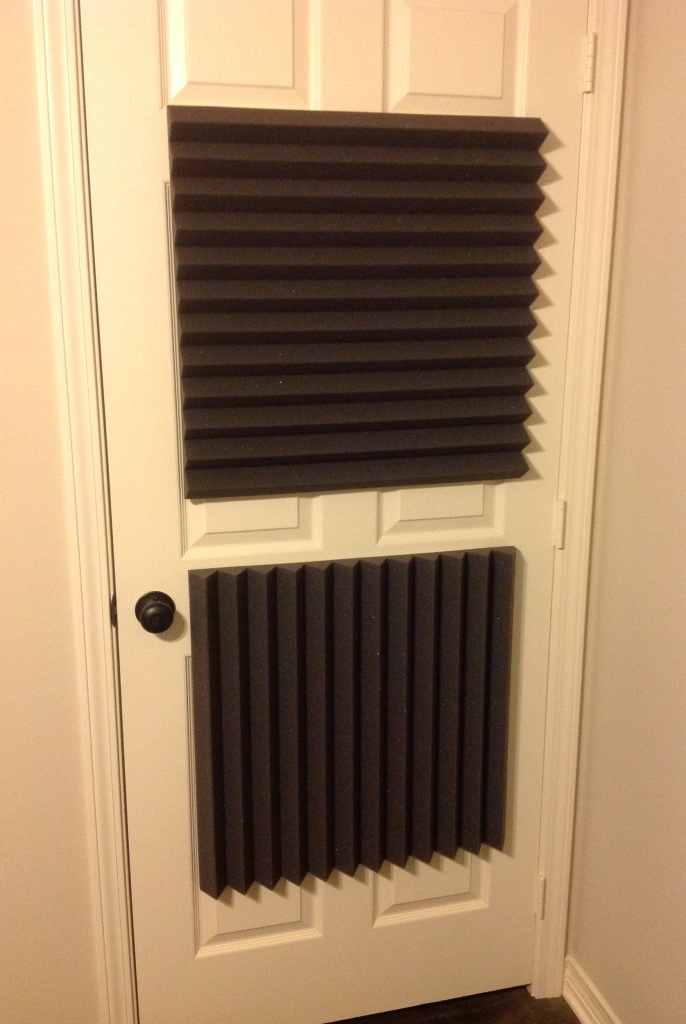
Until recently I hadn’t devoted much time to exploring the last category in the above list – other sound reducing materials –  but a few weekends ago my wife and I went on a quest to find/create some better sound conditioning for the room. My main goal with this project was to eliminate or reduce  slap echo , caused in this case by two parallel drywall surfaces. After a bit of searching online, I decided to go with some ATS wedge foam acoustic panels, sold here in a package of six at a reasonable price. Each panel was pre-cut  into 2 feet by 2 feet squares. It is possible to buy this material in larger sections and cut it yourself, but I didn’t want to mess with that for this endeavor. Once the panels arrived, the next step was to figure out how and where to mount them. I knew that I wanted to cover as much of the bare walls as possible, especially in places that were likely to create an echo. It is possible to attach the panels directly to the wall using glue or another adhesive, but if you ever want to remove them you can damage both the panel and the section of wall where it’s mounted. Since the panels were very light and also a bit flimsy, the best option in this case was to mount the panels to foam board first, and then attach the foam board to the desired section of wall. After cutting the foam board into 2’X2′ sections, a hot glue gun (low temperature) worked very well to attach the panels to them.

To mount the foam board/acoustic panel units, we used Velcro picture hanging strips. They are light, strong, and very easy to install. They are also advertised as being easy to remove, which will be nice if we want to remove or reposition the panels. Here are some snapshots of the finished product, starting with the door (2 panels attached).

soundpanels2

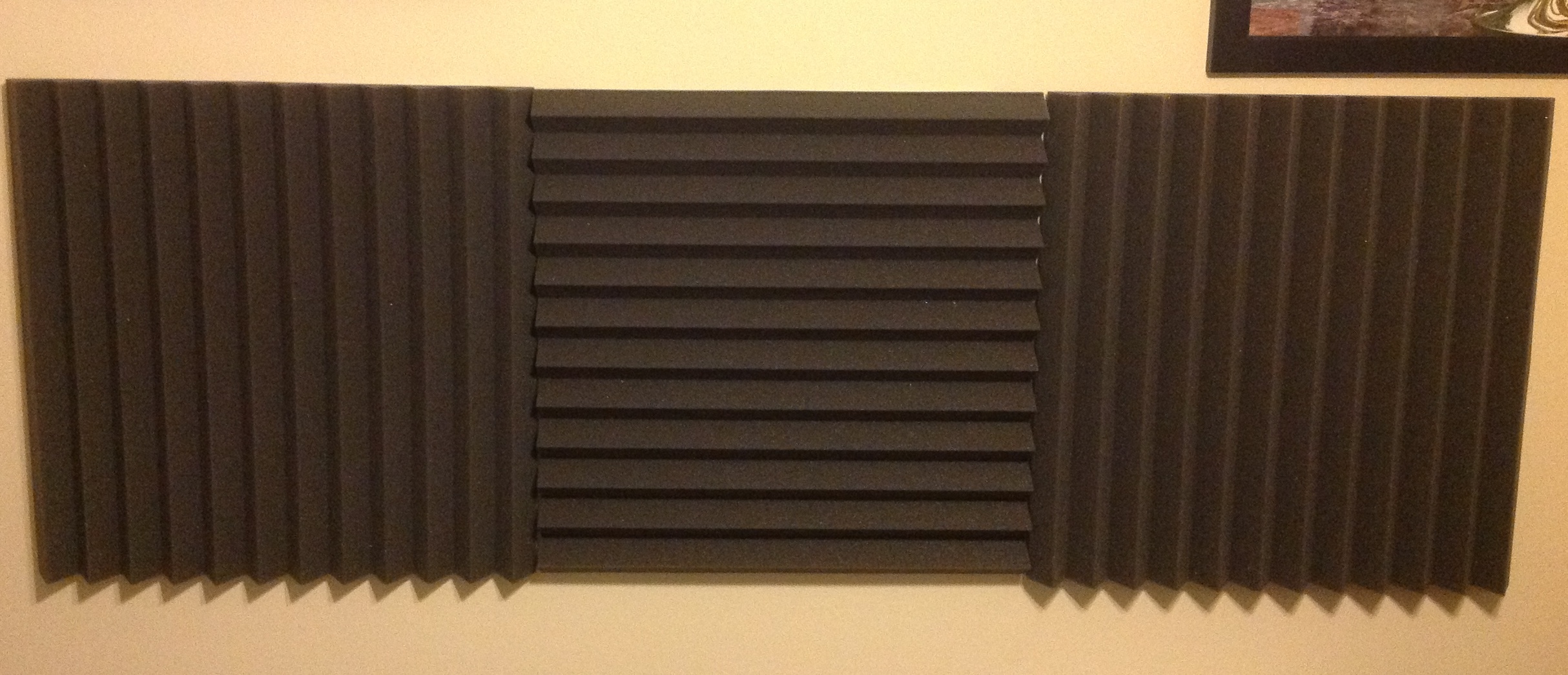
And now a section of bare wall.

soundpanels

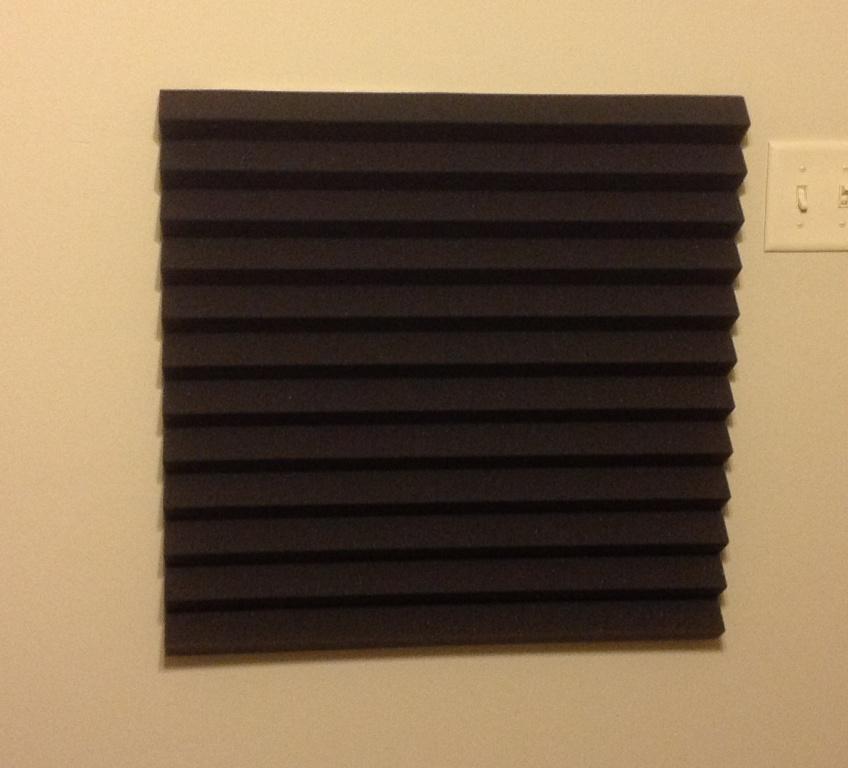
And one more section of wall.

soundpanels1

I read somewhere that alternating the direction of the ridges optimizes the sound absorption. Of course, the main question is “do they work?” Although I didn’t measure the decibel levels before and after installing the panels, I do think that they help reduce the amount of slap echo. The room is more comfortable to practice in now, which was the goal. Although there are more effective (and more expensive) ways to sound condition a room, these panels worked very well for the price and difficulty of installation.

Kopprasch Project Continued, No. 50

Etude No. 50 is similar to No. 48, but focuses primarily on diatonic (instead of chromatic) scales and arpeggios. Suggested tempo is quarter-note=104-120, although a more brisk Presto can work as well, provided that everything is clean without sounding frantic. The “espressivo” marking is interesting, and there are probably several ways to interpret it, including shaping the phrases through dynamic changes (beyond what is marked), varying the intensity and strength of articulations, and perhaps even a small amount of rubato.

More Online Practice Tools

In three previous posts (here, here, and here) I’ve mentioned several music-related smartphone apps and online tools.  Although I still highly recommend the smartphone apps listed, I’ve recently been using my office computer and internet connection as a central workstation for practice sessions. If you’re a student and don’t have a dedicated practice space, a laptop computer and wi-fi connection can work just as well, provided that you have decent headphones or speakers.

My favorite metronome is still the Advanced Metronome Online, because of its capability for customization and very high bpm (beats per minute) limit. Most standalone metronomes – even expensive ones – top out around 300 bpm, but this one can be cranked up to 900+ bpm. This feature is very useful when you want to hear all of the eighth notes or sixteenth notes in asymmetrical meters like 5/8 and 7/8. **Note: Recently this website has been triggering a “Java Security Alert,” but I think updating to the most recent version of Java fixes it.

I’m a big fan of using intonation drones instead of tuners, and recently stumbled upon two very helpful sites. First is a collection of downloadable sound files from the International Double Reed Society. The files are in MIDI format, which iTunes (and other media players as well) will play. The files can also be converted to mp3 format and burned to a CD or loaded on a portable device. The organ sound is easier on the ears than the sound from a tuner or other tone generator. Multiple temperaments are available.  Next is an online tuning fork at Seventh String Software. This one is customizable to different temperaments and timbres. To me the sound isn’t quite as pleasing as the organ drones, but not bad overall.  **The Java security warning above also applies to this site.

The last tool for today is the InTune app for smartphone. Designed and developed by Professor Daniel Kazez at Wittenberg University in Ohio, this handy little app takes a simple principle and uses it to help improve intonation. Here’s a full description from iTunes.

InTune is an outgrowth of twenty-five years of research and testing in the field of intonation by cellist and professor of music Daniel Kazez. The concept began as a simple game to test the ability to hear two pitches that are very close together. But then in a university research study, Kazez discovered that students’ hearing improved the more often they played — at triple the rate of those who did not.

With InTune, you’ll hear two pitches and determine whether the second is higher or lower than the first. It starts easy but gets more difficult, until you find the closest pair of pitches that you can hear. Play again and improve your score — and your ear! Share your score with others and find out who has the best ear.

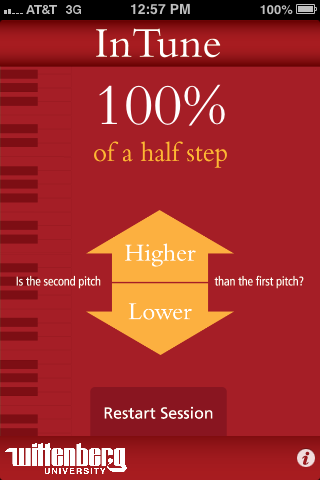
Although I haven’t thoroughly tested the effectiveness of InTune, I can say that it is very easy to use, and fun as well. It has numerous applications for use in private or classroom instruction, and other intonation games could easily be built off of the basic design. Here’s a screenshot.

Intune

The price is also very reasonable, making it a fun and useful addition to your practice toolbox. If you’re not convinced, try a brief session with the InTune app every day, and see if it helps improve your ability to hear intonation discrepancies. Also noteworthy from this developer is the free Composer of the Day app.

Kopprasch Project Continued, No. 49

No. 49 is an excellent study for developing a consistent sound and accurate intonation in and around the mid-low range. Changes in air speed and jaw position are very helpful in tackling the large leaps. Try playing the entire etude on the B-flat or F side to help learn the different intonation tendencies for each set of fingerings. Tempo range in my edition is quarter note=66 to 84. A slower tempo will work, but breath control can become an issue, especially in the lower range. *Apologies for the unusual formatting of the video (black box around the video). I was trying out a new setting when converting the footage from my camera into a format that Adobe Premiere could open, and unfortunately it resulted in the weird formatting.

Comparing Descant Horns

Last weekend my wife and I took a day trip over to Shreveport. Our trip had two purposes: 1) shopping for some items we couldn’t find in Monroe, and 2) visiting Craig Pratt, a colleague and friend from the Shreveport Symphony. Craig has played with the SSO for a number of years, and is an active freelancer throughout the area. He also has an amazing collection of horns, mouthpieces, and other related equipment. Craig is generously letting me borrow his Paxman model 40M descant horn for some upcoming performances, which I picked up during our visit. More on the horn later, but first here are some pictures (posted with permission) of a few of the items in Craig’s collection.

craigmouthpieces

And I thought I had lots of mouthpieces! There are a number of vintage and otherwise rare pieces in this collection. Craig also owns a natural horn built by Carl Geyer, a Trompe de chasse, and another natural horn built by Lowell Greer. Oh, and he also has a few mutes.

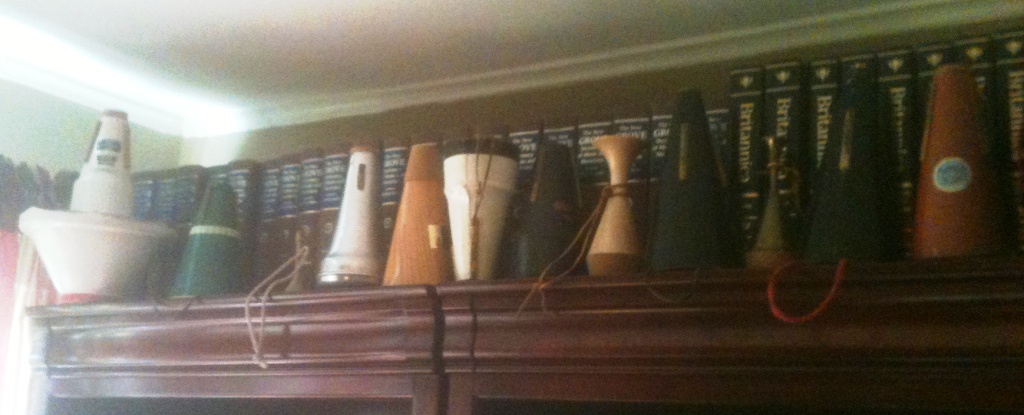
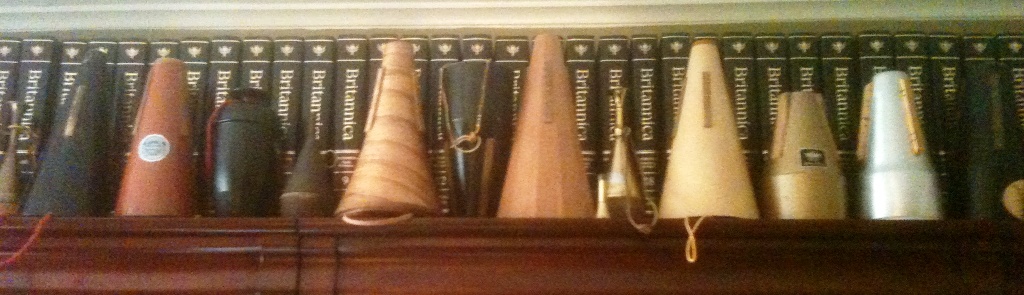
mutecollection mutecollection1 mutecollection2

Of particular interest in his arsenal are an original Rittich mute, as well as a cup mute (top image, far left) and a Harmon mute (top image, fourth from left). I wasn’t aware that a Harmon mute for horn had ever been manufactured, although Allan Mathieu Perkins has discovered that a bass trombone Harmon mute fits very well in a horn bell.

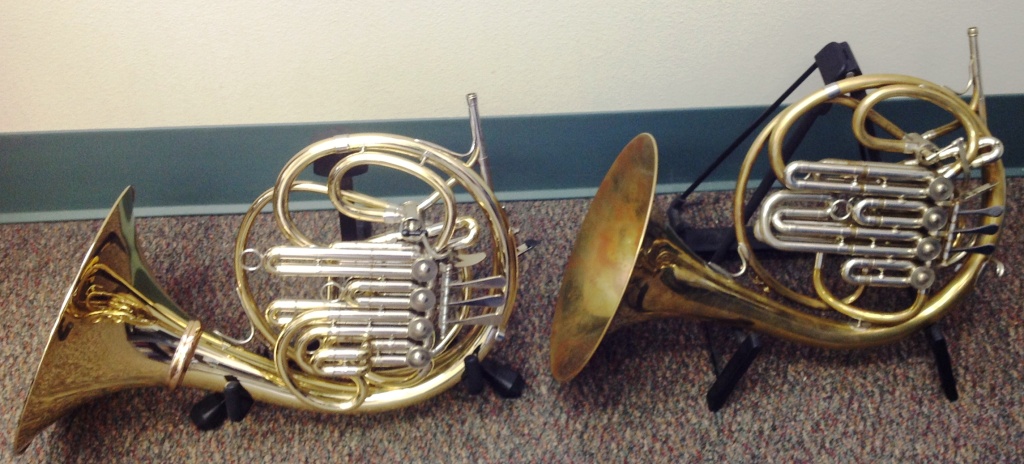
As for the descant horn, it is a great little instrument, and I am enjoying playing it. I had already planned to use my Holton H200 descant for some upcoming performances, but jumped at the chance to try out one of Paxman’s earlier Model 40’s, which in the opinion of many players are among the best descants around. Looking at the two horns side by side, it’s clear that they are based on a similar design – the Holton is on the left and the Paxman is on the right.

descanthorns

After playing on it for a few days, here are the differences I’ve noticed.

  • The horn is a bit lighter, and more resonant throughout the range.
  • The B-flat side is much easier to tune than on the Holton, and in general locks into the center of each note more quickly.
  • The high F side is more responsive than the Holton, and has a less brittle quality to the sound.
  • The grip is less comfortable than my Holton, which has an Alexander flipper installed, but I have ordered a velcro hand strap to see if that will help.

This is not to say that the Holton is a poor instrument, and for the price it would be hard to find a better entry-level descant. However, the Paxman was probably built to much closer tolerances, and plays like it. Hopefully I’ll be able to pick up a similar model on the used market in the future. In the meantime, my gratitude goes to Craig Pratt for the generous loan!