It’s been a while since I posted anything here, but I recently received three excellent publications for review from Legacy Horn Experience, https://www.legacyhornexperience.com/. LHE was created by Steve Lewis, who, as he mentions on the About page, is not “the” Steve Lewis of S.W. Lewis Horns. Rather, this company sells a variety of horn-related items including music and mouthpieces:
We are proud to offer new editions by Martin Hackleman and David Jolley. Other publications offered include those by Vitaly Buyanovsky, Daniel Bourgue, Eli Epstein, Frøydis Ree Wekre, Andrew Lewinter, and John Barrows. Additionally we publish Wendell Hoss’s 9 Studies which have been out-of-print for decades.
We are also pleased to offer the most commonly used of the Moosewood and L’Olifant mouthpiece cups and rims.
https://www.legacyhornexperience.com/about
Additionally, they plan to offer a “Legacy” line of mouthpieces, including “recreations of Reynolds and King mouthpieces with the benefit of CNC technology.”
This post will briefly review three new LHE publications:
- Vitaly Bujanovsky – Sonata for Solo Horn No. 1, edited by Martin Hackleman
- Frédéric Chopin – 6 Studies for solo horn, adapted by Steve Lewis and edited by Martin Hackleman
- Richard Strauss – Till Eulenspiegels lustige Streiche, Op. 28, Arranged for trumpet, horn, and trombone by David Jolley
As a composer, Vitaly Bujanovsky (1928-1993) is most well-known for his Four Improvisations (from traveling impressions) for Solo Horn, but he has some other substantial works with horn as well. This edition of his Sonata No. 1 includes “descriptive text and instructions” by Martin Hackleman, which could be very useful to both performers and teachers looking to craft a convincing interpretation of this unaccompanied work. For example, the first movement, Moderato espressivo, includes the editorial phrase “The curtain opens as our hero strolls peacefully through the forest.” The other three movements contain helpful phrases along the same lines. The engraving is clear and easy to read, and the piece is available for download directly from the LHE website. There are a few discrepancies between this version and a recording I found on YouTube by Dmytro Taran.
These discrepancies are presumably the result of this new edition, but I am not entirely sure. Also included is a brief article by Hackleman, “Playing Together But Not at the Same Time,” in which he describes a creative way for two players (teacher and student, perhaps) to work on phrasing and musical effect in a single solo piece. The article is followed by an annotated version of Buyanovsky’s Sonata designed to be practiced collaboratively in this manner. The price ($10 as of this writing) makes this publication an excellent value and well worth adding to your library.
Frédéric Chopin is renowned as a composer of works with piano, and his gift for idiomatic melodies on that instrument is enough to make even a horn player jealous! If you’ve ever wanted to play some of Chopin’s most well-known melodies on the horn, while also working on flexibility, endurance, phrasing, and other fundamentals, this collection of 6 Studies for solo horn is for you. It includes horn-only versions of the following:
- Mazurka in F Minor, Op. 7, No. 3
- Prelude Op. 28, No. 6
- Prelude Op. 28, No. 15 (The “Raindrop” prelude)
- Polonaise in B-flat Major
- from Fantasie-Impromptu No. 4, Op. 66
- “Largo” from Cello Sonata, Op. 65
These adaptations work quite well on the horn, while retaining the essential character of the original compositions. The range and rhythmic requirements are well within the abilities of an intermediate to advanced player, but achieving the appropriate style and overall effect could prove challenging. My favorite so far is the “Largo” from the Cello Sonata, and I’m looking forward to spending more time with these pieces.
Last in this collection of reviews is a brass trio version of Strauss’s famous tone poem, Till Eulenspiegel. David Jolley’s arrangement is in the original key and requires virtuosic technique from all three players. This arrangement is as close to the original as you can get with only three voices, but it is relentless! Most of the major horn excerpts are included, but there’s so much more: violin parts, clarinet parts, etc. Jolley does a great job of spreading these additional passages around the ensemble, but as there are only three voices everyone is playing most of the time during this nearly 10-minute tour de force. Jolley’s recording with the New York Brass Arts Trio proves that it is playable, and musically at that!
Having played in a brass trio for several years, I know how difficult it can be artistically and technically. With this arrangement and others, David Jolley continues to push the boundaries of what is possible on the horn and for the brass trio. Despite the difficulty, it’s a fantastic arrangement with lots of potential for live performances. Portions of the entire work could be excerpted and included on a lecture recital, for instance. At $15 for the score and parts, it’s a great value.
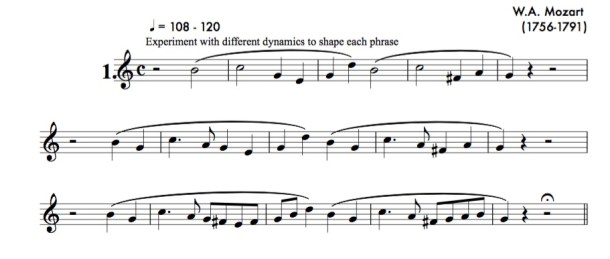
 …can be adapted into the following progressive exercise:
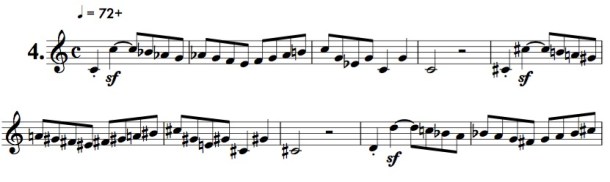 Here’s a demonstration of the complete exercise.
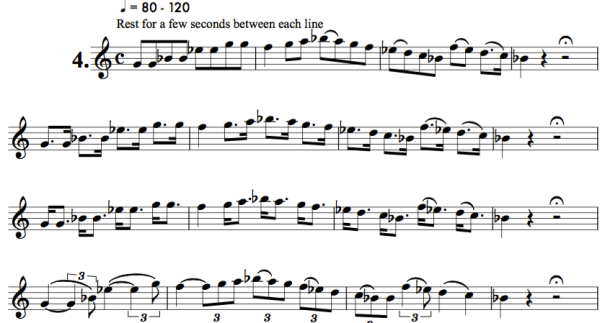
 becomes:
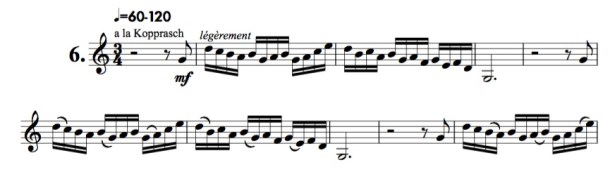 And here it is demonstrated.




 This summer it was my pleasure to carry on some correspondence with Portuguese horn player and teacher
  Catchy, isn’t it? I have worked on this one a bit, and it is just as fun to play as it is to hear. Overall, the second book of studies is more approachable than the first, especially if you are new to jazz rhythms, jazz articulations, and several kinds of extended techniques. However, if you like challenges, go ahead and dive right into 12 Jazzy Etudes. You’ll find rhythms in the style of Messiaen, tuneful melodies in a variety of modes, and extended techniques like singing, tapping on the bell, microtones, and more! I highly recommend first listening to the recordings and reading the comments and suggestions provided (these are found in all three books). In some ways Ricardo’s music reminds me of Douglas Hill’s jazz-inspired compositions; they are difficult, but well worth the effort it takes to learn them.
 Philharmonic. There are some very fine low horn studies out there – Neuling’s 30 Special Etudes for Low Horn, Marvin McCoy’s 46 Progressive Exercises for Low Horn, Douglas Hill’s Low Range for the Horn Player, and more – and 15 Low Horn Etudes is well deserving of a place among them. They of course emphasize the low register, but also call for extended techniques, lots of flexibility, and the ability to read some complex rhythms. And I would also add that many of the studies in all three books could make very nice unaccompanied works for a recital or other performance.
 James Boldin's Horn World