Up next in the First Solos for the Horn Player series we have one of several arranged works by Beethoven found in this collection, a German Dance based on No. 6 in the 12 German Dances, WoO 8. It’s a fun little tune, suitable for a high school player.
Up next in the First Solos for the Horn Player series is the second movement from Mozart’s Quintet for Horn and Strings, K. 407. It’s a fantastic piece, easily the equal of any of Mozart’s horn concertos . For more information on this work, check out John Ericson’s article at Horn Matters.
The slow movement is the most difficult selection in First Solos for the Horn Player. At first I thought the book was organized chronologically, which would explain the Mozart’s inclusion near the beginning. However, that’s not quite the case, so perhaps it’s included early so that anyone casually thumbing through would see something they recognize in the first few pages.
This one took me a while to work up, and though it’s not perfect by any means, I’m satisfied with this recording with SmartMusic accompaniment. On the technology front, I’ve come to the conclusion that it would be better at this point not to stress over the video/audio syncing issues, and instead to focus on making good recordings and including some public domain images to accompany the audio. The syncing issue was never a problem before I started using a Blue Yeti USB microphone, so I presume it will resolve itself when I go back to using my normal audio interface and XLR microphones. For now, though, my current setup will suffice. For the especially curious, here are the technical fixes I’ve tried (unsuccessfully):
Set Logic Pro X sample rate to 48 kHz (default is 44.1), and the Blue Yeti specs list its sample rate at 48 kHz.
Set Q2n-4K audio sample rate to 48 kHz
Neither of the above resolved the problem, although I have noticed upon further inspection that the camera records at 25 frames per second, and Final Cut Pro adjusts it to 23.9 fps. This may be the problem, but it will take me some time to work out a solution. If anyone has other possible fixes, I would be grateful!
For the fifth selection in this series from First Solos for the Horn Player by Mason Jones, I chose Bizet’s “Song of April.” I wasn’t familiar with the work prior to this project, but it’s a lovely tune that lays well on the horn. Technology update: I’m still working on the sampling rate issues I mentioned in my previous post, but have so far not found a resolution. I have a couple more ideas to try…hopefully I’ll have it fixed for the next video.
In the meantime, I have posted two videos for this selection: an audio-only version with some reverb and equalization added, and a version with video that has not been edited. It’s interesting to compare the two, and in the video I get to support one of my alma maters, the University of Wisconsin. Enjoy!
Here’s the fourth selection in the First Solos for the Horn Player video series, Alexander Scriabin’s Romance for Horn and Piano. Here are links to the other recordings up to this point.
Along with the second movement of Mozart’s Quintet for Horn and Strings, K. 407, this miniature for horn and piano is probably the most recognized work in the collection. The score and solo part are also available on IMSLP, and there appears to be little difference between the Mason Jones and IMSLP editions.
A few interesting technical notes about this recording, and thoughts on this project thus far:
I experimented with the recording process on this one, using a Blue Yeti USB microphone in stereo pattern to record the audio into Logic Pro X. My hope was to sync this audio with the video from my Zoom Q2n-4k camera, and apply some equalization and reverb to improve the overall sound quality.
The latter effort was successful, and the overall sound quality belies the modest recording environment, a bedroom! The sound of the digital accompaniment is pretty good too, although it would have been nice to be more flexible with the tempo and dynamic subtleties. With a collaborative pianist, this would have been easy and natural.
Syncing the audio from Logic Pro with the video file should have been a routine task, and one which I have done several times in the past, though not with an identical set up. But as you can tell from the absence of video footage, I could not get it to work! Despite spending several minutes playing around in Final Cut Pro and consulting help pages, it still wasn’t working. I have very limited technical knowledge, but my guess would be that the sample rate between the Logic Pro recording and the camera recording was not the same.
Because the sound quality of the audio-only recording was superior to the camera audio, I decided to use it without any video footage, and insert a public domain image of Scriabin and his mistress, Tatiana Schloezer. For the next video I hope to work out the syncing issues.
A final note: I decided early on to NOT record every solo in this book. There’s a couple of reasons for this, not least of which is that recording the entire book would probably run afoul of “Fair Use.” I haven’t settled on which solos to record for the remainder of the project, but I anticipate five or six more. Enough to to be representative, but certainly not a majority of the book (or even half). After that, I have some ideas for future projects, more to come.
Next in this video project series is an arrangement of Franz Schubert’s Air from Rosamunde. Like the previous selections in First Solos for the Horn Player, this brief solo emphasizes lyrical playing. The range and technical requirements are suitable for beginning to intermediate players.
A few technical notes: if you have the book First Solos for the HornPlayer, you probably know that the second movement from Mozart’s Horn Quintet, K. 407 is actually listed third in the book. I will be recording that one as well, but could use some more time to practice it! I also think a more suitable place for that one is near the end of the collection, along with the rest of the more extended and difficult solos. It’s certainly the most recognizable work in the whole book, which probably explains its early inclusion.
As mentioned in my previous post, I’ll be recording these from home for the foreseeable future. I haven’t edited the audio in any way, other than to trim the beginning and ending. The sound is consistent with a small room, but overall acceptable, I think, as is the sound of the SmartMusic accompaniment. Although nothing has been decided yet, it may turn out that our students play juries this way: recorded or live streamed from home with pre-recorded accompaniment. As such, another goal of this project is to demonstrate the possibilities and limitations of this recording set up.
The next video in the First Solos for the Horn Player project is “No More, I Have Heard Everything” (Non Più, Tutto Ascoltai), by W.A. Mozart. Paraphrasing some of the information provided by SmartMusic, this short work was originally for soprano and tenor with chamber orchestra, and was later included in Act II of the opera seria Idomeneo. It’s a lovely tune, and offers ample opportunities for the horn player to work on expressive playing.
For those who might be interested, here’s the equipment I’m using on this project.
Horn: Yamaha 667V
Mouthpiece: Houser, San Francisco 14-0-2 with 17.5mm Houser E Rim
Camera/Microphones: Zoom Q2n-4K
Video Editing: Apple Final Cut Pro
I might add that this was the last video recorded in my teaching studio at the University of Louisiana Monroe. Shortly following this session, we were advised that further precautions were being enacted to help prevent the spread of COVID-19. The rest of the videos will be recorded from my home, and I might need to adjust camera placement, microphones, etc. to fit the new space. Stay tuned!
Like many colleagues around the world, I am now working exclusively online, and all upcoming performances have been cancelled or postponed until further notice. In lieu of live chamber and solo performances, I thought it would be useful and fun to start another video project, similar to my Kopprasch Project from several years ago.
My repertoire choice this time is a book of horn and piano arrangements by Mason Jones, First Solos for the Horn Player. It’s a great collection, but not nearly as well known as his “yellow book,” Solos for the Horn Player, the contents of which can be found on a really great recording by Gregory Miller. The works in First Solos for the Horn Player are generally shorter and less complex, but are very tuneful and lay quite well on the horn. Any of them would make a fine addition to a recital program in need of lighter, accessible pieces.
I plan to post a few of these each week, recorded with SmartMusic accompaniment. It is my hope that teachers and students find these videos useful during this difficult time. If you like these pieces, be sure to order the book!
I’ve seen this discussion come up frequently among horn players on social media, and have been considering it from a couple of different perspectives.
On the “Yes, you definitely need to know how to transpose” side, here are some thoughts to consider.
The bottom line is that yes, it is a required skill for professionals and aspiring professionals.
It provides a connection to hand-horn playing and music/composers of the past.
For conductors, music educators, etc. transposing is a necessary skill for score reading and analysis.
Many orchestral parts are not available in transposed versions, so if you want to perform in an orchestra you need to be able to read these parts.
And on the “Well, maybe you don’t always have to know how to transpose” side of the coin:
For players in community orchestras and other similar ensembles, having to read non-transposed parts can be a barrier to enjoyment and engagement in those groups.
Not necessary to be a “good” horn player, meaning, one can be a competent player in terms of range, technique, and musicality without having this particular skill.
I have observed some condescension towards horn players who haven’t yet mastered transposition or who question how necessary it is today. This attitude does not help make the case for transposition.
Can be a difficult skill to master once out of school, especially without a private instructor, and a method to learn it.
Can be seen as an archaic tradition, without much connection to modern valved horn playing. *I don’t agree with this view, but have seen it expressed.
All this can be confusing to impressionable music students, so if I could offer one piece of advice it would be to go ahead and start learning to transpose now, it will ultimately make your life easier as a horn player. However, if you’ve taken several years off and are returning to horn playing, don’t feel bad about not remembering all the intricacies of transposition. There are some transposed parts available in the orchestral repertoire, and if you can get your hands on them they will probably do just fine. Should you feel motivated to add transposing to your skill set, there are fortunately lots of great resources available today. Here are a few of my favorites:
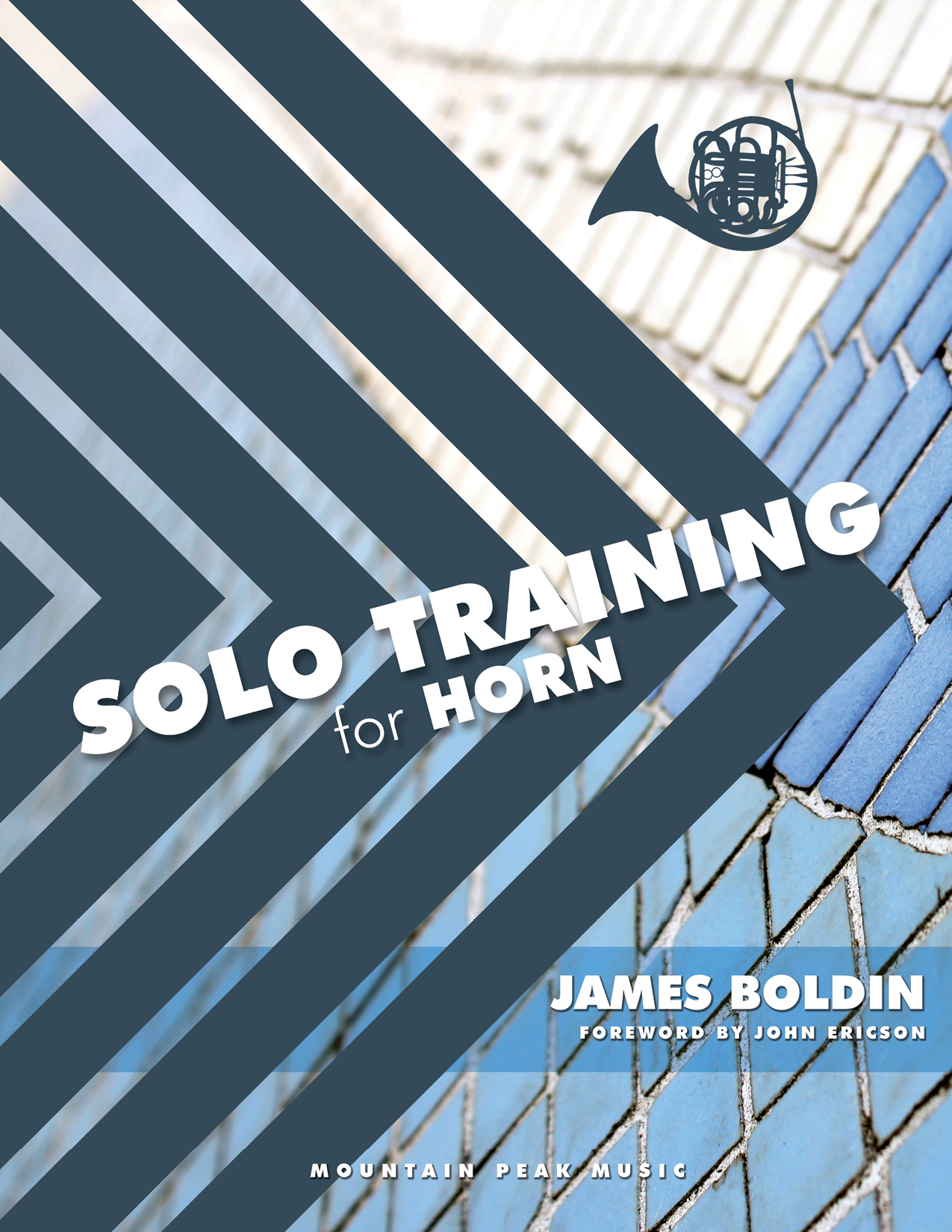
As mentioned in this post, I think my Solo Training for Horn book can be used as a source of effective warm-up and daily practice routine materials. See the link below for a free sample routine drawn from a small portion of the contents in Solo Training. The exercises are based (some closely, some more loosely) on the following works:
Sonata, Op. 17 – Ludwig van Beethoven
Concerto No. 1, Hob. VIId:3 – Franz Joseph Haydn
Concerto, K. 495 – Wolfgang Amadeus Mozart
Morceau de Concert – Camille Saint-Saëns
Adagio and Allegro, Op. 70 – Robert Schumann
This brief packet addresses the traditional topics you would find in most warm-ups:
First notes
Legato/Staccato Playing
Scales/Arpeggios
High Range/Low Range
Lip Trills/Flexibility
Stopped Horn
But the bonus is that all of the exercises can be clearly related back to major solo works in the horn’s repertoire. If you’re looking for an alternative warm-up routine to add to your toolbox, feel free to download the PDF, and let me know what you think in the comments or an email.
AND, if you find this material interesting and/or useful, please do check out the entire book, available on the Mountain Peak Music website. It contains much more material than this 15-page sample, as the entire book is over 100 pages.
In looking over some year-end tax information from Mountain Peak Music, the publisher of my two books, I noticed a couple of things:
Horn players like Duet Books! Solo Training Duets did pretty well in 2019, probably because of the recently released 2nd edition, and also because duets are an enjoyable way to package useful content (fundamentals, long tones, solo repertoire, etc.) Thinking about this generated some interesting ideas for future publications…more on that in the future!
People might not know about my other book, Solo Training for Horn: This book is actually more recent than the first edition of the duet collection, although it has been far less popular. There are probably a couple of causes for this, number one being that it was published in 2016 and horn players might have forgotten about it, and also because it isn’t something you can necessarily pull out and sight-read with a student or colleague. However, I would still encourage anyone who enjoys Solo Training Duets to check out the solo book. There are several pieces covered in the one-horn book that don’t appear in the duet book, and I think there are some very useful exercises and derivative etudes. One could even put together a comprehensive warm-up/fundamentals routine by picking and choosing certain excerpts. This is a topic I plan to explore further in a future post.
Meanwhile, feel free to visit the Mountain Peak Music website and view the samples from Solo Training for Horn.I also recorded a brief promo/demo video for the book back in 2016. Take a look and listen, and let me know what you think. I would be happy to answer any questions you have about it!
 James Boldin's Horn World