A Recital Practice Plan

Photo by Emerald Harris/ULM Photo Services

Photo by Emerald Harris/ULM Photo Services

So be sure when you step, Step with care and great tact. And remember that life’s A Great Balancing Act.
― Dr. Seuss, Oh, The Places You’ll Go!

As this semester draws to a close, I’m gearing up for several performances in December and during the spring. These include: recruiting concerts and a recital with our faculty brass trio, various orchestral performances, and a recital tour with Trio Mélange, a voice, horn, and piano trio (see image at left). The trio consists of myself and two ULM colleagues, Claire Vangelisti, soprano, and Richard Seiler, piano. We’ve performed together frequently over the past few years, including a contributing artist concert at the 45th International Horn Symposium in Memphis, TN. In addition to a faculty recital here in Monroe, we’ll perform at Centenary College of Louisiana, Stephen F. Austin State University, and The University of Texas at Tyler. Our program will include several lesser known, but high quality, works for voice, horn, and piano.

  • Carl Gottlieb Reissiger, 4 Gesänge, Op.117
  • Eurico Carrapatos, Dois Poemas de Miguel Torga
  • Gina Gillie, To the Seasons
  • Auguste Panseron, Le Cor: Romance

It’s a challenging program (approximately 52 minutes of music), and while it would be nice to have an open practice schedule to devote exclusively to this repertoire, as you can tell from the above I am going to be balancing a lot of different material in my day to day work. During graduate school I would have gone through all of this repertoire, plus etudes, ensemble music, and other materials, every day, averaging three and a half to four hours of practice. At this point in my career, though, I simply do not have the time to devote four hours every day to individual practice. Now, I strive to practice for two hours each day, unless I have a concert or heavy rehearsal schedule. When preparing for multiple programs, I usually create a rotation that allows me to practice everything over a period of several days. This approach seems to work, and it is really the only way I’ve found to make sure I cover everything. Here’s my current rotation for the Trio Mélange program. The numbers beside each work indicate specific movements to be practiced.

Day 1 Day 2 Day 3 Day 4 Day 5 Day 6 Day 7
Reissiger 1, 3 Reissiger 2, 4 Reissiger 1,2 Reissiger 3,4 Reissiger   3, 1 Reissiger 4, 2 Reissiger 1,4
Carrapatoso Carrapatoso Carrapatoso Carrapatoso Carrapatoso Carrapatoso Carrapatoso
Gillie 1 Gillie 2 Gillie, 3 Gillie 4 Gillie 1 Gillie 2 Gillie 3, 4
Panseron Panseron Panseron Panseron Panseron Panseron Panseron

The Gillie and Reissiger are both lengthy, four movement works (20 and 17 minutes, respectively), and this schedule allows me to address each piece in its entirety multiple times over the course of a seven day period. The Carrapatoso and Panseron are a bit shorter and less technically involved, and won’t require as much time to prepare. Because of intervening commitments like rehearsals and performances, it might take longer than a week to progress through this seven day schedule. However, keeping track of the dates allows me to pick up where I left off  in the rotation after missing a day. After a warm-up/fundamentals session, I work for approximately 10-15 minutes on each piece, depending on the needs of each day. The remainder of the two hours is spent on ensemble music, etudes, and other chamber or solo repertoire. As the date of the performance gets closer, one or more of these days will be replaced with complete runs of the program.

If you’ve not tried such a detailed approach to recital or audition preparation, give it a shot! You will hopefully find yourself more prepared, more confident, and less stressed out even in the face of multiple performing commitments.

 

Back to Basics: One Month with the Standley Routine

At the beginning of September I decided to take a break from my regular warm-up and maintenance routine – Douglas Hill’s Warm-ups and Maintenance Sessions for the Horn Playerand began working on the Standley Routine. Going in, I decided to commit to it for one month before making any long term decisions. If you are not familiar with the Standley Routine, here’s a brief summary, excerpted from the previous post linked above.

From 1949 to 1957, Forrest Standley performed as Principal Horn of the Pittsburgh Symphony Orchestra, and later taught for many years at what is now Carnegie-Mellon University.  Two of his former students, son Gene Standley of the Columbus Symphony, and H. Stephen Hager of Southwest Texas State University, have made available a revised and edited version of their teacher’s warm-up and daily routine.  Although the Standley Routine is fairly lengthy when compared to other daily routines – one hour and forty minutes according to the original preface – the level of thoroughness and organization is unparalleled.

Before getting to my conclusions about the routine, an explanation for the switch is in order. There were a few big reasons why I thought a change could be helpful to my playing, and here they are in no particular order.

  • Endurance: After returning from a wonderful week at the 47th International Horn Symposium, I had a difficult time getting back in shape for some upcoming solo, chamber, and orchestral performances. As anyone who has attended a large conference like the IHS Symposium (or ITG Conference or ITA Festival) can attest, the irony of these events is that you don’t really have time to practice very much. I managed to get the horn on my face every day during the symposium, with the exception of the day I departed, but resuming a full practice regimen upon returning was a challenge. I did what I normally do to build endurance, which is add five minutes of practice time to my routine every other day, but wasn’t totally satisfied with the results. Having had some prior experience with the Standley Routine, and having heard that it was good for building endurance, I decided to give it a shot.
  • Concentration: As with the first reason, this one probably has very little to do with what I was practicing, and more to do with how I was practicing it. Nevertheless, after many years of playing my regular routine on a daily basis, I began to notice my focus and attention wandering during the first hour of practice – precisely when they needed to be most present. I should state for the record that this doesn’t mean there are any shortcomings in design or content with Hill’s routine, nor does it indicate that I had mastered it so well as to be bored. Nothing could be further from the truth! Still, I thought changing routines might help me break out of this habit.
  • Consistency: One of the strengths of Hill’s routine is that it covers everything, within a reasonable amount of time. I knew that if I played the full warm-up plus routine I had touched on pretty much every technique required of modern horn players. But, over time I began to think that maybe it might be useful for me to forego some of that variety in favor of more similar patterns which emphasize the same basic techniques. For example, the Standley Routine doesn’t include any stopped horn, multiple tonguing, or lip trill patterns (Hill does), but instead presents four types of exercises (scales, arpeggios, endurance, and overtone) in every key. Is it a comprehensive routine? No, not in the sense of Hill’s Warm-Ups and Maintenance Sessions, but it is very thorough.

Ok, so what has the past month with the Standley Routine been like? On the whole, it’s been very productive, and I’ve noticed improvement in all of the above mentioned areas. It is taxing, especially the endurance exercises, but seems to be exactly what I needed at this point in my career. The entire routine takes me about 65-70 minutes to complete, although instead of performing the arpeggio exercises both slurred and tongued (as indicated), I alternate articulations each day. In addition, I use a tonic drone, and play the endurance exercises on the F horn. I would also recommend supplementing with various etudes and/or exercises to cover stopped horn, multiple tonguing, and lip trills. Recently I’ve been working through Robert Ward’s 30 Etudes for Stopped Horn, which I picked up at the IHS Symposium. It’s a fantastic collection of stopped horn studies; look for a more detailed review in the coming weeks.

I plan to continue with the Standley Routine for the immediate future, although at some point I will probably return to Hill’s Warm-Ups and Maintenance Sessions. To be clear, they are both great routines, and I am not necessarily advocating for one over the other. What I think is important, though, is that we periodically take stock of our daily routines, and consider trying other patterns and approaches.

Review: Songs of Love, War and Melancholy/Mozart: Stolen Beauties

songsoflovegallaycoverI recently received two wonderful new discs for review from Anneke Scott, a phenomenal performer on both natural and valved horns. Scott serves as principal horn of the Orchestre Révolutionnaire et Romantique and The English Baroque Soloists, and also performs frequently as a soloist and chamber musician. In addition to her busy performing schedule, she has also found the time to record several albums of music by the great 19th-century horn virtuoso Jacques-François Gallay. The third and final volume in this series is titled Songs of Love, War and Melancholy: The operatic fantasias of Jacques-François Gallay (read a review of the second album here.) As in her earlier Gallay recordings, Scott’s natural-horn playing is expressive, athletic, and robust; in short, very impressive! She negotiates even the most difficult passages on the natural horn with beguiling ease. The selections on this disc belong to a repertoire that was extremely popular during Gallay’s day, but is less known to modern horn players. Here’s a brief quote from Scott’s liner notes, which are copious and very informative.

During this period the opera fantasia offered virtuoso musicians the opportunity to demonstrate a number of aspects of their playing that were viewed as highly desirable by their audiences. The choice of themes, especially if Italian in origin, was à la mode and their settings offered the musician the opportunity demonstrate his amazing skills both in performing a melody in a vocal style as well as showing off with spectacular embellishments.

I think the same holds true today for these works, though they do contain plenty of “real” music, and not just virtuosic display. It is also interesting that while Gallay’s Op. 27 Preludes and Op. 57 2nd Horn Studies have become a standard part of the modern horn player’s curriculum, these equally (if not more so) substantial pieces remain more or less unknown. I was familiar with operatic fantasias for horn, mainly through Thomas Bacon’s edition and recording of C.D. Lorenz’s Fantasie, Op. 13, but I knew very little about Gallay’s contributions to the genre. One factor that probably contributes to this disparity is the difficulty in tracking down modern editions of these works. The Op. 46 Fantaisie sur ‘L’elisir d’amore’ can be found on IMSLP, and Op. 49 is available through Koebl, but I was unable to find either public domain or commercial editions of the other works. I contacted Ms. Scott, and she quickly responded with the following information.

Now, all the Gallay pieces are available but right now it’s a bit tricky. I published them as part of the crowdfunding for the original disc. (They’re all here: http://www.plumstead-peculiars.com/Index.html). But just what with one thing and another haven’t had the chance to set up selling myself. They will be available from www.corniworld.com (Sheet music) and www.devinemusic.com (downloads) I think from July onwards.

So, it looks like new editions of these will be available very soon. These are lovely pieces – especially the three works for horn, voice, and soprano – and would make excellent editions to any recital.

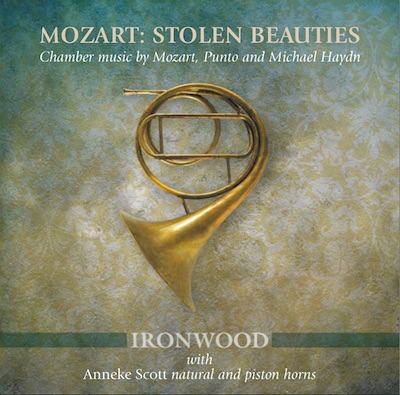
stolenbeautiescoverThe second recording for review today is Mozart: Stolen Beauties, a collaboration between Anneke Scott and the period instrument ensemble Ironwood. Here’s a brief introduction to the album, again from Scott’s liner notes.

In this disc we take as our central point one of Mozart’s most memorable works for horn – the Quintet in E-flat major, KV407. Rather than choosing the more common path of combining this work with a number of other late 18th- and early 19th-century works for horn and strings…we have illustrated the various ways in which Mozart’s works have been ‘appropriated’ for the horn, or, in one case how Mozart ‘appropriated’ a work for himself.

The result of this novel approach to programming is an album full of obscure, but nonetheless beautiful, works for horn and various combinations of strings and piano. The exception is of course Mozart’s well-known Quintet, but the interpretation recorded here makes for very enjoyable listening as well. There is a freshness and presence to this album that rivals anything I’ve heard from modern instruments. Like the Gallay recordings, the liner notes are meticulously researched, yet pleasant and easy to read. Horn players will be especially interested in the recording of Michael Haydn’s Romance in A-flat major, which bears a striking resemblance to the Romanza movement from Mozart’s K. 447 concerto. Scott’s explanation and subsequent thesis regarding this peculiar work are quite convincing. I must say that after listening to both works back to back the Haydn seems more musically interesting! The music on this recording is a little more difficult to track down than the Gallay disc. Here are some additional details from Ms. Scott.

For the music on the Mozart disc it’s a bit more tricky. The Mozart quintet is quite easy to get hold of. I thought the Michael Haydn was as well but now looking for it it seems more tricky. We used a copy of the original edition – maybe I should do an edition of that myself? The Punto duets I found in a library in Russia and did my own edition which again I should make available through Plumstead Peculiars. I did the same with the Anon variation – these are available from Tanglewind Music – http://www.tanglewindmusic.com/Site/Historical_%26_Urtext.html. They’ve got the variations down as being by Puzzi which is a misreading of the manuscript, also the extra variation is missing from this edition.
The Kegelstatt though… I did my own edition for this piece so it’s kind of ready to publish but I’d like to do a lot of work on it first. There’s a lot of “textural” things in it – for example places where Livius obviously made a mistake (some strange viola figurations) which needed correction and other places where he deviates from the original Mozart. Eventually I would like to publish this but there’s a lot of information that I’d like to include so that performers have various options and can make their own decisions. Basically it needs a critical report. So it’s on the cards but I need to find the time to do it.

Also of note is Scott’s use of a hybrid instrument, a natural horn by Courtois Frères, Paris, c. 1835, with a removable set of piston valves (sauterelle) by Antoine Halary, Paris, c. 1840. She seamlessly combines both hand horn and valve technique in her recording of Mozart’s Concertante for pianoforte, horn, viola, and cello, arranged by Barham Livius.

On a related topic I’ll close with a general statement about Scott’s natural horn playing, which incorporates lots of different colors and expressive contrasts. There are varying schools of thought regarding hand horn technique, one of which emphasizes absolute evenness and consistency of sound between stopped and open notes. While there is merit to this approach, I personally enjoy hearing a difference in stopped and open timbres, especially when in the hands of a consummate musician like Anneke Scott. When performed tastefully, these contrasts add an elusive, but very important, quality to the music of that era. As a primarily modern (valved) horn player, I have been inspired by these recordings to strive for more expression and timbral variations in my own playing. I think you will as well!

Notes on a Commission: Gary Schocker’s In Arkadia for Horn and Harp

In my Summer Plans post last week I mentioned the upcoming premiere of In Arkadia, a new work for horn and harp by Gary Schocker. Harpist Jaymee Haefner and I recently had our first rehearsal for the performance, which is scheduled for August 3 at the 47th International Horn Symposium in Los Angeles, CA. After hearing the work with both parts, we’re even more excited about performing it. I think it will be received very well, and become a substantial addition to the repertoire for these two instruments. Here’s a bit of background on the commissioning process for In Arkadia.

In December of 2012, I collaborated with Dr. Haefner, who teaches harp at the University of North Texas, for a recording of Jan Koetsier’s Sonata for Horn and Harp. We enjoyed performing and recording the piece very much, and in the fall of 2013 began discussing plans to commission a multi-movement work for horn and harp. Here are some of the criteria that we developed in the course of those early discussions.

  • Multiple movements, 10-15 minutes in length
  • Accessible, though not necessarily traditional
  • Commission a well-known composer who understands how to write for both harp and horn

Based on these general guidelines, we began the process of contacting various composers who might be a good fit. Our funding was not yet confirmed, but Jaymee and I did have a rough idea of the budget we would be working with. One name that kept coming up was Gary Schocker, an internationally known composer and flutist. A colleague of mine had worked with Mr. Schocker before, and he came highly recommended. He has composed extensively for harp, and also has a few compositions for horn. This turned out to be an important issue, because a few of the composers we contacted stated that they were simply not comfortable writing for the harp. It didn’t take long for us to decide that Gary was the right person for the job. The next step, funding the project!

There are many ways to fund commissions and other creative projects: crowd-sourcing (Kickstarter, GoFundMe, etc.), external grants (state level, national level, other organizations), internal grants (university), consortia, or a combination of the above. In our case, we funded In Arkadia with two grants, one from the International Horn Society’s Meir Rimon Commissioning Assistance Fund, and another from the University of Louisiana at Monroe. Both grants required a written application, including a detailed description of the project and a budget. If you are interested in your own commissioning project, see the end of this article for more information and suggestions on getting started.

After securing funding for the project, Mr. Schocker began composing. He worked incredibly fast, and both Jaymee and I had ample opportunity to offer input and suggestions. The result is a beautiful, atmospheric piece. It is tonal/modal, with hints of impressionism. The horn writing is quite nice, playable, but not without some challenges (which I like). Here are the movement titles.

In Arkadia for Horn and Harp, Gary Schocker (b. 1959)
1. Dryads Dance
2. Nyctimus
3. Kallisto
4. Cynaethus
5. Lycaon

Mr. Schocker also provided the following program notes.

In Arkadia was titled, as is my usual way, after the piece was written. I don’t intentionally try to turn literary or visual ideas into sound, rather I take what the music suggests when written and then find words to describe the tone.

In Arkadia. Here is the land of Pan and the place is free of any humans,ahh. There is a central myth about King Lykaon who served his dead son to Zeus (who was not amused), but the music does not try to recreate that gory story. Rather the names of various characters  have a sound which go with corresponding movements.

The harp is a new love of mine, and having been harping now for several years has informed my writing for the instrument. Never having played the horn I rely entirely on my experience as a flutist, my ear, and guidance from James. ~Gary Schocker

I also asked Mr. Schocker for permission to share a few clips from our recent rehearsal, and he generously agreed. Here are two short clips from the third and fifth movements of In Arkadia. Both recordings are live and unedited, although I added a small amount of reverb to the files since we were not rehearsing in a concert hall.

Movement 3

Movement 5

After hearing the recording of our rehearsal, Gary had some wonderful suggestions, as well as a few minor changes to the score. This is one of the great things about working with living composers – if they don’t like something, they can just change it! Commissioning a new work is a great experience, and something I am definitely interested in doing again.

To finish out this article, here are some suggestions and resources for commissioning compositions.

Further Reading

Other Thoughts on Commissioning a Composition

  • Decide what you want, and with whom you want to work. The more details you have in hand about your proposed commission, the better positioned you will be to find interested composers and secure funding.
  • Seek out funding in a variety of places, crowd-sourcing (Kickstarter, GoFundMe, etc.), external grants (state level, national level, other organizations), internal grants (university), and consortia.
  • For grant applications and other funding opportunities, be able to clearly and concisely explain why your project requires funding. Will the proposed work create or explore a previously under-recognized repertory? Will it bring together various disciplines (artistic or otherwise)? Above all, be excited about your project, and learn how to communicate that excitement in both written and verbal terms.
  • During the composition process, stay in contact with the commissioned composer. Offer to help by trying out new ideas and recording them for the composer to listen to. Make constructive comments about what you think does and does not work for your instrument.
  • Once the composition is completed, premiere it! Apply to perform at a regional, national, or international conference. Share information about your project and get others excited about it.

Friday Review: New Publications from AvA Editions, Little Suites 1, 2, and 3 by Ricardo Matosinhos

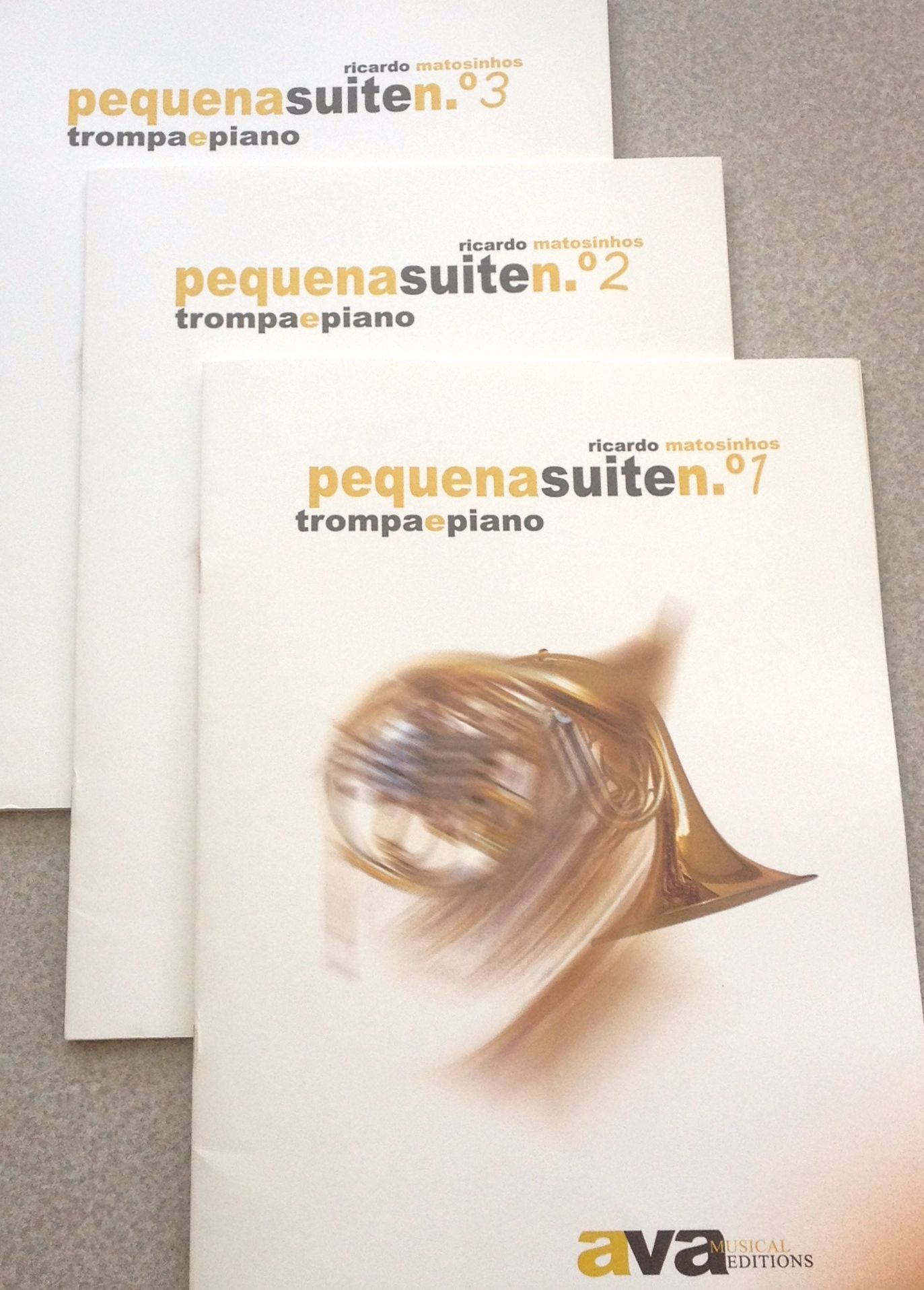
avaeditionsRecently I received several new publications from AvA Musical Editions, which specializes in the music of Portuguese composers. Though they aren’t very well known in the United States, AvA has a variety of high quality publications for horn and other brass instruments.

Ricardo Matosinhos, Little Suite Nos. 1-3, for Horn and Piano

I have previously reviewed other publications by Dr. Matosinhos (here and here), and am likewise impressed by these three charming compositions. The composer has recognized and filled a very important need in today’s music for horn: high quality solo music for beginning to intermediate players. Modern horn music has plenty of intermediate to difficult compositions, but it is rare to find well-written material for younger players. One exception to this observation is First Solos for the Horn Player, by Mason Jones (not to be confused with his more popular Solos for the Horn Player), but this collection contains primarily transcriptions, many of which are too difficult for young players. In addition to composing these accessible and artistic solos for horn and piano, Matosinhos has also recorded them and provided excellent annotations such as range requirements and descriptions of each movement.  Here are some brief summaries of each suite, with links to the recording page and more detailed information.

  • Little Suite No. 1: In terms of range and endurance requirements, this is the easiest of the three. However, it has plenty of melodic and rhythmic variety, and even introduces concepts such as asymmetrical meter, the blues scale, and swing rhythms. Approximate duration is 6’15”
  • Little Suite No. 2: Expanding upon the requirements in Little Suite No. 1, the second suite covers a wider range and uses more complex rhythmic and harmonic material. Stopped horn and syncopations abound, and one instance of flutter tonguing is also required. It should be noted that these techniques are rarely taught until much later in a horn player’s education, and it is refreshing to see them incorporated into a piece for intermediate players. Approximate duration is 5’40”
  • Little Suite No. 3: This would be an excellent solo for a talented young student, and would also work quite well as a lighter selection on a recital at the undergraduate level. The high range is utilized more extensively than in the previous two suites, as is fitting for more advanced players.  Approximate duration is 6’16”

This is fun music – composed especially with younger players in mind – yet full of challenges for the student and teacher to navigate together. The piano parts require a competent and sensitive collaborator, but on the whole are quite reasonable. All three works are found on competition lists in Portugal, and it would be wonderful to see them appear on similar lists in the United States.

Upcoming Recital: Music for Horns and Organ

pipe-organ-in-church-11288023147MRq2On Tuesday, October 7th, I’ll be performing my annual faculty recital. The venue for this performance will be First Presbyterian Church of Monroe, Louisiana, which has a wonderful pipe organ in the sanctuary. (The image at right is NOT of the organ at First Pres., but rather a stock public domain image.) Two good friends and colleagues will join me on the program; Richard Seiler on organ, and Andrew Downing on horn. Seiler is Professor of Piano at ULM, and a wonderful collaborative artist on the organ as well. Downing is a very active freelancer in the Dallas/Fort Worth area, and also serves as a District Manager for Music and Arts. Andy and I met several years ago while attending the Brevard Music Center, and have stayed in touch over the years. I’m delighted that he was willing to take time out of his busy schedule to collaborate with me.

Our program will feature several original and arranged works for solo horn with organ, as well as two works for horn duo with organ.  There is a fairly large repertoire of works for horn and organ, and many of them are quite substantial. If you are interested in finding out more about this unique and fun repertoire, as well as some general tips on performing with the organ, I highly recommend a dissertation by Kristen Michele Johns, Original Compositions for Horn and Organ: Performance Problems Unique to the Medium with Discussion of Selected Solutions through Analysis of Representative Works D.M.A. diss., University of Cincinnati, 2006. This very useful document is available for free at the link above.

Here’s our program, followed by some brief notes about each work.

Celebration for Horn and Organ, Randall E. Faust (b. 1947)

Dr. Randall E. Faust is a Professor of Music at Western Illinois University, where he teaches applied horn and performs with the Camerata Woodwind Quintet and LaMoine Brass Quintet. In addition, he has served for many years on the Summer Horn Faculty at the Interlochen Center for the Arts. His many fine compositions for brass have been performed throughout the world and recorded numerous times. Celebration for Horn and Organ was composed in 1974 for an Easter Service at Calvary Church of the Brethren in Winchester, Virginia. This energetic but brief work features incisive fanfares in the horn and powerful chords in the organ.

Missa Muta: Five Miniatures for Horn and Organ, Op. 55, Bernhard Krol (1920-2013)

Bernard Krol’s name is well known among horn players, who have benefitted greatly from his compositions for the instrument. He studied composition in Berlin and Vienna, and performed as a horn player with the Berlin Staatskapelle. The following notes are taken from the album Twentieth Century Works for Horn and Organ (Ralph Lockwood, horn and Melanie Ninneman, organ, Crystal Records, S671, 1985).

Missa muta consists of fragments of the Mass mutated in a kind of spiritual impressionism which to me conveys the spirit of each segment of this ancient ritual. The horn intones a distant chant – melismatic, mysterious. This, since it intones all twelve tones, might be taken as the germinal nexus of the entire work…Krol’s ingenious organ registration provides a vivid foil to the horn’s sonorous cantilena. ~Ralph Lockwood

Meditazione, Op. 117, No. 2, Oreste Ravanello (1871-1938)

From 1897 until his death, Oreste Ravanello was organist at the Basilica of Saint Anthony in Padova, having previously played the same role at the famous cathedral of San Marco in Venice. Like Bruckner, he was a child of the church; all his writings were liturgical in nature, and included a periodical for church organists. Meditazione is ternary (trinitarian?) in design with a brief coda. ~Ralph Lockwood, Twentieth Century Works for Horn and Organ, Crystal Records S671, 1985.

Cantabile No. 2 “For You”, Enrico Pasini (b. 1935)

Enrico Pasini was born in Rome, and studied piano and composition from an early age. He attributes his love of the organ to a meeting with the famous organist Ferdinando Germani. Pasini teaches at the Conservatory of Music in Cagliari on the island of Sardinia, and is organist at the Church of Santa Rosalia. According to the composer, the Bay of Calamosca, which is located near the church, inspired him to compose the melody in his Cantabile No. 2.

Sesquicentennial Prelude, Randall E. Faust

A more extended work than his Celebration for Horn and Organ, Faust’s Sesquicentennial Prelude was composed in 2004 for Centenary United Methodist Church in Mankato, Minnesota. It takes as its basis the 19th century hymn tune by R. Kelso Carter, Standing on the Promises of God. The reflective opening builds in intensity, leading to a faster, straightforward presentation of the hymn tune. The organ melody is embellished by recurring fanfares in the horn, culminating in one last heroic statement.

Variations on “Divinum Mysterium,” Ronald Arnatt (b. 1930)

Born in 1930 and educated in England, Ronald Arnatt later immigrated to the United States and has since held many professorial and music director positions. He is currently organist and director of music at St. John’s Church in Beverly Farms, Massachusetts. Variations on Divinum Mysterium is a theme and set of variations based on the 11th-century chant of the same name. Several meter changes reflect the contour of the original chant melody, and the use of stopped (muted) horn creates a variety of timbres. ~Kristen Michele Johns, Original Compositions for Horn and Organ: Performance Problems Unique to the Medium with Discussion of Selected Solutions through Analysis of Representative Works, D.M.A. diss., University of Cincinnati, 2006.

Sinfonia in D, G. 29, Giuseppe Torelli (1658-1709)/arr. Michel Rondeau

Along with Arcangelo Corelli, Giuseppe Torelli is credited with developing the Baroque concerto and concerto grosso. As a violist, he performed with the orchestra of the Basilica di San Petronio in Bologna, and composed numerous works for string instruments. In addition, he wrote prolifically for the trumpet, including sonatas, sinfonias, and concertos for one to four trumpets. The Sinfonia in D, G. 29 was originally composed for two trumpets (or oboes) with string and basso continuo accompaniment, but works equally well for two horns and organ.

Deep Inside the Sacred Temple, from The Pearl Fishers, Georges Bizet (1838-1875)/ arr. James Boldin

Predating his famous opera Carmen by over ten years, Bizet’s The Pearl Fishers achieved little critical acclaim during his lifetime. However, the work was revived in the late 19th century, and has since become a staple in opera houses worldwide. The plot of the opera centers around two friends, Nadir and Zurga. Act I begins with Zurga recognizing his long lost friend Nadir. The two enter the ruins of a Hindu temple, and reminisce about their love for the same woman, which almost destroyed their friendship. In this duet, by far the most well known excerpt from the opera, Nadir and Zurga pledge to remain loyal friends for life.

Summer Update, and Brass Trio Lists

I’ve been enjoying some much-needed vacation time this summer, complete with an extended hiatus from blogging. Although I haven’t posted any new content for the last several weeks, this time has not been spent idly. Summer is a great time to work on various projects and get in lots of focused practice sessions. Here’s a brief list of what I’ve been up to this summer.

  • New Arrangements: Two have been submitted for publication, and I anticipate sending in a couple more by the fall. More details once they’re in print!
  • Wedding Season: In June I was invited to play at a good friend’s wedding. We became friends in high school band, and have stayed in touch for the last 2o years. My wife and I had a great time catching up with old friends and celebrating at the reception. Here’s a a picture of me playing some pre-ceremony music. Photograph by Urban Bloom Photography.hornpicture
  • Practicing: A short run of Les Misérables coming up at the beginning of August, and a faculty recital (Music for Horn and Organ) coming up in early October. More details on this recital in a future post.
  • Brass Trio Article: I recently submitted an article to The Horn Call titled “Brass Trio Repertoire: Beyond Poulenc.” For a while now I’ve been planning to put together a list of original brass trio compositions, and I hope that others find the article useful. The story behind the title is that I’m often asked by colleagues what other good works are out there for brass trio in addition to Francis Poulenc’s Sonata for Trumpet, Horn and Trombone. The short answer is “a lot!” For part of the article I put together my personal “Top 10” list of works that I consider basic repertoire. Such lists are of course arbitrary, but if you’re looking for music to play in a brass trio in addition to the Poulenc this is a great place to start. Here’s the list, in alphabetical order. Where available, I’ve included a link to a live performance of the work.
  1. Lauren Bernofsky, Trio for Brass
  2. Eric Ewazen, A Philharmonic Fanfare
  3. Arthur Frackenpohl, Brass Trio
  4. Jan Koetsier, Figaro-Metamorphosen, Op. 131
  5. Jean-François Michel, Suite
  6. Jérôme Naulais, Flash
  7. Václav Nelhýbel, Trio for Brass
  8. Anthony Plog, Trio for Brass
  9. David Sampson, Duncan Trio
  10. Daniel Schnyder, Trio for Trumpet, Horn, and Trombone/Bass Trombone or Tuba

Another portion of the article includes a list of currently or recently active ensembles, with links to their websites, if available. This is only a partial alphabetical listing, and I’m sure there are many other fine groups out there. If you are a member of an active brass trio I’d love to hear from you and chat about repertoire.

  1. Auckland Chamber Ensemble (ACE) Brass
  2. Black Bayou Brass
  3. Borealis Brass
  4. Contrapunctus Brass Trio
  5. Del Mar College Faculty Brass Trio
  6. Kalamazoo Brass Collective
  7. Louisville Orchestra Brass Trio
  8. New Mexico Brass Trio
  9. New York Brass Arts Trio
  10. New York Chamber Brass
  11. Old Dominion University Faculty Brass Trio
  12. Ouachita Baptist University Faculty Brass Trio
  13. Pro Musica Brass Trio
  14. Reedy River Brass Trio
  15. Southern Illinois University at Carbondale Faculty Brass Trio
  16. Three Body Problem
  17. Trillium Brass Trio
  18. University of Maryland Brass Trio
  19. V3NTO Brass Trio
  20. Warsaw Brass Trio
  21. Welsh Brass Trio
  22. Wenham Street Brass
  23. Yale Brass Trio

If this brief look whets your appetite for more information about brass trio music, be sure to check out the article in a future issue of The Horn Call!

I’ll only post sporadically between now and the beginning of the fall semester, but plan to resume a more regular writing schedule once school begins. Enjoy the summer!

Upcoming Concert: New Works for Brass Trio

1507878_10152042441082199_1987437686_n

On Sunday, April 13th, Black Bayou Brass will premiere six new works for brass trio. These pieces were submitted in response to a call for scores from the Mid-South Chapter of NACUSA (National Association of Composers/USA). According to its website, NACUSA is “devoted to the promotion and performance of American concert hall music,” and they are certainly fulfilling their mission! Our trio is always interested in new music, and we eagerly awaited the arrival of scores once the call was announced. We quickly received more scores than we could prepare in the brief time we had (the deadline for submissions was March 1), but hopefully we will be able to perform all of the music we received at some point in the future.

As for Sunday’s program, a wide variety of styles and approaches to brass writing are represented. Here’s a list of the titles and composers.

All of the works are very playable, but not without their challenges. Perhaps the most interesting part of the rehearsal process was discovering each composer’s musical voice, both in individual parts and in their writing for the ensemble as a whole. Contrary to what you may have heard about “modern” music, much of the material is tonal (or tonally-inspired), and often very tuneful. Many of the composers also seem to have been influenced by the heroic fanfares and flourishes which distinguish much of the brass literature, but others went in a different direction, exploring some very unique colors and sonorities. The image above is my stand setup (in my teaching studio) for Mel Mobley’s Flotsam, a quasi-antiphonal work which asks the players to rotate during and in between musical statements. The result is very interesting (think Doppler effect). Surprisingly, there is very little muting (or hand stopping for the horn) in any of these works, but that is ok with me because I think those effects can sometimes be overdone.

If this brief post makes you curious about these new works, come out to our concert (5:00 p.m., April 13th, University of Louisiana at Monroe). If live out of the area but are still interested in hearing the premieres, I’ll plan to post some video and or audio samples from the concert – with the composers’ permission, of course!

More Works for Horn by Jan Koetsier

koetsier_concertinoAlthough my solo CD Jan Koetsier: Music for Horn contains a large sampling of the composer’s works for the instrument, there are several others which I did not record. There were various logistical reasons for not including these compositions, chief among them finding the required personnel, as well as the sheer number of works. There is enough material for several recordings, and perhaps some of them will be included on a future project! If you’re already familiar with the solo works included on my recording, be sure to check out the following list of Koetsier’s compositions which include the horn. It has been culled from a much more comprehensive and detailed bibliography found here. Publisher information is included in brackets where available. Click on the publisher’s name for a direct link to each work. This is a hefty list, but there are actually many more works by Koetsier with horn, including several for large brass ensemble and mixed chamber groups. Visit the website mentioned above for the complete list.

Solo Horn/Solo Horn + Other Solo Instruments

  • Concertino for Horn and String Orchestra: To my knowledge, this is the only solo horn work of Koetsier’s which does not appear on my recording. Dedicated to Hermann Baumann, it has been recorded by Zbigniew Zuk and the Polish Radio Symphony (click here for more info). [Editions Bim]
  • Symphonietta Concertante for Solo Oboe, Solo Clarinet, Solo Horn, and Solo Bassoon with Strings [Donemus]

Horn Ensemble

Brass Trio/Brass Quartet/Brass Quintet/Brass Quintet + Harp or Another Instrument

Wind Quintet/Wind Quintet + Piano

  • Divertimento 1 for Wind Quintet [Donemus]
  • Divertimento 2 for Wind Quintet [Donemus]
  • Introduction et Folatrerie avec un Thème for Wind Quintet and Piano Left Hand [Donemus]
  • Sextet for Flute, Clarinet, Oboe, Horn, Bassoon and Piano [Donemus]

Other

  • Dresdner Trio for Oboe, Horn, and Piano [Donemus]
  • Skurrile Elegie über Richard Wagner for Wagner Tuba and String Quartet [Donemus]

Upcoming Horn Quartet Performances

I have several performances coming up over the next week or so, including an orchestral concert (Britten, Four Sea Interludes from Peter Grimes, Korngold, Violin Concerto, Grieg, Peer Gynt Suite No. 1) a performance with brass quintet and choir,  and two concerts with a horn quartet. The quartet concerts are of particular interest because of the repertoire. On Monday, March 17th our quartet (Les Cors de la Louisiane) will join the Centenary College Camerata for a performance of Stravinsky’s Four Russian Peasant Songs for Female Voices and Horn Quartet, and Robert Schumann’s Jagdlieder, Op. 137 (Hunting Songs) for Men’s Choir and Horn Quartet. We’ll also be performing Eugène Bozza’s Suite for Four Horns on the same concert.

Both the Stravinsky and the Schumann were new to me, and have been very rewarding to prepare and rehearse. As might be expected, the Stravinsky is full of fun “licks” for the horns, and the quartet parts are often independent of both one another and the choir. The original version of the work is for unaccompanied female voices, and Stravinsky added the horn parts at a later date. If you ever perform this work, be aware that there are some differences in the first movement between the quartet parts and the vocal score. Figuring these out in advance will help save time at the first rehearsal. There are quite a few recordings of the original a capella version, but I was only able to find one recording with horn quartet (Stravinsky conducting). You can check out samples from each movement here: https://itunes.apple.com/us/album/stravinsky-conducts-stravinsky/id401560244. The image at right is from the album cover. It’s a charming piece, and well worth the time it takes to work out all of the tricky rhythmic devices Stravinsky employs.

Schumann’s Jagdlieder is more straightforward than the Stravinsky, but also lots of fun. The style is of course rooted in hunting horn music, but with some interesting chromatic chords in the slow movements. Much of the writing in the fourth song, Frühe (Morning) reminds me of the second movement of the Konzertstück. Here’s a video from a live performance of the first song (performers not listed).

Later in the week we’ll perform again on a concert series in Marshall, TX. It’s a light program, with a variety of original and arranged works for horn quartet. Here’s the list.

  • Bozza, Suite (Selections)
  • Shaw, Frippery No. 5
  • Scheidt/ed. Jones, Canzon Cornetto
  • Turner, The Ghost Town Parade, from Quartet No. 3
  • Tchesnokov/arr. Wood, Salvation is Created
  • Bach/arr. Shaw, Fugue in C Minor
  • Kallstrom, Headbanger

If you are within easy traveling distance of either of these performances we’d love to see you there!