New Videos: LMEA Middle and High School All-State Etudes for Horn (Set 1)

Now that the busyness of the semester has started to settle down, I’ve had a chance to work on a few other projects. One of them is new recordings of the upcoming 2024-2025 All-State etudes for both middle and high school horn players in Louisiana. While there have long been high school All-State bands (and orchestras) in Louisiana, next year will be the first time a Middle School All-State Band will be offered to my knowledge.

The high school audition etudes are on a four year rotation, with two etudes (lyrical and technical) in each of the four sets. When I moved to Louisiana in 2006, these etudes had been in use for some time, but they were updated a few years ago. Each set of high school audition etudes includes one selection from Kopprasch, Op. 6 Book 1, and one selection from John Shoemaker’s Legato Etudes for Horn. Since the switch to these new etudes, I’ve been slowly making new recording and tutorial videos for them, this one being the last of the four sets. Although it’s titled “Set 1” it’s the last of the videos I’ve made of the high school repertoire. I hope students and teachers find it helpful!

As for the Middle School Etudes, they are on a 2-year rotation, with both etudes in each set taken from Volume 1 of the Rubank Advanced Method. I’ve used this book a few times over the years, but was not very familiar with it. There’s some interesting information in Volume 1, though it seems to me a little beyond the average middle school horn player. Perhaps it was chosen to provide a challenge for advanced middle school players. One of the required etudes in this set is actually a duet, with students being asked to prepare the top line only for the auditions. I recorded both lines for this video, so that students can play the top line along with it. Good luck and happy practicing!

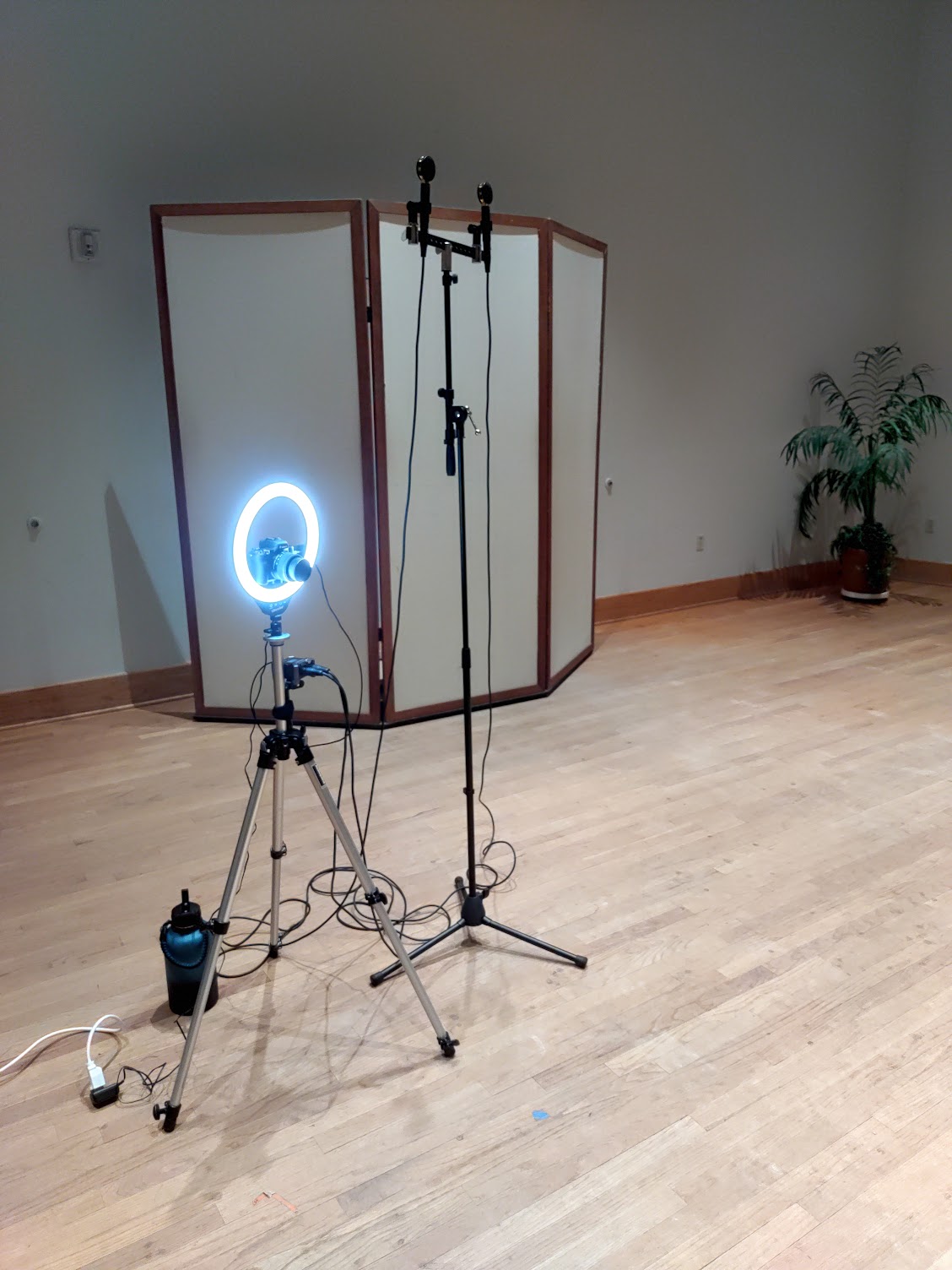
For those who are interested, I have been tweaking my recording setup for videos over the last few years. I’m not an expert in videography, but this equipment seems to work pretty well and delivers a decent product.

  • Camera: Canon EOS M50 Mark II mirrorless camera with the kit lens that comes with the camera
  • Audio Recorder: Zoom F3 Field Recorder with audio cable out to the camera (The audio is recorded simultaneously to the F3 recorder and is also output to the camera’s microphone jack.)
  • Microphones: 2 Audix SCX25A-PS Large-diaphragm Condensers. The school happens to have a pair of these very nice microphones, and they work great!)
  • Video Editing Software: Adobe Premiere Pro
  • Audio Editing Software: Logic Pro

Here’s a picture of this gear set up in our recital hall at school.
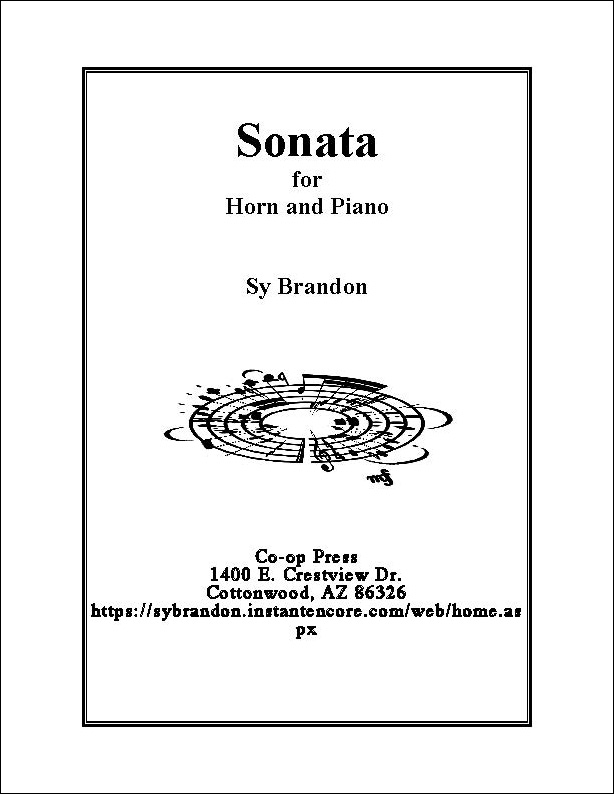
A Belated Commission “Performance” – Sonata for Horn and Piano by Sy Brandon

In 2018 I participated in a consortium to commission a sonata for horn and piano from Sy Brandon. I’m very familiar with his music, having recorded his Inventions for Brass Trio on our recent album Scenes from the Bayou.

Brandon’s music is fun for the performers and accessible for audiences, so participating in the consortium was a no-brainer. Part of the commissioning agreement was to perform the new work at some point after its completion, but other obligations have prevented me from programming it thus far. After our state’s stay-at-home order went into effect, I contacted Sy and asked him if he would be willing to provide me with an electronic realization of the piano accompaniment, as well as permission to record and share the piece on YouTube. While not the same as a live performance, I hope this rendition is representative of the work. Each movement was performed in its entirety, and the recording is unedited except for some added reverb and equalization. I hope you enjoy it!

More information about the piece can be found below the embedded video, including the names of the other consortium members and program notes by the composer.

Sonata For Horn and Piano, by Sy Brandon In Memory of David Baptist
Commissioning Consortium
  • James Boldin – University of Louisiana, Monroe
  • Erwin Chandler – Mohnton, PA
  • Patrice Chandler – Mohnton, PA
  • Benjamin Lieser – University of Central Florida
  • Ellie Jenkins – Dalton GA Joseph Johnson – Augusta GA
  • Sarah Schouten – Edinboro, PA
  • Nancy Sullivan – Flagstaff, AZ
Program Notes This three-movement Sonata was created in memory of my dear friend, Hornist, and composer/arranger, David Baptist. To read more about Dave, visit  http://todd.macshare.com/davidbaptist/index.html This work was created with the support of a commissioning consortium. The first movement is heroic in style as Dave was one of my heroes. He had so much talent and yet was very humble. He was one of the first friends we made when we moved to Arizona and his sense of humor was priceless. The movement is in a modified sonata form. The recapitulation begins with the secondary theme, then the closing theme and finally the main theme therefore creating an arch form. The second movement reflects Dave’s love of jazz. This bluesy movement uses a slight twist of the blues scale. Normally the lowered third is in the melody and the normal 3rd in the harmony. While this occurs in this movement, the reverse also occurs. The normal third is in the melody and the lowered third is in the harmony. Frequent use of both the normal and lowered versions of the 5th and 7th also occur. The form builds to a climax about two-thirds through before returning to the opening material. The third movement is in a modified rondo form. The 2/4, 5/8 rhythm of the A theme was inspired by my counting my vitamins in the morning to make sure that I had what I was supposed to take. I counted 1234 12345 which gave rise to the rhythmic pattern. The asymmetrical meter idea is carried over into the B theme where it begins with 4 measures of 5/8 followed by alternating 2/4 and 3/4. The character is similar to the A theme. The C theme is radically different and sounds more like a development with its repeated Horn notes and changing harmonies underneath. I am in the process of preparing Dave’s compositions for publication and observed that Dave used this technique frequently. After the C section the themes return as B followed by A and a coda.The odd meters, articulation, and dynamic surprises create a lighter, more humorous movement. -Sy Brandon


First Solos for the Horn Player: I Hear as in a Dream, Bizet

The eighth installment in this series of recordings from Mason Jones’s First Solos for the Horn Player is a transcription of the  aria “I Hear as in a Dream” (Je crois entendre encore) from Act I of George Bizet’s opera The Pearl Fishers. The first image after the titles is a public domain illustration for the final scene of  Act I as produced at La Scala in 1886, designed by Giovanni Zuccarelli (1846–1897) and illustrated by Antonio Bonamore (1845–1907).

This brief vocal transcription would pair nicely with the other Bizet work in the collection, Song of April. As with most of the material in First Solos for the Horn Player, the range and technical requirements in this piece are suitable for intermediate players. It makes for a great study in playing soft, sustained melodies.

First Solos for the Horn Player: Andante from Horn Quintet, K. 407, by Mozart

Up next in the First Solos for the Horn Player series is the second movement from Mozart’s Quintet for Horn and Strings, K. 407. It’s a fantastic piece, easily the equal of any of Mozart’s horn concertos . For more information on this work, check out John Ericson’s article at Horn Matters.

The slow movement is the most difficult selection in First Solos for the Horn Player. At first I thought the book was organized chronologically, which would explain the Mozart’s inclusion near the beginning. However, that’s not quite the case, so perhaps it’s included early so that anyone casually thumbing through would see something they recognize in the first few pages.

This one took me a while to work up, and though it’s not perfect by any means, I’m satisfied with this recording with SmartMusic accompaniment. On the technology front, I’ve come to the conclusion that it would be better at this point not to stress over the video/audio syncing issues, and instead to focus on making good recordings and including some public domain images to accompany the audio. The syncing issue was never a problem before I started using a Blue Yeti USB microphone, so I presume it will resolve itself when I go back to using my normal audio interface and XLR microphones. For now, though, my current setup will suffice. For the especially curious, here are the technical fixes I’ve tried (unsuccessfully):

  • Set Logic Pro X sample rate to 48 kHz (default is 44.1), and the Blue Yeti specs list its sample rate at 48 kHz.
  • Set Q2n-4K audio sample rate to 48 kHz

Neither of the above resolved the problem, although I have noticed upon further inspection that the camera records at 25 frames per second, and Final Cut Pro adjusts it to 23.9 fps. This may be the problem, but it will take me some time to work out a solution. If anyone has other possible fixes, I would be grateful!

First Solos for the Horn Player: Romance, by Alexander Scriabin

Here’s the fourth selection in the First Solos for the Horn Player video series, Alexander Scriabin’s Romance for Horn and Piano. Here are links to the other recordings up to this point.

Along with the second movement of Mozart’s Quintet for Horn and Strings, K. 407, this miniature for horn and piano is probably the most recognized work in the collection. The score and solo part are also available on IMSLP, and  there appears to be little difference between the Mason Jones and IMSLP editions.

A few interesting technical notes about this recording, and thoughts on this project thus far:

  • I experimented with the recording process on this one, using a Blue Yeti USB microphone in stereo pattern to record the audio into Logic Pro X. My hope was to sync this audio with the video from my Zoom Q2n-4k camera, and apply some equalization and reverb to improve the overall sound quality.
  • The latter effort was successful, and the overall sound quality belies the modest recording environment, a bedroom! The sound of the digital accompaniment is pretty good too, although it would have been nice to be more flexible with the tempo and dynamic subtleties. With a collaborative pianist, this would have been easy and natural.
  • Syncing the audio from Logic Pro with the video file should have been a routine task, and one which I have done several times in the past, though not with an identical set up. But as you can tell from the absence of video footage, I could not get it to work! Despite spending several minutes playing around in Final Cut Pro and consulting help pages, it still wasn’t working. I have very limited technical knowledge, but my guess would be that the sample rate between the Logic Pro recording and the camera recording was not the same.
  • Because the sound quality of the audio-only recording was superior to the camera audio, I decided to use it without any video footage, and insert a public domain image of Scriabin and his mistress, Tatiana Schloezer. For the next video I hope to work out the syncing issues.
  • A final note: I decided early on to NOT record every solo in this book. There’s a couple of reasons for this, not least of which is that recording the entire book would probably run afoul of “Fair Use.I haven’t settled on which solos to record for the remainder of the project, but I anticipate five or six more. Enough to to be representative, but certainly not a majority of the book (or even half). After that, I have some ideas for future projects, more to come.


Lagniappe Brass Videos

LAGNIAPPE BRASS LOGO(3)Last week the ULM Brass Faculty presented our annual holiday concert. This is always a fun concert, but this year there were a number of things that made the event special. First, our concert was part of a new chamber music series for the Monroe Symphony Orchestra, called “MSO Presents.” Second, we were joined by some special guests, turning our brass trio (Black Bayou Brass) into a full brass quintet, the Lagniappe Brass.  The term “lagniappe” is derived from a Louisiana French Creole word meaning “something given as a bonus or extra gift.” We thought it a fitting name for this ad hoc ensemble, and we hope to schedule more performances in the future. Our extra players included Steven Cunningham (trumpet) from Grambling State University, Cory Mixdorf (trombone) from the University of Arkansas, and a few ULM students who helped out on percussion parts for Sleigh Ride. For several pieces on the program we were also joined by ULM keyboard professor Richard Seiler on the organ. It was a really fun concert, with great attendance and an appreciative audience, for which we are extremely grateful! Special thanks to Steven and Cory; Craig West, Executive Director of the MSO; and Grace Episcopal Church in Monroe, LA. This concert would not have been possible without their efforts. And now, here are some brief excerpts from the concert. Hopefully they will put you in the holiday spirit!
*For those interested in the technical side of these things, see additional note at the bottom of this post.

We recorded this performance using several different methods: two Zoom Q2n recorders set up in front and behind the ensemble (primarily for video, but also recording audio), a pair of Cascade ribbon microphones set up in a Blumlein configuration directly in front of the quintet, and a Zoom H4 set up in the balcony at the rear of the sanctuary. All of these audio sources gave us a variety of ways to mix the sound, which I did using Logic Pro X after the fact. It would have been easier to run everything into the same audio interface, but we didn’t have the capability to do that for this particular performance. The video switching was created using Final Cut Pro, which has a very handy tool for syncing audio and video from various sources. Looking at the various videos back to back, you can tell that I was experimenting with (or rather fumbling around with) different lighting effects and color balances. This was my first experience with combining video and audio from so many different sources, but I think the end product is more visually engaging than a single camera. Look for more videos like this from us in the future!

Throwback Thursday: Senior Recital Recordings, October, 2001

While going through some old CDs recently, I came across my final undergraduate recital at Appalachian State University. I don’t recall the exact date, but it would have been sometime in October of 2001. I had not listened to these recordings in years, and doing so was a great trip down memory lane. Here is the program, with embedded audio. Feel free to take a listen!

Unfortunately I don’t have a copy of the program handy, but if memory serves here are the names of the other performers.

Kudos to all of them for very fine performances! Overall I still feel good about that recital from nearly 20 years ago. *An interesting piece of information about the Mozart is that one of the viola players injured their hand the day before the recital, and we had to get a sub at the last minute. I can still vividly remember getting the call from my teacher on the day of the recital, and singing my way through an impromptu rehearsal of the Mozart that afternoon with the new violist!

I have many fond memories of Boone and Appalachian State, and  got a terrific undergraduate education there, studying with Dr. Karen Robertson. During my senior year I also had the opportunity to perform with the Asheville Symphony as well as the usual collegiate ensembles. I’m so thankful for those opportunities, as they really helped me get on the right track at an early stage in my career. Looking back on where I was playing-wise at the time, I struggled with the high range and also had issues with intonation, endurance, and consistency of sound. I continued to work through these over the course of my graduate studies and well into my first few years at ULM. To close, I think the big thing to take away from this throwback Thursday post is to never stop practicing! Be proud of your successes  – as I was and still am proud of this recital from 2001 – but always  keep trying to become a better horn player. 


New Brass Trio CD Released!

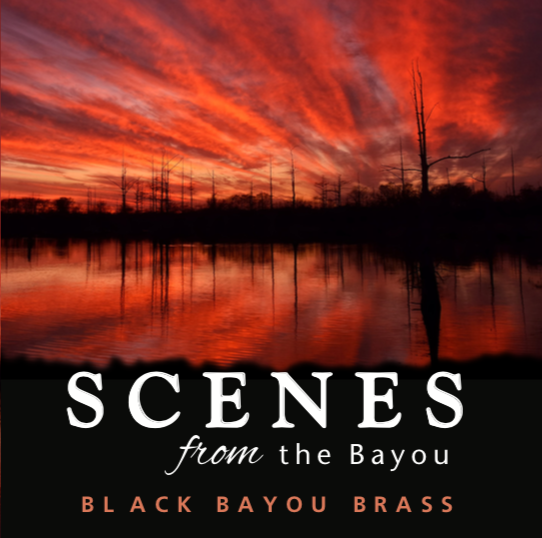
I’m happy to report that Scenes from the Bayou, our new brass trio album, is now available on the Mark Custom Recordings label. Anyone who was released a recording knows how much work is involved, and while I truly have enjoyed every bit of the process, I’m nonetheless relieved (and excited) to see the final product in physical form. If you’re interested in reading more about the recording and editing process, you can see my previous posts here and here. At this time the recording is available for purchase directly from me and also on the Mark Recordings store page, linked above. It will be available very soon on iTunes and Amazon. I will post updates as soon as the links are up.

Here’s a small quote from the liner notes which explains the scope and contents of this album. You can also read the Sales Sheet, a handy one-page document with more information about the recording.

The repertoire for brass trio is not extensive, especially when compared to more venerable chamber ensembles such as brass quintet or string quartet. With only three voices, the number of possible harmonies and timbres is limited, and there are few works written by major composers. Furthermore, there are only a handful of established professional ensembles. Yet, the number of student, amateur, and professional ensembles is growing, and there are jewels in the repertoire which help give the medium credibility. Since its inception, Black Bayou Brass has sought to promote brass trio music through performances, commissions, arrangements, and recordings. This album showcases several World Premiere recordings in various styles and time periods, from the 18th to 21st centuries. We feel it represents the best of what brass trio compositions have to offer, and we sincerely hope you enjoy listening to it!

And here’s a complete track listing, as found in the CD tray, along with a video containing score samples and brief clips of each work.

Allegro 
Menuetto                                                              
Adagio 
Menuetto
Rondo: Allegro assai
Preludio            
Allemanda 
Corrente 
Gavotta 
Hopak from Sorochinsky Fair by Modest Mussorgsky/arr. Aaron Witek 
The Wheel             
The Metronome 
The Periscope 
Morse Code
The Airplane     
Morning on the Bayou   
Chasing Prey                
Bayou Boardwalk              
Cypress Trees            
Fire in the Sky 
All are world premiere recordings, and with the exception of Flash by Jérôme Naulais, all the works on this album were either commissioned by us or created by members of the ensemble. If you haven’t heard any brass trio music before, or if you aren’t very familiar with the repertoire, make sure you check out Scenes from the Bayou!

Recording Reviews: Richard Deane; Steven Cohen

I seldom post recording reviews on this site, but every once in a while I either receive a complimentary album in the mail, or hear about a project that piques my interest. To close out a series of reviews from this summer, here are two horn recordings that are well worth your time.

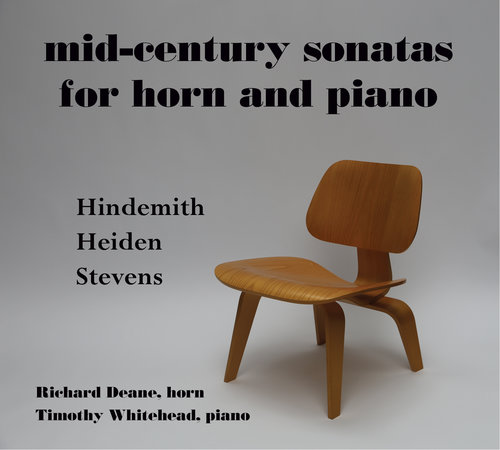
Mid-Century Sonatas for Horn and PianoRichard Deane, horn; Timothy Whitehead, piano

  • Halsey Stevens, Sonata for Horn and Piano (1953)
  • Paul Hindemith, Sonata für Althorn in Es und Klavier (1943/1956)
  • Bernard Heiden, Sonata for Horn and Piano (1939)
  • Paul Hindemith, Sonata für Horn und Klavier (1939)

Front+CoverBIGGER

These sonatas for horn and piano by Halsey Stevens, Paul Hindemith, and Bernard Heiden are staples in the repertoire. Deane is Associate Principal Horn in the New York Philharmonic, and served as Acting Principal for the 2017-18 season. He was previously a member of the Atlanta Symphony for many years. Though the repertoire is conventional, the extremely high caliber of the performances makes this recording special. Deane plays with a huge but focused sound. To my ear the “New York sound” has changed over the years, partially due to changes in equipment, I’m sure, but also probably as a response to the ever increasing demands of the job. Whitehead’s piano playing is equally impressive – especially in the final movement of the Hindemith E-flat Sonata – and is a fitting musical counterpart to the horn in these works.  There is not much in the way of liner notes, but there is a very nice video on YouTube with background about the project: https://www.youtube.com/watch?v=mP-kJf8xiJM  One other interesting note about this album is that Whitehead not only performed on piano, but did all of the recording, producing, editing, and mixing – not a small feat! The recording is both vibrant and clear, and for those who might be interested the recording equipment is listed in the liner notes.

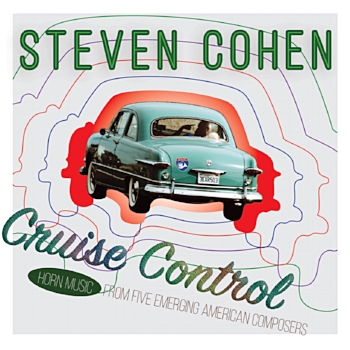
Cruise Control: Horn Music from Five Emerging American Composers – Steven Cohen, horn; Jed Moss, piano; Scott Shinbara, percussion; Amanda Sealock, percussion

  • James Naigus, Sonata for Horn and Piano
  • Jenni Brandon, Dawn for Horn in F and Piano
  • Adam Wolf, Cruise Control for Horn, Piano and Percussion
  • Wayne Lu, Pranayama
  • Gina Gillie, Sonata for Horn and Piano

IMG_5653

Cruise Control is a contrasting but equally interesting album by New York City freelancer Steven Cohen, and features world premiere recordings by several up and coming American composers. This project was sponsored by Siegfried’s Call, with a significant portion of the funding generated through an Indiegogo campaign. Be sure to check out the Indiegogo link for more information about the project and the commissioning process.

The music on this disc is fun and fresh, and showcases what I think the horn does best: play beautiful melodies and exhibit a variety of timbres. Cohen navigates the full range of the horn with ease and expression (using similar equipment to Richard Deane, a triple horn by Engelbert Schmid). Stylistically there is a bit of everything on this recording, from Neo-romanticism in the Sonatas by James Naigus and Gina Gillie to Minimalism and Rock in Cruise Control by Adam Wolf, and avant garde extended techniques in the works by Jenni Brandon and Wayne Lu. This recording is a musical and technical tour de force, and serves as a great resource for anyone interested in new music for the horn.

Brass Trio Recording Update

When I last posted about our brass trio album, we had just wrapped up a three-day recording session in January (you can read that post here). The project is moving forward, and I’m anticipating a release sometime in the fall of 2018. The tentative title is Scenes from the Bayou, which is the same title as one of the works we commissioned for this recording, composed by Gina Gillie. Here is a complete list of what will be on the disc.

Although the actual recording was a major part of the process, there are still many steps to complete before the album is ready to go.

Step 1: Sift through all of the material from our recording session and select those takes to be used in the first edit. After three days of recording, we had roughly 4.5 gigs of wav files, over 650 tracks! For those who might be interested, these were rough 16-bit mixes, not what things will sound like after final editing and mastering. Sometimes the recording producer and/or engineer will assemble a first edit for the client, depending on their contract, but in this case I was the one going through and providing the take list. Luckily, our producer Gina Gillie took great session notes. These notes helped me group our takes into three broad categories: usable, possibly usable for a spot or two in a given set of measures, and not usable. Lots of these decisions were arbitrary, but I feel good about the choices made for the first edit. From there, the take list was sent off to our engineer, Dave St. Onge.

Step 2: Dave worked incredibly fast (but very accurately) and put together a complete first edit within a matter of days. The first edit sounds very good, and I think the album is going to be an enjoyable listen – high quality, lots of variety, and musically interesting. But, there is still some work to be done. One of my summer projects (already in progress) will be going through the first edit with an even more critical ear to find any issues that need to be addressed for the second (or possibly third) edit. Things like small intonation concerns, precision of attacks (a few cases), and any other rough spots missed during the first edit will be the priorities. Unlike the first edit, I won’t be listening for long stretches of usable material, but instead trying to find small bits and pieces which can be dropped in to address a specific issue. For example, a 16-bar take might be great except for a single chipped note or other small imperfection. I tried to account for these when choosing takes for the first edit, of course, but I’ve already found a few things that slipped through the cracks the first time.

Step 3: Mastering will include tweaking the balance of all three voices to arrive at the final sound of our recording. Again, a very subjective process!

From here there are lots of production-related items to discuss with Mark Custom Recording Service, who will be manufacturing and distributing the album. These include:

  • Mechanical licenses (mostly handled at this point)
  • Package design, cover and interior art (in progress)
  • Liner notes (another summer task)

It’s exciting to see another recording project take shape. Stay tuned for more updates!