This is the 2nd of a two-part interview with Andrew Downing about his recent visit to the Alexander showroom in Mainz, Germany to hand pick a new Alexander horn. You can read Part 1 here.
 JB: What did you play for your trial on each horn?
AD: I brought a folder of my favorite music that I thought would give me the best representation of my playing. I didn’t bring music that was intentionally flashy but brought things that would demonstrate a high quality of tone, intonation, and articulation. I used the Gliere Concerto as my core demonstration piece as I feel each of the movements are really excellent for demonstration purposes and cover the whole range of the horn. I also brought a few low Kling etudes and a few melodic excerpts from the Brahms and Mahler symphonies.
JB: Besides the consultant, who else was in the showroom with you? Did you feel comfortable playing in the room and for the consultant?
AD: The appointment times for their showroom were strict – each player (or players if travelling together) are seen one at a time for a four hour window. If they exceeded their time, they would be asked to leave and wait until the next client had made their selection. The staff at Alexander works regularly with some of the finest players on earth and they seem intent on giving you privacy unless feedback is requested. My appointment began promptly at 1pm and Reimund began my visit with a walk through their facility. Prior to my appointment time a pair of professional hornists from Italy had not yet made their selections and were forced to leave and wait until I finished! They found a local coffee shop to pass the time and patiently waited for me to finish selecting my instrument. When I began my trials my wife and brother were invited to join me in the showroom. They were given coffee and chocolates to enjoy while I tried the horns – I was jealous! Both are professional horn players and their input was very helpful. My trial experience there was incredibly enjoyable and relaxing overall.
JB: What kinds of feedback did the Alexander consultant provide? Did you find it helpful in making your final decision?
AD: Periodically Reimund would enter the demo space and ask if I wanted feedback. He would turn his back to me and listen to what I would play. When I would finish a passage he would ask me first what I liked or didn’t like and then share his opinion. I ultimately found that we both have different sound preferences – I was seeking a balanced sound that had a certain weight to it and he preferred a brighter sound with pronounced overtones. Ultimately the 1103 has a slightly larger bell and more open wrap that gives the horn the heft that I was looking for. It’s interesting that very few of these models make it to North America as I found it has a nice blend of the Alexander “zing” but is much more closely in line with current trends in American horn design and sound.
JB: Were you surprised by any particular model of horn? In other words, did you have any preconceptions that were disproven?
AD: I had one very common preconception justified through this experience: that many Alexanders of the same model will play very differently. This is common in many other manufacturers of brass instruments so it should come as little surprise. I was really taken by how each horn I tried had a special trait or two but might be limited in another. Ultimately the horn I chose had the best balance of all the characteristics I was seeking. If you are in the market for a new Alexander I would strongly recommend travelling to their workshop or a horn convention to select one. The feel of each was quite different! Alexanders are often generalized as having poor response in the low register but I was really impressed with the brilliance many could make down there. Alexander horns now seem to make a very exciting low sound and many hornists who watch the Berlin Philharmonic on the digital concert hall should find this as no surprise. I have since used my horn for a heavy low horn job and found it no trouble at all.
JB: What horn did you end up choosing? Were you able to take it home right away?
AD: I settled on an un-lacquered yellow brass 1103 with a spun bell. All the horns I tried came with a detachable bell so if someone was seeking a fixed bell option they should communicate that well ahead of time. Alexander does not provide a case but there were a wide assortment of horn cases to select from. Once I made my selection I was given a tour of the manufacturing side and was able to see where the horn was built. I found the freezing process of their bell tails particularly interesting: they fill their unbent spun bell tails with water and freeze them below zero. When bending it give the metal a very consistent shape and it also very eco-friendly. There is an excellent video of this bending process as part of a documentary on making a 103 on YouTube I would highly recommend. [https://www.youtube.com/watch?v=XD3_c05JqNo&t] Here it would stay for two weeks to be finished while I spent time while with my family.
JB: Any other thoughts you would like to share about this experience?
AD: Mouthpiece, mouthpiece, mouthpiece. I should have thought ahead but realized once I began the trials that the leadpipe would not fit my American shank mouthpiece. If you have an American shank and are in the market for a german horn I would highly recommend reading John Ericson’s article regarding the impact of different leadpipe tapers. [http://hornmatters.com/2010/05/european-shank-mouthpieces/] I tried all the horns on a Yamaha 32C4 (my standard mouthpiece for years) but after some trial and error have since settled on a Tilz McWilliam 1 that was specifically designed for an Alexander. In retrospect I would have enjoyed going over with a European shank mouthpiece I was comfortable on. Alexander has a cabinet with hundreds of mouthpieces on site but time is valuable and trying to pair a new mouthpiece with a completely new horn is almost too much for one day.
My final thought is that anyone that plans carefully, creates a realistic savings plan and understands the value of a great instrument can find a way to get a beautiful handmade horn in their hands. Yes, the high end market is expensive these days but there is some magic to having something built, prepared, or even customized for you. In the realm of high end instrument pricing horn players are quite lucky. Woodwind and string players may have to buy instruments that cost as much as a house to play at the highest level: our top of the market is basically equivalent to a used car. The experience of finding your ultimate horn might just be worth that memory of a lifetime!
Andrew Downing lives in suburban Dallas, Texas. He is an active freelance artist and is a member of the Mockingbird Brass, a quintet based in North Texas. More information about him can be found at: http://www.mockingbirdbrass.com/about.html
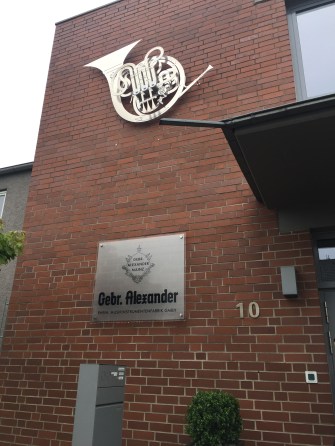 My longtime friend and colleague Andrew Downing recently visited the
 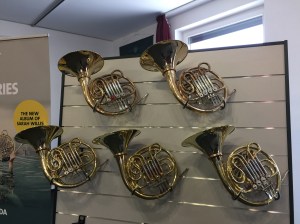 AD: I spent a few years of my collegiate studies playing on a 1960’s era Alexander model 103 I acquired from a European professional that had moved to the states. I immediately fell in love with the special character of Alexander horns – dark and velvety in softer dynamics and brassy and bright when played loudly. There is an unmatched color they make that seems to encourage many European horn sections to use them down the line to generate a uniform sound. I have always felt that the best Alexanders I’ve played seemed to vibrate in the core of the horn rather than at the embouchure much like the way a great bowed instrument resonates from within. I played many memorable concerts on my old horn and only gave it up in the early 2000’s to get on the Geyer-style horn bandwagon for American auditions and jobs I was taking. It also needed quite a bit of work and I ended up selling it to someone that wanted to invest in the restoration. I have missed it ever since.
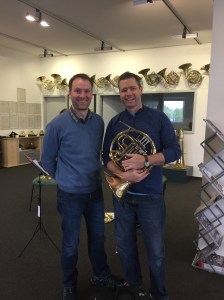 AD: The sales experience began in the early fall of 2016 with an email to Reimund Pankratz, one of the sales managers for Alexander. He was extremely welcoming to my request and was pleased that I was planning so far out. Reimund took time to discuss my options and talk through the buying process. Once we settled on my instrument preferences we agreed on a set time and date to visit during my trip early on to select a horn. I would then wait about a week and a half for finishing. No deposit was required for the trial and the payment takes place at the time of final selection. All horn trials in their shop are done with their horns in “raw condition” – their term for unfinished brass with much touch up work to do to the finish at solder points. Once my choice was made and I had completed my purchase they would move it to their shop for touch up and customization per my requests. Based upon my experience it seems that the best chance for someone to secure an appointment for a horn trial would be to contact Alexander nine to twelve months prior and attempt to secure a date. They focus on a very private trial experience and their time and space are limited for demos.
 James Boldin's Horn World