Summer Update, and Brass Trio Lists

I’ve been enjoying some much-needed vacation time this summer, complete with an extended hiatus from blogging. Although I haven’t posted any new content for the last several weeks, this time has not been spent idly. Summer is a great time to work on various projects and get in lots of focused practice sessions. Here’s a brief list of what I’ve been up to this summer.

  • New Arrangements: Two have been submitted for publication, and I anticipate sending in a couple more by the fall. More details once they’re in print!
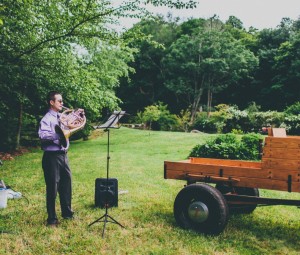
  • Wedding Season: In June I was invited to play at a good friend’s wedding. We became friends in high school band, and have stayed in touch for the last 2o years. My wife and I had a great time catching up with old friends and celebrating at the reception. Here’s a a picture of me playing some pre-ceremony music. Photograph by Urban Bloom Photography.hornpicture
  • Practicing: A short run of Les Misérables coming up at the beginning of August, and a faculty recital (Music for Horn and Organ) coming up in early October. More details on this recital in a future post.
  • Brass Trio Article: I recently submitted an article to The Horn Call titled “Brass Trio Repertoire: Beyond Poulenc.” For a while now I’ve been planning to put together a list of original brass trio compositions, and I hope that others find the article useful. The story behind the title is that I’m often asked by colleagues what other good works are out there for brass trio in addition to Francis Poulenc’s Sonata for Trumpet, Horn and Trombone. The short answer is “a lot!” For part of the article I put together my personal “Top 10” list of works that I consider basic repertoire. Such lists are of course arbitrary, but if you’re looking for music to play in a brass trio in addition to the Poulenc this is a great place to start. Here’s the list, in alphabetical order. Where available, I’ve included a link to a live performance of the work.
  1. Lauren Bernofsky, Trio for Brass
  2. Eric Ewazen, A Philharmonic Fanfare
  3. Arthur Frackenpohl, Brass Trio
  4. Jan Koetsier, Figaro-Metamorphosen, Op. 131
  5. Jean-François Michel, Suite
  6. Jérôme Naulais, Flash
  7. Václav Nelhýbel, Trio for Brass
  8. Anthony Plog, Trio for Brass
  9. David Sampson, Duncan Trio
  10. Daniel Schnyder, Trio for Trumpet, Horn, and Trombone/Bass Trombone or Tuba

Another portion of the article includes a list of currently or recently active ensembles, with links to their websites, if available. This is only a partial alphabetical listing, and I’m sure there are many other fine groups out there. If you are a member of an active brass trio I’d love to hear from you and chat about repertoire.

  1. Auckland Chamber Ensemble (ACE) Brass
  2. Black Bayou Brass
  3. Borealis Brass
  4. Contrapunctus Brass Trio
  5. Del Mar College Faculty Brass Trio
  6. Kalamazoo Brass Collective
  7. Louisville Orchestra Brass Trio
  8. New Mexico Brass Trio
  9. New York Brass Arts Trio
  10. New York Chamber Brass
  11. Old Dominion University Faculty Brass Trio
  12. Ouachita Baptist University Faculty Brass Trio
  13. Pro Musica Brass Trio
  14. Reedy River Brass Trio
  15. Southern Illinois University at Carbondale Faculty Brass Trio
  16. Three Body Problem
  17. Trillium Brass Trio
  18. University of Maryland Brass Trio
  19. V3NTO Brass Trio
  20. Warsaw Brass Trio
  21. Welsh Brass Trio
  22. Wenham Street Brass
  23. Yale Brass Trio

If this brief look whets your appetite for more information about brass trio music, be sure to check out the article in a future issue of The Horn Call!

I’ll only post sporadically between now and the beginning of the fall semester, but plan to resume a more regular writing schedule once school begins. Enjoy the summer!

Conference Report: 2014 International Women’s Brass Conference

bbb_iwbcAfter a 1600 mile round trip, we returned to Louisiana early yesterday morning from the 2014 International Women’s Brass Conference, hosted by Dr. Raquel Rodriguez at Northern Kentucky University. Our performance went well, and overall it was a great experience. For more details on our program – Music for Brass Trio by Women Composers – see this link. A big Thank You! and Bravo! are in order for co-hosts Raquel Rodriguez and Karen Koner. They put together a wonderful event. Because of our travel schedule and some other prior commitments, we were only able to attend a few days of the conference, but from what we observed everything ran smoothly and efficiently. Rehearsal space at conferences like this one are always at a premium, but we were allowed access to a large room complete with an organ (which we needed to perform Libby Larsen’s trio). We also had plenty of time for a sound check in the performance space, which is not always possible. After our performance we got some great feedback from audience members, including composer Dr. Lauren Bernofsky, who composed the final work on our program. It is always a special experience for the performers when the composer is in attendance, and we were honored that Dr. Bernofsky could be there. If you don’t know this very substantial work for brass trio, you can listen to it on this recording by the University of Maryland Brass Trio.

Although our time at NKU was limited, I did have a chance to check out the exhibit hall and speak with Dr. Randall Faust, Professor of Horn at Western Illinois University and owner of Faust Music. I have been slowly acquiring the horn-related publications in their library, and they are all highly recommended. On this trip I bought both volumes of The Advancing Hornist,written by Marvin Howe and edited by Randall Faust. Marvin Howe taught for many years at Eastern Michigan University and at Interlochen National Music Camp. While familiar with his name, I don’t know many details of his pedagogy, and am looking forward to working with these two books. I also got a chance to catch up with Dr. Stacie Mickens, Assistant Professor of Horn at Youngstown State University. Stacie and I have known each other since 2002 when we started our master’s degrees at the University of Wisconsin. She is doing some great things at YSU, and we hope to have her visit ULM soon for a recital and masterclass.

While I would have liked to attend more of the performances at IWBC, the ones I did make it to were excellent. Two that stand out in my mind were a performance of Ann Callaway’s Four Elements for Horn and Piano by Dr. Katie Johnson, Assistant Professor of Horn at the University of Tennessee, and a recital by Ava Ordman, Associate Professor of Trombone at Michigan State University. Sadly, we did not make it to the conference in time to hear Elizabeth Freimuth‘s recital (Principal Horn, Cincinnati Symphony), but we did get tickets to hear the Cincinnati Pops present a very brass heavy concert. I was familiar with this group through their numerous recordings with Erich Kunzel on the Telarc label, and they did not disappoint! Works on the program included Shostakovich’s Festive Overture, Finale from Stravinsky’s Firebird Suite, Montagues and Capulets from Prokofiev’s Romeo and Juliet, Pines of the Appian Way from Respighi’s The Pines of Rome, and many more. Elizabeth Freimuth sounded fantastic, as did the rest of the horns and brass.

The 2014 International Women’s Brass Conference was a terrific event, and I highly recommend it to brass players of all levels. The site for the next IWBC in 2016 hasn’t been announced yet, but when it is be sure to check out their website for more details.

As usual, I’ll be taking some time off from writing blog posts, but will be working on some other projects as well as spending time with friends and family. Best wishes to everyone for a fun, safe, and productive summer!


Book Review: Notes of Hope

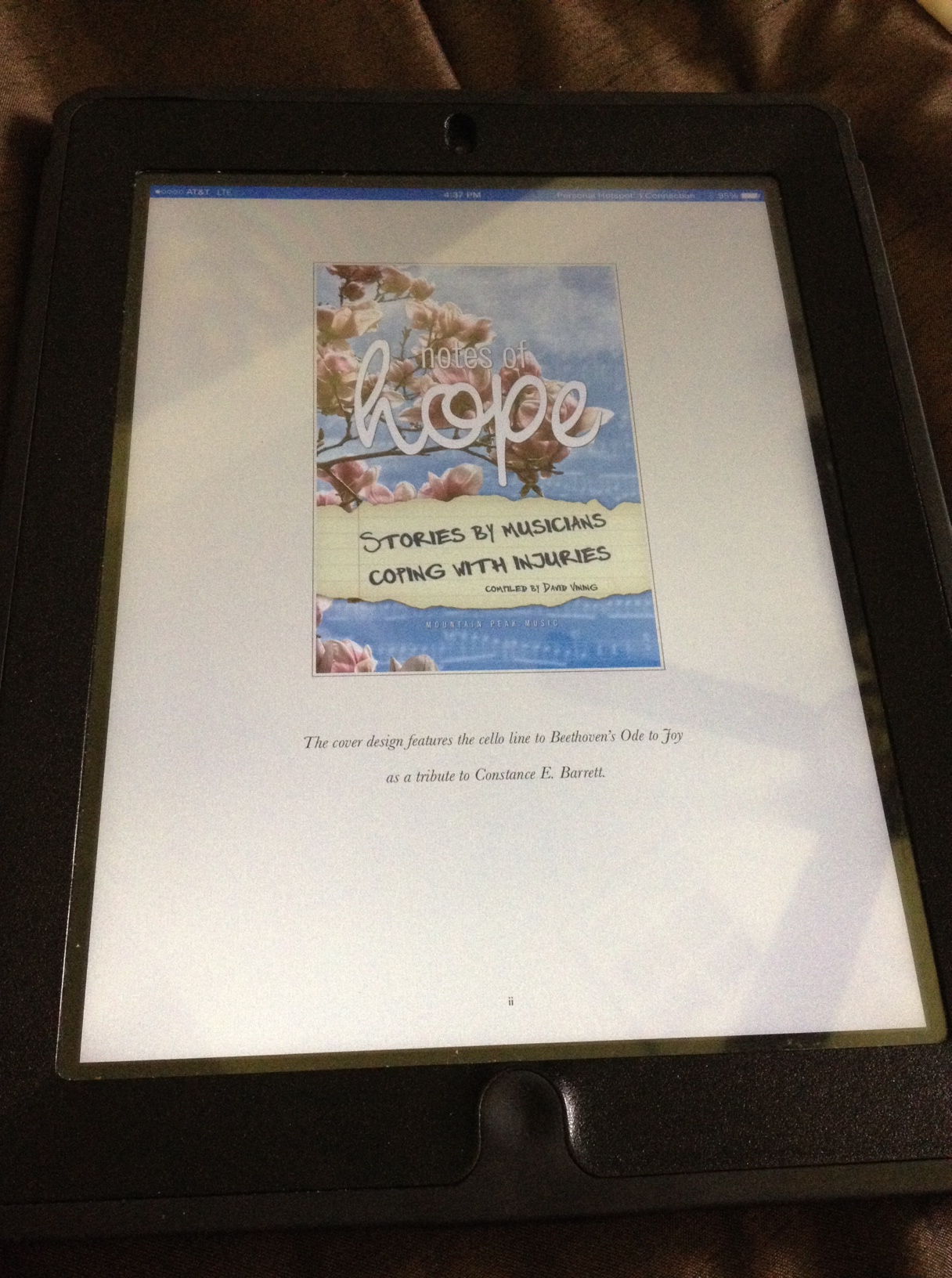
photoOne summertime activity I really enjoy is catching up on my reading list, which consists of a variety of books; some purely for pleasure – the Riverworld Series by Philip José Farmer and The Bourne Legacy by Eric Van Lusbader – and others for professional purposes. Notes of Hope, the topic for today’s brief review, is something I think belongs to both categories. This new publication from Mountain Peak Music consists of twelve personal accounts from musicians who have dealt with some kind of performance-related injury. Here’s an excellent video introduction to the book by its compiler, David Vining.

The book’s professional relevance is obvious, but beyond that I found each author’s story inspirational and uplifting. Their courage and perseverance in the face of potentially career-ending hardship transcends any one discipline, and each chapter is written in a straightforward manner without an excess of jargon. This is all to say that yes, musicians will be interested in this book, but I think many other readers will be as well: athletes, dancers, painters, teachers etc. The authors come from a variety of backgrounds and career paths, with vocalists, wind players, and string players being represented. Here is a list of the authors and their instruments, in the order they appear.

  • Amy Likar, flute
  • Shelley Rich, violin
  • Sarah Schmalenberger, horn
  • Adam Cole, piano
  • Bonnie Draina, voice
  • David Vining, trombone
  • Andrée Martin, flute
  • Marie Speziale, trumpet
  • Allison Dromgold Adams, saxophone
  • Constance E. Barrett, cello
  • Jennifer Johnson, violin
  • Kristin Delia Hayes, flute

There is a wealth of information in these pages, far too much to quote at length, but here is a short list of  common themes I took from their stories.

  1. Every injury is unique. Although there are generalizations that can be made about certain types of injuries (such as focal dystonia), the path to recovery for each author was incredibly personalized, often consisting of a variety of therapies. In the case of these authors, there was no magic bullet for recovery.
  2. You can’t go back to the way you used to play. Though it is tempting after an injury to try to get back to the way one used to do things, recovering from an injury often requires the retraining of neural pathways. In many of these stories, the authors had to re-conceptualize the way they produced sound in order to move forward.
  3. Seek out specialists. Performing arts medicine is a relatively new field, but there are specialists out there who can help. Groups such as the Performing Arts Medicine Association and journals such as Medical Problems of Performing Artists can help make us aware of the latest research.
  4. Perception is everything. Many of the injuries documented by the authors were at least in part the result of false perceptions – either mental or physical – about the way they produced a sound with their instrument or voice. Our kinaesthetic sense is incredibly powerful, but prone to misconceptions.
  5. Awareness matters. Disciplines such as Alexander Technique, Feldenkrais Method, Body Mapping, and Yoga are playing an increasingly larger role in the arts, especially in the field of performing arts medicine. Though different in their specifics, each one helps bring about a greater awareness of the body/mind connection. If you aren’t familiar with any of these, you owe it to yourself and your students to find out more!

Notes of Hope is a great book, and one that I plan to come back to with my students this fall. It is also available in a version for iBooks, which at $4.99 is an incredible deal. In closing, here are a few links to related stories on this website. Looking ahead to this summer, I will post some summary comments about our visit and performance at the upcoming International Women’s Brass Conference, but will be taking a few weeks off following that.

For Further Reading

Recording Review: Solo, J. Bernardo Silva

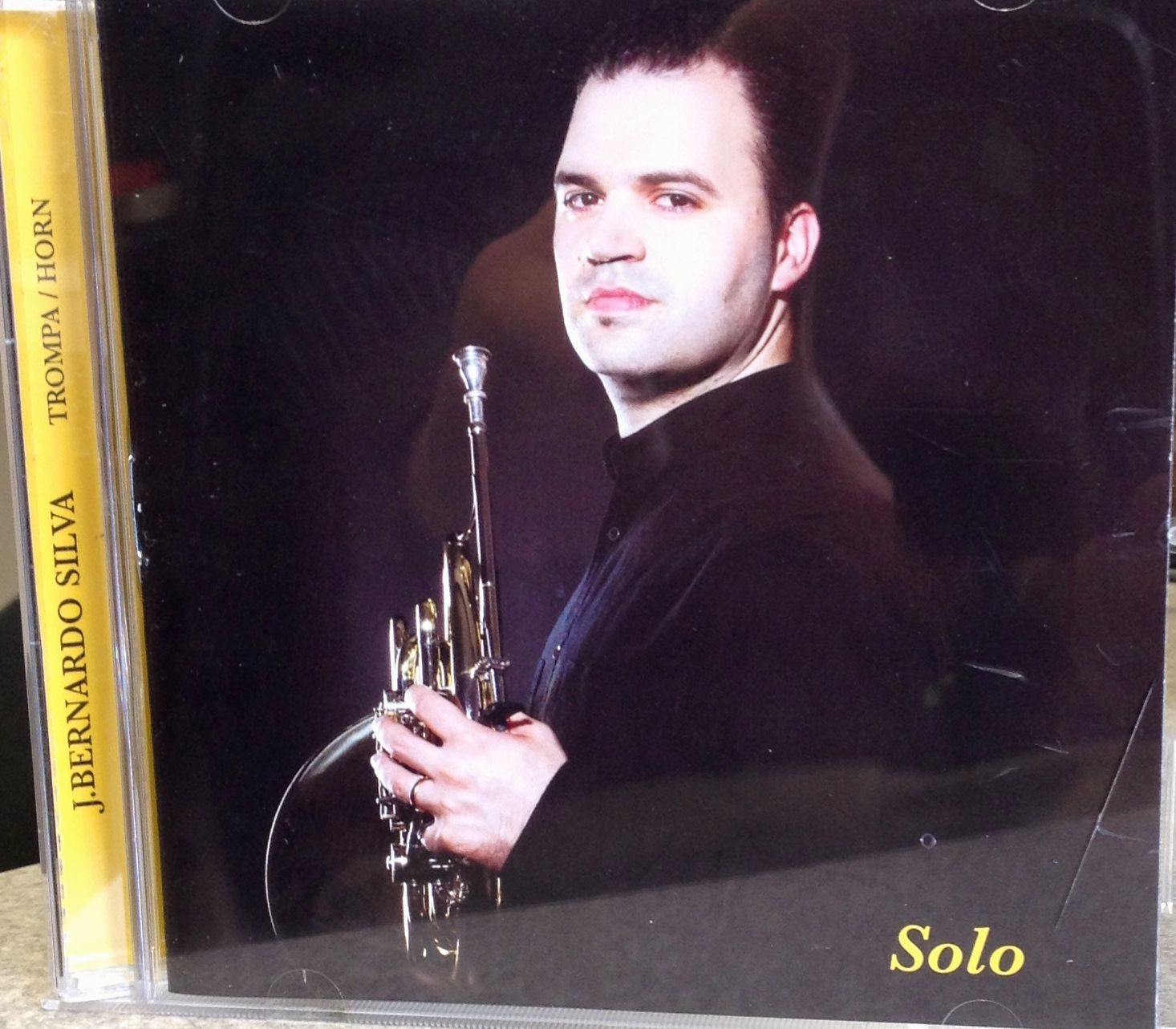
silvacoverI received this very fine recording several months ago, and have listened to it multiple times. The soloist is Portuguese hornist  J. Bernardo Silva, a member of the Orquestra Sinfónica do Porto Casa da Música, and faculty at Espinho Professional Music School and at the University of Aveiro. Having previously reviewed  a handful of unaccompanied horn recordings (herehere, and here), I think one of the biggest challenges is choosing a program with enough variety to keep the listener interested. In addition, the soloist must play be able with a wide range of colors, dynamics, etc., perhaps even beyond what is necessary  for a horn/piano or chamber music recording. With this disc, Mr. Silva delivers on both counts. The repertoire is a mix of standards and less familiar works.

  • J.S. Bach/ed. Orval, Cello Suite No. 1, BWV 1007
  • Bernhard Krol, Laudatio
  • Sigurd Berge, Hornlokk
  • Charles Koechlin, Monodie, Op. 218bis
  • Trygve Madsen, The Dream of the Rhinoceros
  • Vitaly Buyanovsky, España, from Traveling Impressions
  • Stephen Dodgson, Cor Leonis
  • Gioacchino Rossini/arr. Baumann, Le Rendez-vous de Chasse

Especially interesting are the Koechlin and Dodgson, because of their unfamiliarity. Both date from the 20th century, 1948 and 1990, respectively. The Koechlin is full of bravura writing, particularly in the  upper register, and would be a great addition to a recital program. In contrast, the Dodgson is more atmospheric, though equally effective. Dodgson is perhaps most well known for his guitar compositions, and studied horn at the Royal College of Music in London. For more information, see his obituary in The Guardian, April 2013. Here are some brief excerpts from each work, as found on YouTube.

These relatively obscure works are complemented with several standards from the unaccompanied horn repertoire, performed here with great virtuosity and sensitivity. I am always interested in hearing various interpretations of staples such as Krol’s Laudatio and Buyanovsky’ s España, and these are well worth a listen! Silva plays with a brilliant sound, refined phrasing, and a touch of vibrato. Even if you own several other recordings of the standards found on this disc, it’s worth picking up for the Koechlin and Dodgson alone.

Upcoming Performance: International Women’s Brass Conference

Although I have a number of projects to work on this summer, one big event will be a performance with Black Bayou Brass at the International Women’s Brass Conference, June 4-8 on the campus of Northern Kentucky University. I’ve never attended an IWBC, but have heard very good things about both the organization and the conference. This year’s conference will feature a number of renowned artists, including Elizabeth Freimuth, Principal Horn of the Cincinnati Symphony. While the title of this conference might suggest that participation is limited only to women, this is not the case at all. The mission of the IWBC is to educate, inspire, and encourage women brass players, and membership is open to all women and men who want to support these goals. For our part, we’ll be performing a program of music for brass trio by women composers. Here’s the lineup.

  • Engelberg: Trio for Brass and Organ, Libby Larsen (b. 1950)
  • Three Chorals for Brass Trio, Adriana Figueroa Mañas (b. 1966)
  • Wandl’ ich in dem Wald des Abends, Fanny Mendelssohn Hensel (1805-1847) Arr. James Boldin
  • Trio for Brass, Lauren Bernofsky (b. 1967)

As our presentation time is limited to 20 minutes, we will perform selected movements from the Mañas and Bernofsky. If you don’t know any of these works they are definitely worth checking out. For a more comprehensive list of brass trio (and other) music by women composers, visit the website of Dr. Lin Foulk, Associate Professor of Horn at Western Michigan University. I’ve also included a few program notes below for each of these works. We are very excited to perform at this conference, and as always are looking forward to hearing lots of great brass playing and catching up with colleagues and friends from around the country. On a related note, I just recently learned of a newly completed brass trio by Dr. Gina Gillie, Assistant Professor of Horn at Pacific Lutheran University. This work was commissioned by Elliott Higgins for the New Mexico Brass Trio, and although we won’t be performing it at this year’s IWBC, our faculty trio here will definitely be reading it in the future.

If you are planning to attending the 2014 IWBC we hope that you can hear our performance, and look forward to seeing you there!

Program Notes

Libby Larsen’s Engelberg: Trio for Brass and Organ is based upon the hymn tune of the same name, composed by Charles V. Stanford, and perhaps most well known as the setting for “When in Our Music God is Glorified.” It was commissioned by Ray and Elsie Martin for the Zephyr Brass Trio, to commemorate the birthday of Raymond J. Martin, Sr. on November 5, 2006. Though firmly grounded in tonality, the work makes use of several non-traditional modulations.

Adriana Figueroa Mañas was commissioned to compose her Three Chorals for Brass Trio by Dr. James Bicigo and the Borealis Brass (University of Alaska Fairbanks). Since its premiere by that ensemble, Three Chorals has had numerous performances throughout the world, and has been recorded by the Borealis Brass on their CD Roman Holidays. Though the work does not directly quote any folk melodies from her native Argentina, Mañas has stated that it freely incorporates the colors and rhythms of folk music.

Originally scored for two sopranos and alto on a text of Heinrich Heine, Fanny Mendelssohn Hensel’s Wandl’ ich in dem Wald des Abends (I wander in the evening forest…), depicts a melancholy reminiscence brought on by an evening stroll through the woods. Its chromatic harmonies and quasi-imitative texture are well suited to the brass trio medium.

Lauren Bernofsky’s Trio for Brass was commissioned by Mary L. Thornton for the Delmar Trio. The following notes are from the composer:

I wanted to write a piece that would be an exciting challenge for the performers (though not impossibly difficult). The piece is cast in three contrasting movements, following the traditional slow-fast-slow scheme. The overall duration is approximately fifteen minutes, which makes it a relatively long piece for this number of brass instruments; since there are only three in the group, allowing one to rest results in a duo texture, which is notably thinner than a trio texture (as compared to a brass quintet, where the resting of one voice leaves us with the full sound of four others still playing.). I made a real effort to “thin out” the texture in many places of especially the last movement, by which time the players would of course need it the most. I tried to create variety in the piece through different textures. The outer movements often alternate between sections of homophony, where the instruments all play the same rhythms together, and more complex-sounding contrapuntal textures. Much of the middle movement has a clear bass line, middle voice, and melody, and I wrote it as a necessary release from the more harder-to-hear outer movements. Most importantly, my intent was to write a piece that would be fun to play as well as to hear.


A Treasury of Horns!

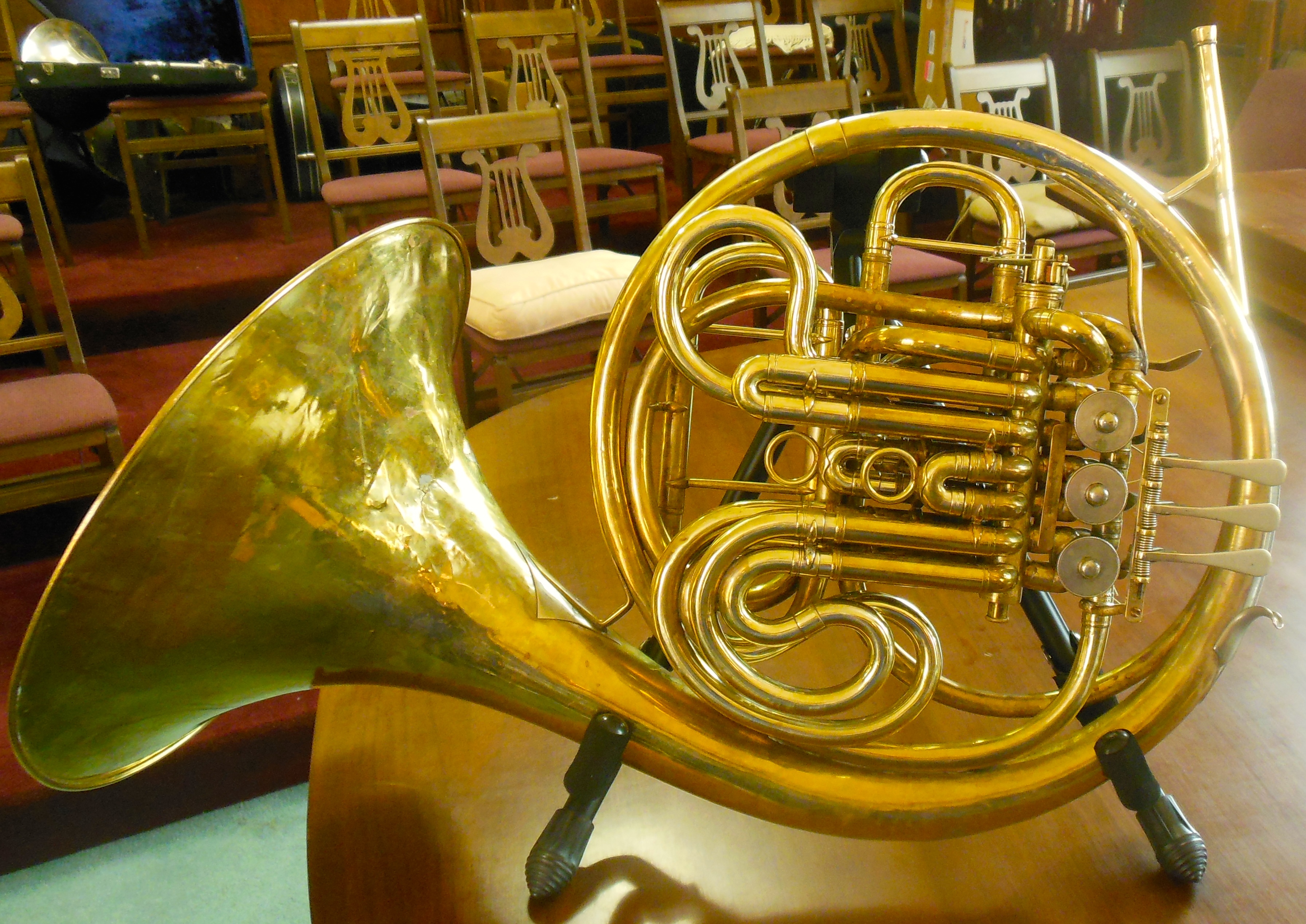
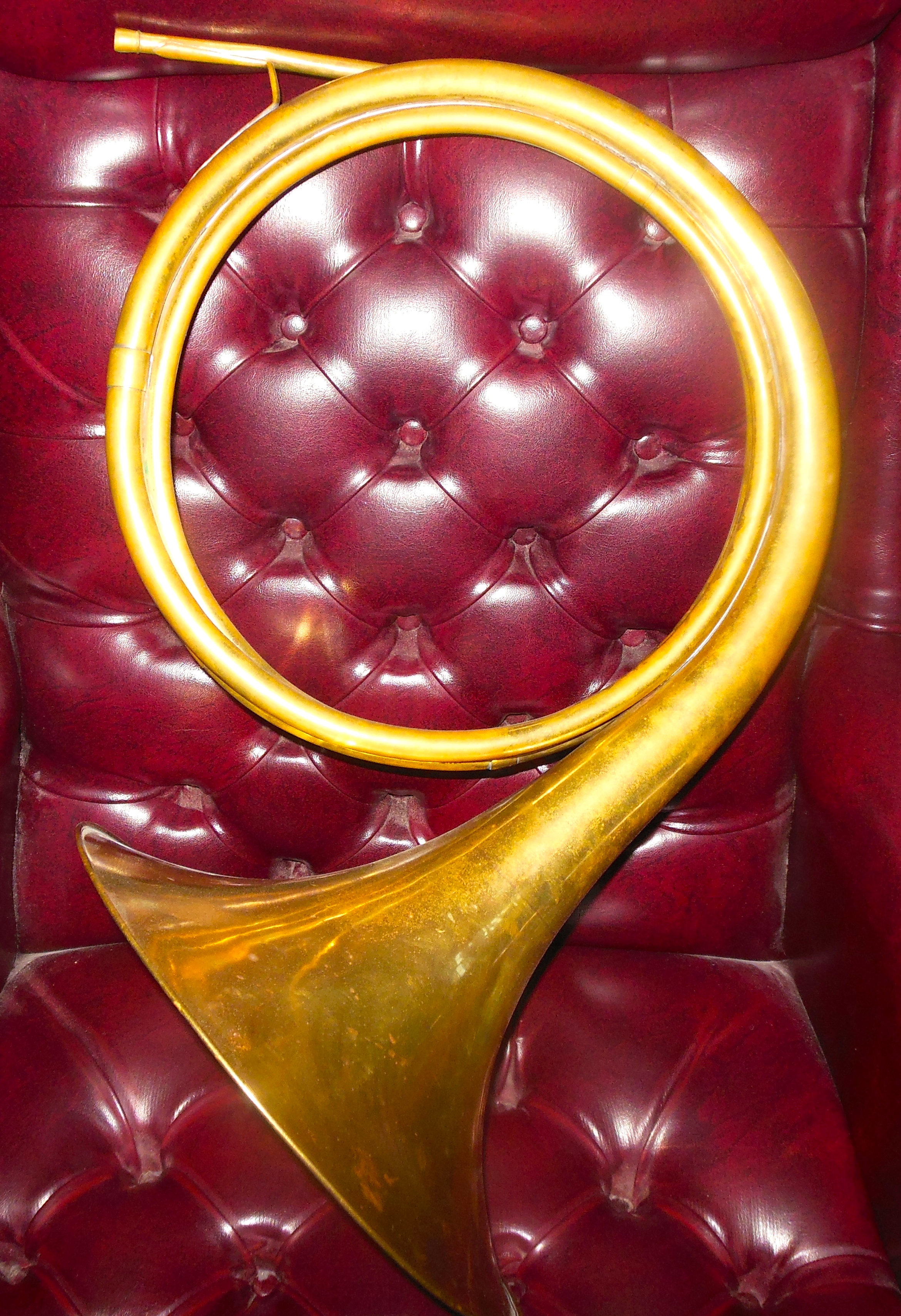
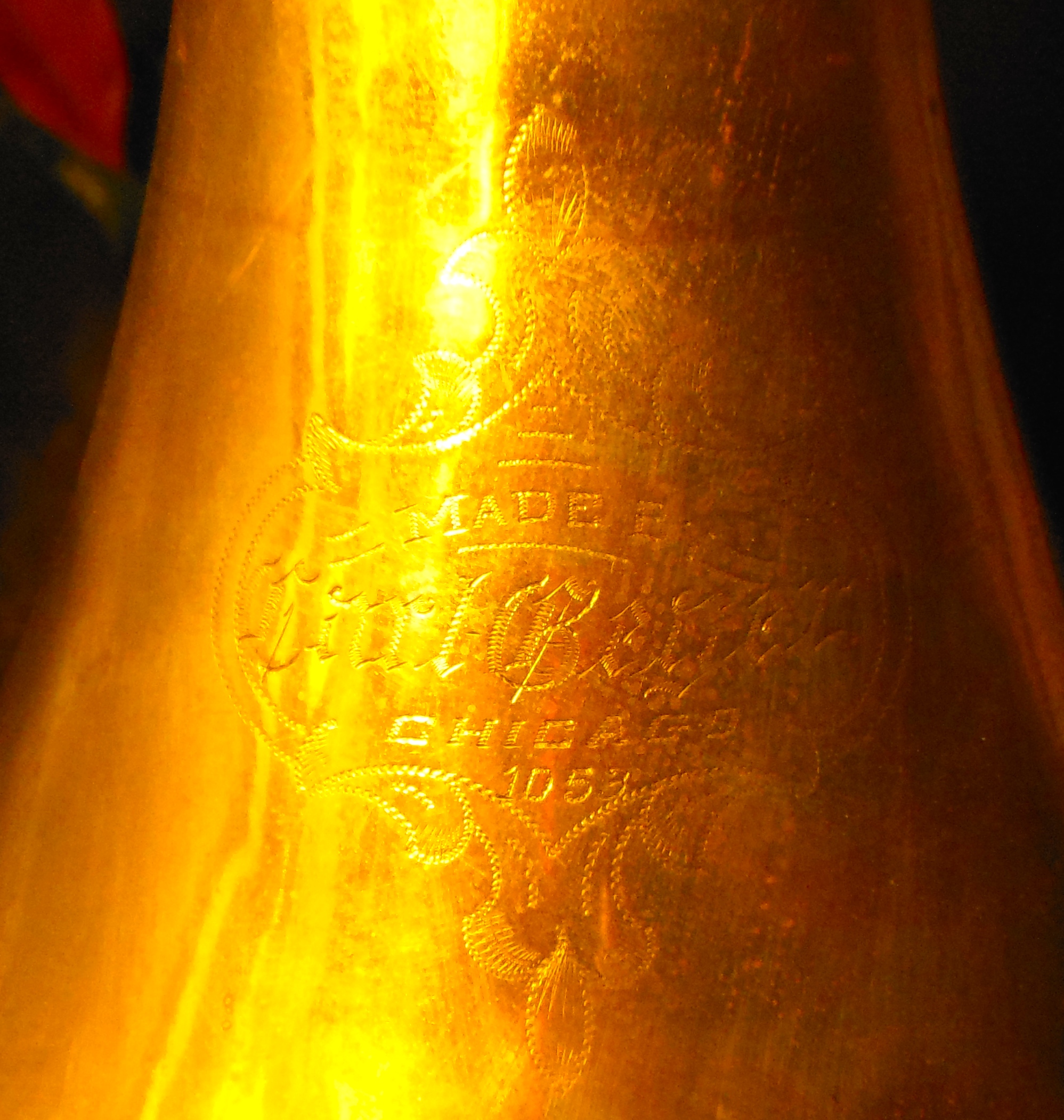
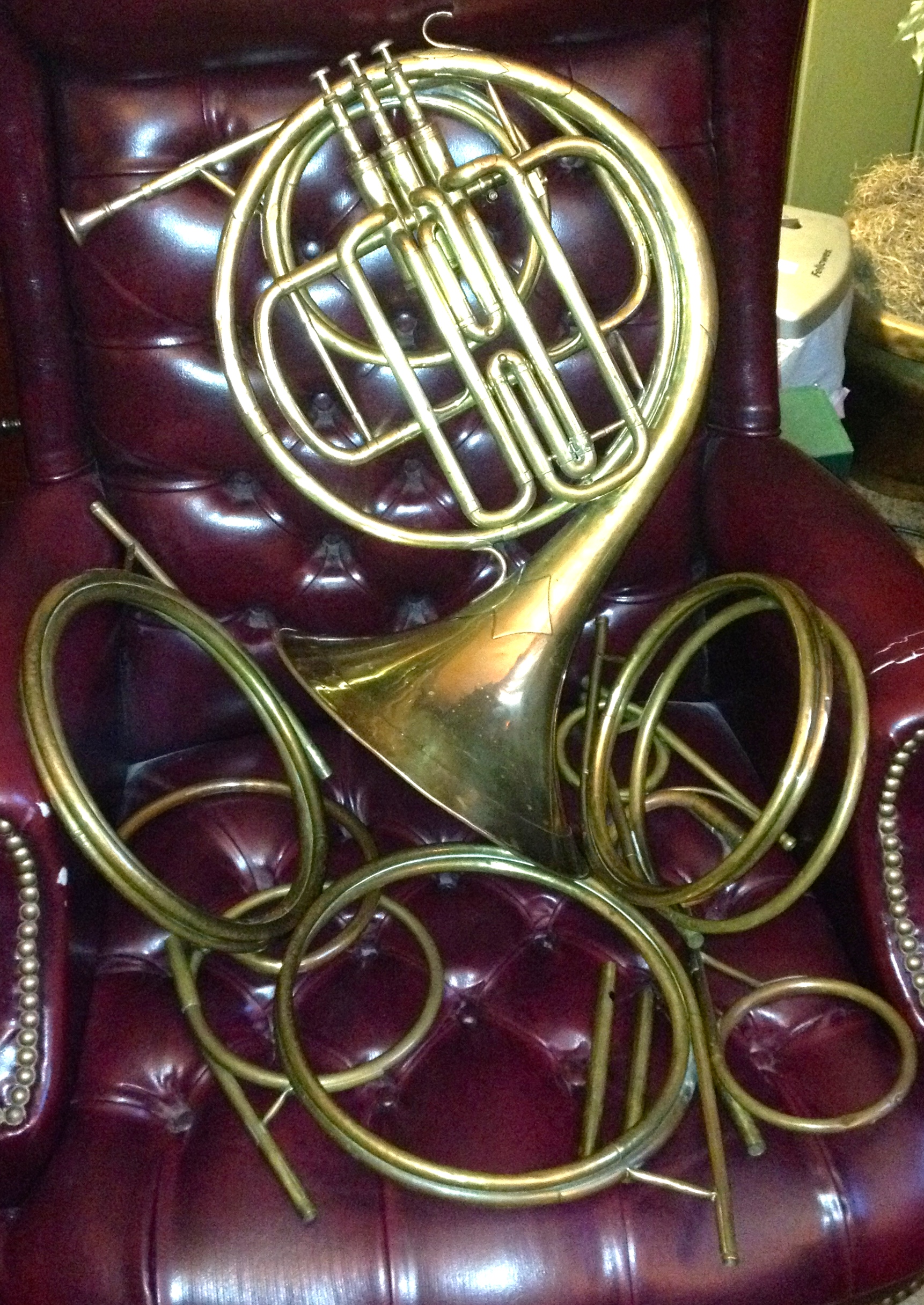
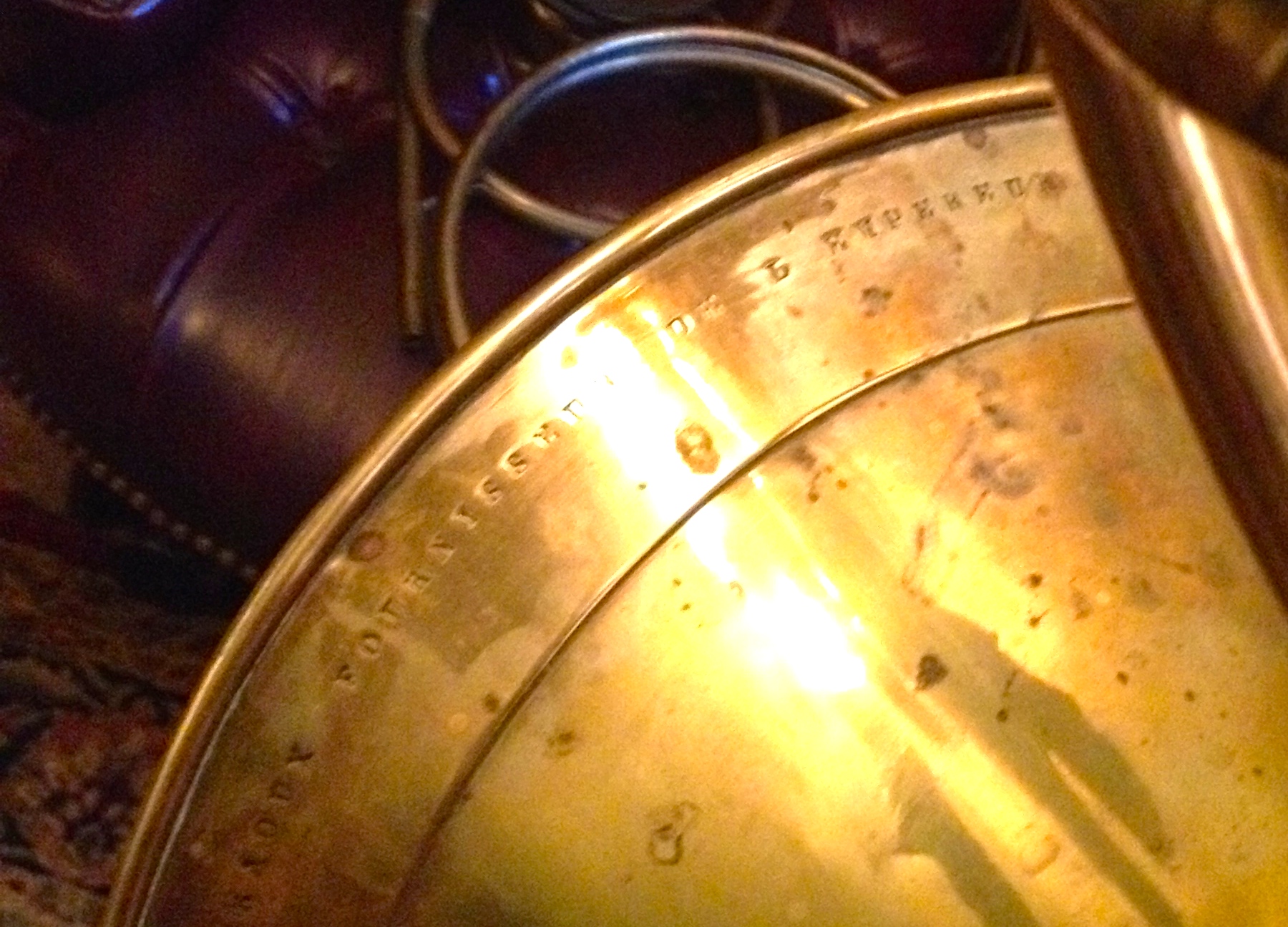
I had the opportunity last week to speak with Craig Pratt, a longtime member of the Shreveport Symphony’s horn section, about his extensive collection of rare and interesting horns. Craig was generous enough to let me photograph some of these instruments, and offered very knowledgable comments about their history and design. His collection is surely one of the most extensive in the state, if not the entire region. You can view the collection by clicking here, complete with photographs, but if you are in a hurry check out the images below for a few of the most interesting horns. If you have any questions about these instruments I would be happy to pass them along. Thanks Craig!

C.F. Schmidt: Double Horn with Horizontal Thumb Valve (1900): This unique horn appears to be a one-off prototype, and to my knowledge (and Craig’s) never went into production.

DSCN1710

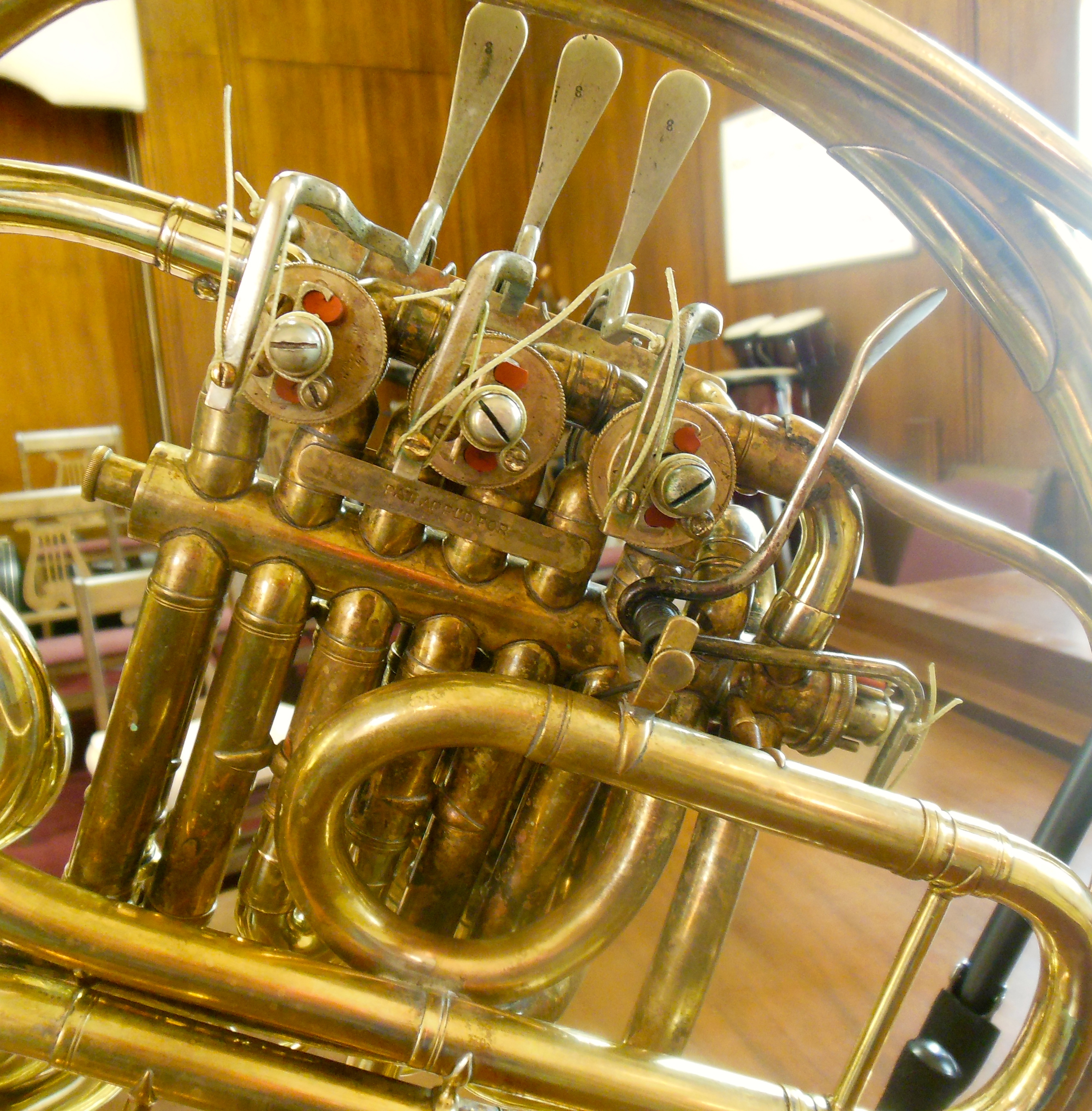
Here’s a closeup of the valve section, seen from the other side of the horn.

DSCN1714

Carl Geyer, Hunting Horn (Rare)

DSCN1752 DSCN1754

Raoux, Cor Orchestra with Sauterelle 

IMG_0447 IMG_0448


The Road to Recovery: An Interview with Bruce Atwell

bruceatwellIn the world of horn playing, Bruce Atwell has done it all. He’s performed in high level professional ensembles – the Philadelphia Orchestra, Hong Kong Philharmonic, and Milwaukee Symphony, to name a few – recorded multiple solo CDs, performed at numerous workshops and conferences, and taught at the college level. He is currently Professor of Horn at the University of Wisconsin-Oshkosh, and maintains a very active performing career. I got to know Bruce while in graduate school at the University of Wisconsin-Madison, and performed with him in the Oshkosh Symphony. His playing was always inspiring, and accompanied by a positive and encouraging attitude. Recently, I found out that Bruce had undergone lip surgery, and was in the process of getting back into shape. Since this was a topic that I felt would be of interest to other horn and brass players, I contacted him and asked if he would be willing to talk about this experience in a brief interview. Bruce generously agreed to share his thoughts, and responded with great candor.

James Boldin: In 2012 you had surgery on your lip. Could you share some background on why you had this procedure?

Bruce Atwell: Starting in 2010 I noticed a callus on the center inside of my upper lip-exactly at the vibrating surface. I tried not playing for several weeks but saw no change in the callus. I spent the next year talking to various doctors, dentists, oral surgeons, and dermatologists about the possible cause and treatment options. Most of the people I saw had no idea what had caused it and did not have recommendations for treatment. I saw a dentist in Chicago (John Kelly) who has experience with brass players. His analysis was that from years of playing, the skin on my upper lip had stretched and was now hanging down and rubbing against the bottom of my front teeth, causing the callus. He suggested using Invisalign to cushion against further damage. I tried this, but had no success in eliminating the callus. During the time my playing was becoming less and less reliable. The vibration would stop without warning and I was losing upper register. After two years of searching I finally decided that surgery was the only option.

JB: How helpful were your care providers (doctors, nurses, etc.) in explaining the procedure, and its possible effects on your horn playing? Did you consult with any other horn teachers/players before deciding to have surgery?

BA: I made a large mistake in this area. My insurance would not cover a surgeon out of network-meaning I only had access to a local oral surgeon who had no experience working with brass players. I was desperate at the time, so decided to trust him. He did warn me that he wasn’t sure what the end result would be in terms of playing. Initially, he said it would be a small incision. However, once he started the surgery, he decide that a longer incision was necessary. I now believe I should have seen Dr. Vander Kolk in Baltimore or at least a plastic surgeon locally to do the procedure.

JB: Do you know of any other horn or brass players who have had the same or a similar surgery?

BA:  I know of several who have had the orbicularis orbis repair done-but I haven’t encountered anyone with this same issue. With the former, the incision is on the skin between the lip and the nose-not directly in the lip.

JB: Was it a fairly simple procedure?  Inpatient or Outpatient? Local or general anesthetic?

BA: My incision was about three inches long right along the wet/dry line. It was outpatient under local anesthesia.

JB: How long did you wait after the surgery before you resumed playing?

BA: I waited about two months before playing anything. It was at least six months before I could really accept professional work.

JB: Did you, or do you, experience any residual pain or numbness after the surgery?

BA: I don’t have any pain or numbness. I do have scar tissue along the incision line that I think is now permanent. This restricts flexibility somewhat and has affected endurance and range. I used to be a high horn specialist (although I played fourth horn professionally for several years) with a range up to about concert C above the staff. Now I only have about a concert G and that is not particularly reliable.

JB: What kinds of materials/exercises did you practice when you resumed playing? Would you recommend these materials/exercises to other players recovering from injuries or medical procedures?

BA: I tried everything I could think of. I started with long tones and soft slurs through the harmonic series. I also contacted Lucinda Lewis and received some advice from her concerning blocked buzzing. I found that useful, but you have to be very careful with that, since in my case it caused me to play with too much tension. I’ve also had lessons with Bill Vermeulen, Gail Williams, Dan Grabois, and Wendell Rider and spoken to numerous other brass players. The best routine I’ve found is Wendell’s harmonic series exercises, following Bill’s and Gail’s advice to use only the minimum amount of embouchure tension to achieve each harmonic. This has resulted in gains in range and endurance-although I’m still far from 100 per cent.

JB: Aside from playing the horn, have you done any other type of physical therapy to aid in your recovery?

BA: I also saw a chiropractor who did Active Release Therapy- a type of massage to break up scar tissue. This was effective for the left side of my lip, but unfortunately was not successful in breaking up the scar tissue in the center. I am also speaking to a plastic surgeon about the possibility of having a lip filler injected in very small amounts to replace some of the tissue that was cut out.

JB: How, if at all, has your physical and/or mental approach to playing the horn changed during your recovery process?

BA: I am forced to focus much more on breathing and relaxation now. I’ve also gone back to the three well-spaced hours of practice I used to do as a student. Mentally, I still have days of extreme frustration, but I try to keep it in perspective.

JB: Did you consult with any other physicians or occupational/physical therapists during your recovery? If so, were they helpful?

BA: I did speak to Dr. Vander Kolk in Baltimore recently. He said he would be happy to see me, but didn’t really know if he could offer any more solutions at this point.

JB: Do you have any advice for other brass players who might be considering lip surgery or going through post-surgery recovery?

BA: I would strongly advise against lip surgery. I think there were other options available to me that I did not consider fully-such as an extended layoff (a year or so)-or trying different methods of playing-minimal pressure, shifting pressure to the lower lip, etc.I was resistant to a long layoff because of the financial implications-but the end result is much worse that if I had simply given up work for a year or more.  The surgery has permanently altered the structure of my lip and I’m still not sure if I will ever completely recover. Even if I am able to regain more playing ability, it will never feel the same-I don’t believe horn playing will ever be effortless for me again.

JB: Any other comments you would like to share?

BA: Don’t make decisions like this when you are in the middle of the problem. Try to get rational advice from friends and colleagues and listen to them. Try an extended period of not playing first. Then come back very slowly and carefully under the guidance of an experienced teacher.

Editor’s Note: For those interested in following his story, Bruce regularly posts updates on his progress to the Horn People group on facebook.
New Resource: Kopprasch Guide, Tips and Suggestions for the Op. 6 Studies

Over the last few days I’ve gone through all of my posts related to the Kopprasch Project, and compiled them into a single document. As I wanted to focus only on tips and suggestions for the etudes themselves, the original posts have been edited for content. A link to a YouTube video of each study is included as well. Teachers and students should feel free to edit and/or amend my comments as necessary. They are only suggestions. Enjoy!

You can download the guide here, Kopprasch Guide: Tips and Suggestions for the Op. 6 Studies, and also on the Resources page.

Friday Review: New E-Books for Horn

As noted earlier this year, I have a backlog of new publications, recordings, and other items that I’m slowly working through in my review series. This week we’ll look at three electronic publications related to teaching the horn, I Like to Practice Scalesby Ricardo Matosinhos, Introducing the Horn, 2nd ed., by John Ericson, and A Mello Catechism2nd ed., also by John Ericson. All three are geared towards younger students and their teachers, but can also be quite useful for other levels as well.

Portuguese hornist Ricardo Matosinhos is extremely active as a performer, educator, composer, and author, and is probably best known for his series of jazz-inspired etudes published through Phoenix Music Editions. In I Like to Practice Scaleshe presents a logical, systematic way for students to progress through all the major and minor scales, with arpeggios. There are many other methods which seek to achieve the same goal, but what sets this one apart is the manner in which those scales are presented. Rather than assigning individual scales in their entirety – which can be quite a lot of material to digest for the younger student – he begins with exercises based on only the first note of each scale, moving through a circle of fourths progression. Two note exercises follow, then three notes, and so on, with each series following the same tonal language. Detailed theoretical discussions are omitted by design – the subtitle of the book is “First comes the practice, then the theory…” – with the emphasis placed on developing fluency first. I really like this approach, as I think it mimics the way we learn our native language(s) as children. Imagine explaining the intricacies of grammar to a child  (or adult) who only spoke a few words of a language – the conversation would break down once the limits of their vocabulary had been reached. Yet how often do we try to explain key signatures, major and minor keys, and other theoretical concepts to beginning musicians, who have the same limited vocabulary? As in spoken languages, theory is of course important, but makes much more sense once the student reaches a certain degree of fluency. The first several exercises make great material for newer students, and the later ones will provide a nice challenge for the advancing player, particularly in the low register. I Like to Practice Scales is available from the International Horn Society’s Online Music Sales page.

First published in 2007, John Ericson‘s Introducing the Horn provides a concise, effective way to give beginning horn players a great start on the instrument. The newly revised edition, available in both hardcopy and E-Book formats, takes into account the increasingly fast pace of college level brass methods courses. The reality today is that there simply will not be enough time to cover all of the potential difficulties and pitfalls of each brass instrument in a one or two semester course, and the best that many instructors can hope to do is provide an overview and a list of resources for future study. There are lots of comprehensive methods covering all of the brass instruments, but it is also recommended that brass methods instructors supplement their main text with handouts and specialist publications like Introducing the Horn. The layout and progression of topics is very practical, and all of the important points are covered. The “Suggestions and Tips for Music Educators” and “Horn Maintenance Tips” included in the appendix are by themselves worth the very reasonable price of the E-Book version. Every band director, veteran or rookie, should own a copy of this book! Download it today from the Horn Notes Edition website.

A Mello Catechism (1st ed. 2007, 2nd ed. 2013) is another book which should be on the shelves of every horn teacher and band director. Though the instrument is often met with resistance and even downright hatred from horn players and their teachers, many high school and even college players spend a significant amount of time performing on it. To my knowledge, Ericson is one of only a few high level horn teachers to devote any time to the instrument, and his book holds an important place in the pedagogical literature. It covers a little bit of everything, from history and nomenclature to tips for band directors and arrangers. On a personal note, I found the book an invaluable resource during my first few years of full time college teaching. Early in the fall semester I spent (and still spend) time working with local band students, who are feverishly preparing their marching shows for the upcoming football season. While I certainly knew about the mellophone, it had been several years since I actually played one myself, and I turned to A Mello Catechism for guidance, advice, and exercises to use when working with the students. I have also taught a number of private lessons on the mellophone, which can be quite a different animal entirely from the horn. Regardless of your personal opinions about the mellophone, if you teach the horn at an level chances are you will encounter it at some point along the way. I think it is much more productive to be prepared and helpful to your students, rather than dismissing the instrument entirely. A Mello Catechism is available from the Horn Notes Edition website.


Upcoming Concert: New Works for Brass Trio

1507878_10152042441082199_1987437686_n

On Sunday, April 13th, Black Bayou Brass will premiere six new works for brass trio. These pieces were submitted in response to a call for scores from the Mid-South Chapter of NACUSA (National Association of Composers/USA). According to its website, NACUSA is “devoted to the promotion and performance of American concert hall music,” and they are certainly fulfilling their mission! Our trio is always interested in new music, and we eagerly awaited the arrival of scores once the call was announced. We quickly received more scores than we could prepare in the brief time we had (the deadline for submissions was March 1), but hopefully we will be able to perform all of the music we received at some point in the future.

As for Sunday’s program, a wide variety of styles and approaches to brass writing are represented. Here’s a list of the titles and composers.

All of the works are very playable, but not without their challenges. Perhaps the most interesting part of the rehearsal process was discovering each composer’s musical voice, both in individual parts and in their writing for the ensemble as a whole. Contrary to what you may have heard about “modern” music, much of the material is tonal (or tonally-inspired), and often very tuneful. Many of the composers also seem to have been influenced by the heroic fanfares and flourishes which distinguish much of the brass literature, but others went in a different direction, exploring some very unique colors and sonorities. The image above is my stand setup (in my teaching studio) for Mel Mobley’s Flotsam, a quasi-antiphonal work which asks the players to rotate during and in between musical statements. The result is very interesting (think Doppler effect). Surprisingly, there is very little muting (or hand stopping for the horn) in any of these works, but that is ok with me because I think those effects can sometimes be overdone.

If this brief post makes you curious about these new works, come out to our concert (5:00 p.m., April 13th, University of Louisiana at Monroe). If live out of the area but are still interested in hearing the premieres, I’ll plan to post some video and or audio samples from the concert – with the composers’ permission, of course!