New Recording: Music for Horn by Gina Gillie

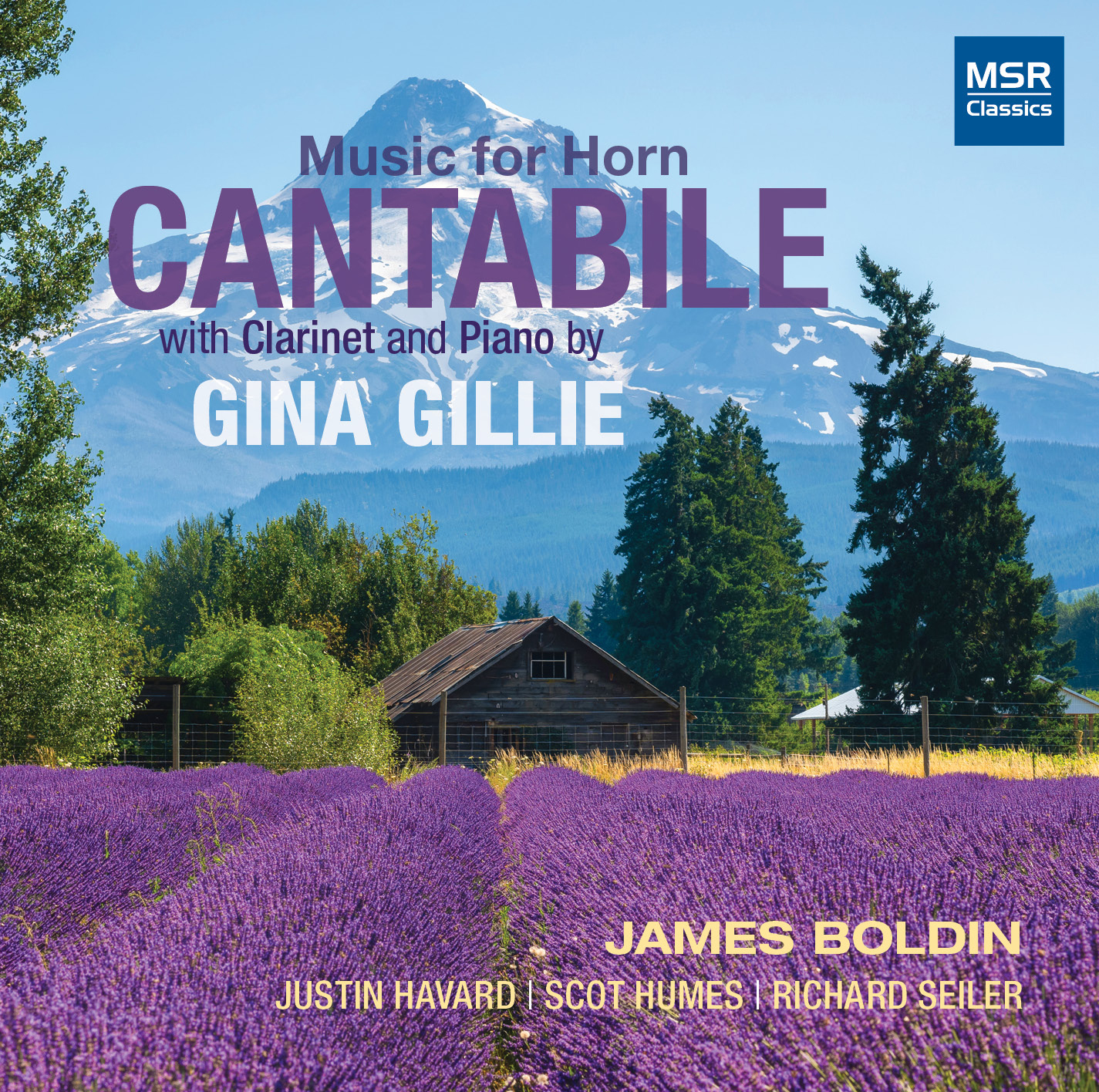
This past summer I had the opportunity to record an album of works by Gina Gillie, a composer and horn player who is becoming increasingly familiar in the horn world! The recording is titled Cantabile: Music for Horn with Clarinet and Piano by Gina Gillie, and it is available through MSR Classics at their website, on Amazon, and other outlets. Here’s a short quote from the liner notes:

I met Gina Gillie in 2004 while we were graduate students at the University of Wisconsin-Madison. Even then, it was clear that Gina was an exceptional musician with a creative gift. In the years since, she has turned what was then a burgeoning interest in composition into a growing library of works, many of which are recorded here for the first time. As both a horn player and vocalist, Gina has always been able to tap into the special singing quality of the instrument. It is fitting that the title of this album is Cantabile, as no matter the style or instrumentation, Gina’s compositions always sing. My deepest gratitude goes to my collaborators for their inspiring work, and to Gina’s and my former teacher, Douglas Hill, for encouraging our musical dreams. Thank you also to the ULM School of Visual and Performing Arts and the family of Emy-Lou Biedenharn for their support of this project.

That pretty much sums up the project, but for anyone interested here is a complete list of the pieces we recorded.

SONATA for Horn and Piano
I. Allegro moderato
II. Melodie
III. Rondo

ESCAPADE for Horn and Piano

SONG FOR THE LOST for Horn and Piano

REVERIE for Horn and Piano

ROMANCE for Wagner Tuba and Piano

THREE PAINTINGS for Clarinet, Horn and Piano
I. Highland Castle
II. Lavender Fields
III. Conneaut Rag

All but one of them – the Sonata, which was commissioned and recorded by Steven Cohen for his fantastic album Cruise Control – are world premiere recordings, and I think listeners will really enjoy them! I and two of my colleagues, Scot Humes and Richard Seiler, commissioned the final work on the album, Three Paintings. It’s a fun piece and a wonderful addition to the clarinet, horn, and piano repertoire. I also want to recognize Paul Eachus, who recorded, edited, and mastered this album. He is a fantastic musician and engineer. We were also lucky to have Gina Gillie here for the recording sessions to offer her expert advice and amazing ears. Thanks Gina! And finally, several of the works on this album – Reverie, Escapade, and the Sonata – are available through WaveFront Music, and the rest are available directly from the composer. If you like them, and I think you will, buy the music and program them yourself on an upcoming recital.
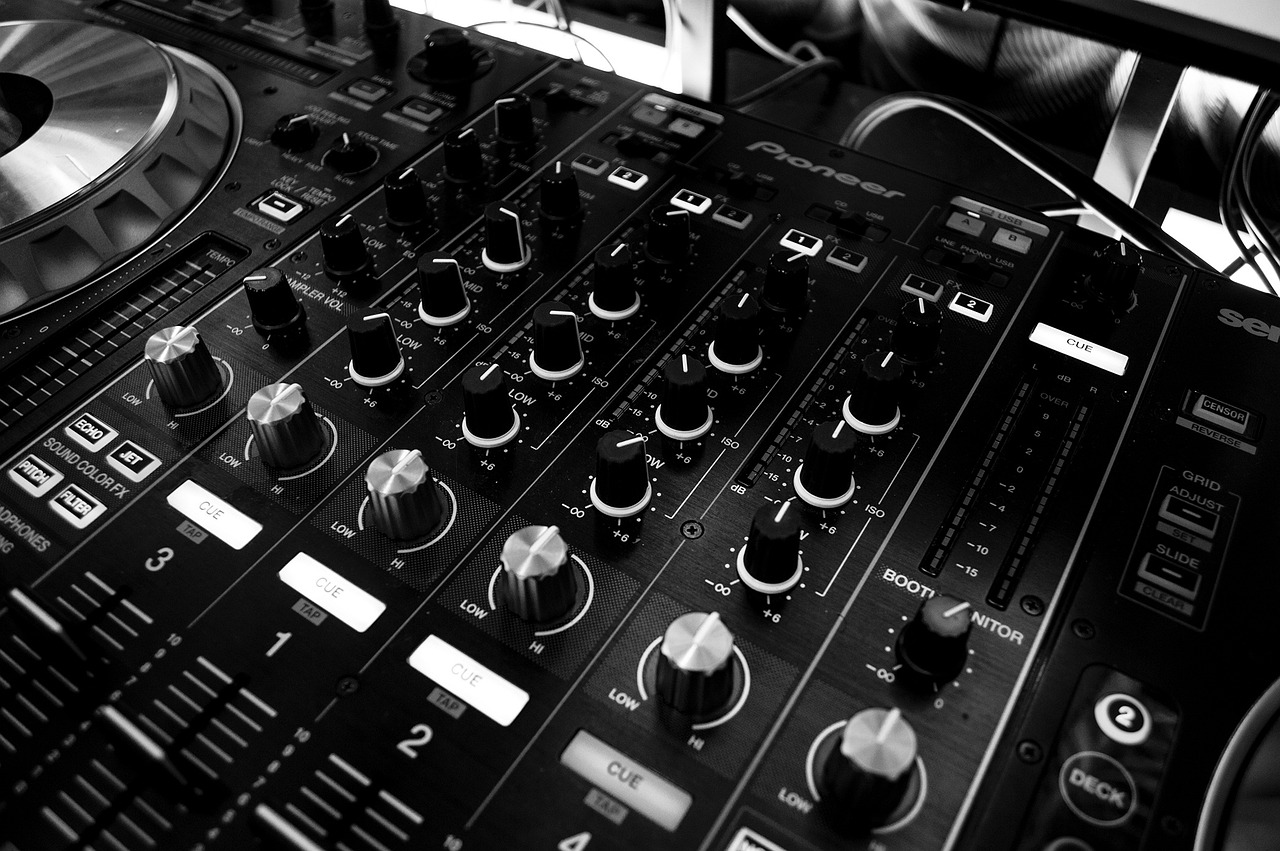
Resources for Performing Music for Brass and Electronics

Image obtained from Pixabay.

Recently, I had the opportunity to speak with the students at Berry College in Rome, Georgia about performing music for brass and electronics. The presentation was part of a recital tour to Georgia, including visits to Dalton State College and Berry College. Unfortunately, the tour had to be cut short because of the arrival of hurricane Helene, which has impacted millions of people across the Southeast. I’m so grateful to my host, Dr. Ellie Jenkins, for the opportunity to visit. The material from the class handout can be found below, and a printable copy can be viewed and downloaded here.

Finding and Choosing Repertoire

  • Theses, Dissertations, Journal articles relevant to your area
  • Attend conferences, new music festivals, etc.
  • Internet, YouTube, Naxos Music Library, Social Media
  • Commissioning, consortia, etc.
  • Considerations:
    • Is the media fixed, or does it respond in live performance? Ex. Delay, distortion, loops, etc. 
    • If the work or works require additional equipment to perform,  how easy is it to obtain, given one’s budget, access, and other factors?

Equipment

  • Can vary depending on the performance venue. Use in house equipment, or bring your own? Advantages and disadvantages to both. 
  • Minimum equipment if you wish to use your own:
    • Portable speaker, bluetooth or wired, choose based on your needs and budget. Brands I have used and can recommend: Rockville, JBL, Bose, Ultimate Ears
    • Laptop, phone, or tablet
  • Optional Equipment, depending on repertoire:
    • Audio interface 
    • Silent Brass, for routing audio signal through effects pedals
    • Condenser and/or dynamic microphones, as needed
    • Individual effect pedals: delay, distortion, etc.
    • Effects software for live performing: I use Apple’s Mainstage
    • Video projector
    • Preamps, mixers to adjust balance of multiple inputs
    • Headphones, onstage monitor, if necessary to align with fixed media
    • Cables, power cords, extension cords, surge protectors, batteries for all of the above.

Preparation

  • Practice the work without the electronics, fixed or otherwise, until comfortable. This will avoid compounding the musical challenges of your part with navigating the technology. If fixed media, aim for the tempo markings in the piece. Tempo can be adjusted to some extent on fixed media tracks using software, but it can distort the audio (unless it’s MIDI, in which case you can change the tempo, key, etc. as much as you want).
  • When putting your part together with fixed media, make note of time codes for major sections and subsections so you can practice just those passages without having to start the track at the beginning every time. 

Performance Considerations

  • Balance between electronics and live (or amplified) sound. Consider speaker placement, if using portable speakers. Performer can move up or down stage as well if necessary for different works.
  • Distortion can occur at high playback levels, so soundcheck these using the performance equipment, if possible. 
  • As with all live performance, the acoustics and overall feel will be different onstage versus your practice room. 
  • If using multiple pieces of equipment, a piano bench or small table is helpful in making sure everything is laid out and accessible in an orderly way. Watch out for your cords!
  • Mute stands, shelves, etc. that attach to your stand can be helpful.
  • Consider the layout and setup of your program, and what’s necessary to transition from one work to the next. Percussionists think about this all the time, but brass players not so much.
  • Turn all levels to zero and turn off all components every time.  Plug in components first, then power on, then adjust levels. Avoid hot plugging. 
  • Relax and have fun sharing this repertoire!

Recording Review: Hornscapes, Ricardo Matosinhos

The horn community is full of creative and productive individuals, and it can be difficult to keep track of all the wonderful books, articles, recordings, compositions, and other contributions out there. Recently, Dr. Ricardo Matosinhos sent me an advance copy of his new recording, Hornscapes, for review. The album was recorded in Mindezell, Germany as part of the “Ring of Engelbert Schmid Horn Soloists” series. Ricardo is active as a performer, composer, teacher, and author (of horn-related articles and children’s books), and is well-known for his solo horn works and his series of jazz-inspired and other etude books published by Phoenix Music Publications.

His playing – and that of his collaborator Isolda Crespi – is agile and expressive, combining technical brilliance with satisfying phrasing. These works are fresh and fun, showing off the best of what the horn (and Wagner tuba on two of the compositions) can do.

The complete program notes and a nice promotional video are available online: https://ricardomatosinhos.com/index.php/en/blog/781-hornscapes-en. The subtitle of this recording is “Music for Horn Composed by Horn Players,” and 6 of the 10 works on this album were composed by Matosinhos. Ricardo is an incredibly creative musician, both as a performer and composer. His compositions span everything from Neo-romantic to Jazz and modern extended techniques. Works by Fernando Morais, Emma Gregan, Kerry Turner , and Jeffrey Agrell fill out the rest of the recording.

The Morais is a fantastic opener for an album, lively and attention-grabbing. Australian horn player Emma Gregan’s works are always enjoyable, and her Rose-Coloured Glasses for horn and piano is no exception. Kerry Turner’s Abide with Me is a substantial ten-minute tour de force of modern horn-playing techniques, commissioned by Matosinhos for his doctoral research.

The next several works are by Matosinhos, who carries on a long tradition of horn-player composers. These works are as varied as they are fun and interesting, and any one (or more) of them would make exciting additions to a recital program. It’s worth noting that several of Ricardo’s compositions, including his etudes, make use of multiphonics, which he has honed to an incredibly high level. Having heard Ricardo perform live, I can say that yes, his multiphonics sound just as good in person as they do on the recording!

In this, and everything else on this album, Ricardo sets a very high standard to which we can all aspire. Also worthy of mention are the two works for Wagner tuba, which are welcome additions to a growing repertory of solo music for the instrument. If you’re accustomed to hearing the Wagner Tuba in an orchestral or operatic context, you are in for a suprise! Matosinhos’s Wagner tuba playing is exciting, at times bombastic and at others lyrical and delicate.

Jeffrey Agrell’s Gallimaufry Suite finishes out this fine recording. This virtuosic multi-movement work makes extensive use of the low register, and is quirky and fun to listen to. Bravo to Ricardo Matosinhos, and everyone else involved, on this new recording!

Equipment Update: Fall 2023

You may have noticed in these recent Middle and High School All-State videos that I’m no longer playing my trusty Yamaha 671 or a Yamaha 668II. Last spring I had the opportunity to order a Yamaha 871 directly from their factory. This is their “custom” Geyer model, and while it does share a lot of similarities with the 671, it is a different horn in some respects and well worth trying. Initially I spent about 2 or 3 months switching back and forth between the 871 and 671, but at this point I’m doing the majority of my playing on the 871. If you’re interested, here are some of my perceptions of the similarities and differences between the two horns.

Both of the horns I have are unlacquered, and the feel and weight are similar. The 871 might be a little bit lighter in the hands, but not by much as far as I can tell. The bore of the 871 is bigger at 12.1mm (0.476″) compared to 12.0mm (0.472″) on the 671. Honestly, I’m not sure how much difference this makes in how the horns play as there are probably other variables to take into account. Both have even sounds across the range. To me, the 871 is a little bit more resonant and vibrates easier than the 671. Perhaps the “custom” line horns are built to closer tolerances, but that’s only speculation. The sound is pretty similar, though the 871 has a few more low overtones in the sound (less “bright” and more “dark” than the 671, to use subjective terms). Again, there are probably other variables at work here, but as this is an opinion piece feel free to take them with a grain of salt! Comparing them back to back, which I’ve done on several occasions, the 871 takes a little more air (because of the larger bore, I assume), but vibrates more easily and rewards a competent player. When people ask me which horn I recommend, I usually encourage them to try both and see which one they like best. If you’re a high school or undergraduate student, the 671 is a great choice, but if you have the extra funds and want to check out the custom 871 it may very well be worth it! Feel free to listen to these two recordings; the first on the 671 and the second on the 871 and see if your opinions match mine.

I’ve also made a few other equipment changes this year: I switched mouthpiece rims from a Houser “E” rim 17.5mm in H-Kote to a Houghton H3 in H-Kote, with a 17.75mm inner diameter. A difference of .25mm might not seem like much, but having a little extra room in the mouthpiece, combined with a slightly different rim contour, has made some positive differences in my playing. With the old rim I felt like my endurance was hitting a wall, despite consistent practicing and being in overall good playing shape. I noticed an improvement almost right away, which is usually a good sign for me when it comes to equipment changes. I’ve been on the H3 rim since September, and I don’t see myself going back to a smaller rim anytime soon.

And finally, a more recent change involves the mouthpiece itself. My go-to mouthpiece for the past several years has been the Houser San Francisco cup. I’ve played both the silver plated and stainless steel varieties of this model, and they are excellent, professional quality mouthpieces that I continue to recommend. After my recital tour back in October I decided to experiment with some different mouthpiece cups, not for any particular reasons, but simply because I find that the down time after big recitals and/or other performances is a good time to try different equipment. Alpine Mouthpieces was a newer brand that I had an interest in trying. These mouthpiece designs are the result of a collaboration between Jacob Medlin and Keith Durand. They have several different cup sizes and designs, and they are all extremely well made. My favorite so far is the “Rigi” cup. In some ways it’s similar to the Houser, but for me it’s even easier to play with a great sound on the Yamaha 871. If you have the opportunity to try an Alpine Mouthpiece, give it a shot, they are great!

New Videos: LMEA Middle and High School All-State Etudes for Horn (Set 1)

Now that the busyness of the semester has started to settle down, I’ve had a chance to work on a few other projects. One of them is new recordings of the upcoming 2024-2025 All-State etudes for both middle and high school horn players in Louisiana. While there have long been high school All-State bands (and orchestras) in Louisiana, next year will be the first time a Middle School All-State Band will be offered to my knowledge.

The high school audition etudes are on a four year rotation, with two etudes (lyrical and technical) in each of the four sets. When I moved to Louisiana in 2006, these etudes had been in use for some time, but they were updated a few years ago. Each set of high school audition etudes includes one selection from Kopprasch, Op. 6 Book 1, and one selection from John Shoemaker’s Legato Etudes for Horn. Since the switch to these new etudes, I’ve been slowly making new recording and tutorial videos for them, this one being the last of the four sets. Although it’s titled “Set 1” it’s the last of the videos I’ve made of the high school repertoire. I hope students and teachers find it helpful!

As for the Middle School Etudes, they are on a 2-year rotation, with both etudes in each set taken from Volume 1 of the Rubank Advanced Method. I’ve used this book a few times over the years, but was not very familiar with it. There’s some interesting information in Volume 1, though it seems to me a little beyond the average middle school horn player. Perhaps it was chosen to provide a challenge for advanced middle school players. One of the required etudes in this set is actually a duet, with students being asked to prepare the top line only for the auditions. I recorded both lines for this video, so that students can play the top line along with it. Good luck and happy practicing!

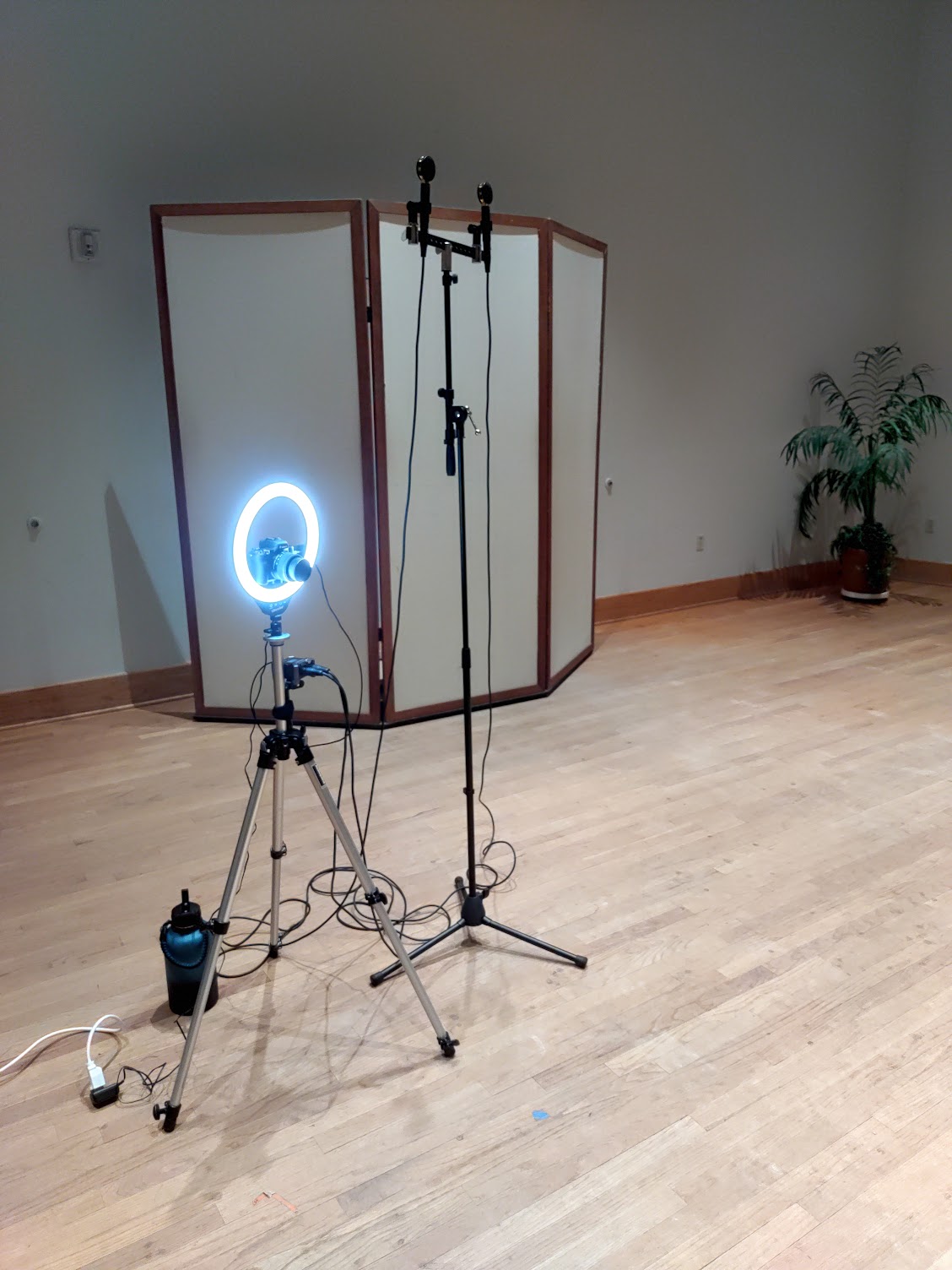
For those who are interested, I have been tweaking my recording setup for videos over the last few years. I’m not an expert in videography, but this equipment seems to work pretty well and delivers a decent product.

  • Camera: Canon EOS M50 Mark II mirrorless camera with the kit lens that comes with the camera
  • Audio Recorder: Zoom F3 Field Recorder with audio cable out to the camera (The audio is recorded simultaneously to the F3 recorder and is also output to the camera’s microphone jack.)
  • Microphones: 2 Audix SCX25A-PS Large-diaphragm Condensers. The school happens to have a pair of these very nice microphones, and they work great!)
  • Video Editing Software: Adobe Premiere Pro
  • Audio Editing Software: Logic Pro

Here’s a picture of this gear set up in our recital hall at school.

Fall 2023 Recital Tour Videos

This fall I was fortunate to be able to go on a brief recital tour, performing the same program three times in one week at the University of Louisiana Monroe, Arkansas State University, and the University of Central Arkansas. Videos from the final performance at UCA can be found at the end of this post. THANK YOU to my collaborator, Justin Havard, as well as our hosts Juli Buxbaum and the Arkansas State University Horn Studio and Brent Shires and the University of Central Arkansas Horn Studio. It’s been a while since I did a strictly horn and piano recital, and this program was tremendously fun to put together and perform. I’m pretty happy with these videos, although I set the camera up a little too close, resulting in a more direct sound than the hall actually had. It was a lovely, resonant space. Here’s the list of works, along with the videos and some program notes sourced largely from the composers’ websites and publishers of their music.

Lauren Bernofsky (b. 1967), Two Latin Dances

Lauren Bernofsky’s catalog includes solo, chamber and choral music as well as larger-scale works for orchestra, film, musical, opera, and ballet. Her music has been performed across the United States, Europe, and Asia, as well as in Australia, New Zealand, Greece, Iceland, Norway, Brunei, Kenya, and South Africa. She holds degrees from the Hartt School, New England Conservatory, and Boston University. Her philosophy of composition is simple: music should be a joy both to play and to hear. Bernofsky’s works have been commissioned by the Harford Ballet, the Bloomington Symphony Orchestra, the Delmar Trio, Jeffrey Curnow (Philadelphia Orchestra), and many others. Her works are published by Boosey & Hawkes, The FJH Music Company, Balquhidder Music, Fatrock Ink, Hal Leonard, Grand Mesa Music, Alfred Publishing, Wingert-Jones, Carl Fischer, and Theodore Presser, and can be heard on the Polarfonia, Albany, Music to My Ears, Blue Griffin, MSR Classics, and Emeritus labels. – Information from laurenbernofsky.com. Commissioned by trombonist Natalie Mannix, Two Latin Dances is a beautifully evocative and sizzling work based on Bossa Nova and Tango rhythms. While at first sounding as two distinct movements, the characteristic dances gradually intertwine to create a uniquely integrated and ever-building whole. This arrangement for horn and piano by the composer.

Edith Borroff (1925-2019) , Sonata for Horn and Piano

Edith Borroff received her education at Oberlin Conservatory, the American Conservatory of Music, and the University of Michigan. She became the contemporary music critic for the Ann Arbor News in 1966. She authored the book Three American Composers (Pub. Univ Press of America, 1986) which traces the power shift from the apprentice/conservatory system of training composers to the university system, which took place in the United States from 1925 to 1975. In addition to her renown as a composer, Dr. Borroff taught at several colleges and universities, including SUNY-Binghamton, where she spent the bulk of her career. Her areas of research centered on 17th-century French chamber music, American and contemporary music, music education, and pre-history. Borroff  authored numerous books including the first history of music to include African-American composers. Edith Borroff’s papers are housed in the Newberry Library in Chicago, and include her writings, musical compositions, correspondence, research materials, and lectures as musicologist and composer. – Information from composers.com/composers/edith-borroff The Sonata for Horn and Piano is idiomatic for both instruments, and the four movements (Rhapsody, Scherzo, Sarabande, and Estampie) move backwards in time, representing musical periods from the Medieval to Romantic eras. The composer describes the movements as differing in mood as well as form and the writing is tonal and melodic. The lush first movement is contrasted with the light, jocular second. The stately Sarabande is followed by the 14th-century round dance, Estampie. Borroff’s Sonata was premiered by Nancy Becknell, horn with Borroff, piano at Northwestern University in 1955. Cynthia Carr, horn recorded the work with Julie Nishimura, piano on Images: Music for Horn and Piano by Women Composers (self-produced). – Notes by Lin Foulk Baird,linfoulk.org

Shanyse Strickland (b. 1991), When I’m Older

Shanyse Strickland is a multi-instrumentalist, vocalist, composer, and arranger. While French horn is her primary instrument, Strickland plays a variety of brass and woodwind instruments. Originally from Akron, OH, her musical journey began on wind instruments as a flutist, then she switched to French horn and eventually a host of other brass instruments including trumpet and trombone. While pursuing her undergrad at Youngstown State University, she played trombone and flute for the reuniting Ohio Players under the direction of the band’s piano player and songwriter Billy Beck. In Pittsburgh, she was the flute feature for a local group called the Level Up Band and performed in a variety of genres including neo soul, jazz, and R&B from the past and present. Strickland was the winner of the 2016 Jazz Solo Competition at the International Horn Symposium where she performed in front of jazz composer and hornist David Amram and a host of other jazz hornists. Her commissioned piece Afrofuturism premiered at the 2023 Music by Women Festival and also won an Urgent Art Fund grant through SPACES. Strickland has been commissioned by the Seattle Symphony horn section, The University of Texas brass faculty, DC Strings, and many musicians around the country. When I’m Older – part of the recently published collection Lift: Solos for Horn by Black Composers – is a composition for the aspiring horn player to explore new horizons of performance as they dream about what it will be like to achieve their goals in the music world. Exploring all the elements that make us fall in love with the horn, this piece makes room for the performer to demonstrate flexibility in articulation, sing wonderful melodic lines, and find the ebb and flow of natural rhythmic drive. There are three sections: the vision, wishful destiny, and the dream. – Notes by the composer.

Anthony Plog (b. 1947) Horn Sonata

Anthony Plog has had a rich and varied international career in music – as a composer of operas, symphonic music, and chamber works; as an orchestral musician, soloist, and recording artist – and as a brass teacher and coach at some of the great music conservatories internationally and now online to students around the world. His music has been performed in over 30 countries, and he has been the recipient of numerous grants and commissions. After beginning his career writing extensively for brass, he now works in many different musical forms. He has composed three children’s operas, the first of which (How the Trumpet Got Its Toot) was premiered by the Utah Opera and Symphony. He completed a major tragic opera (Spirits) based on a Holocaust theme and recently finished a new opera about a drone operator suffering a nervous breakdown (The Sacrifice). Other new works include an oratorio about the first major environmental battle in the United States (God’s First Temples), in versions for orchestra, symphonic band, and soprano song cycle; and a cantata using the stories of women who have recovered from sex trafficking, prostitution, and drug abuse (Magdalene). Plog lives and works in Freiburg, Germany. – Information from anthonyplog.com/about/biography Plog’s Horn Sonata was commissioned through a consortium led by Matthew C. Haislip of Mississippi State University. The sonata is written in two parts, each comprising two movements attacca. The composer skillfully varies passages that highlight the sonority and singing character of the horn with more virtuosic and agitated passages. He maintains a dramatic dynamism throughout the entire work, thanks in part to a piano part that not only punctuates and accompanies, but also plays its own full role. 
– Information from editions-bim.com

Brief Reviews: Legacy Horn Experience

It’s been a while since I posted anything here, but I recently received three excellent publications for review from Legacy Horn Experience, https://www.legacyhornexperience.com/. LHE was created by Steve Lewis, who, as he mentions on the About page, is not “the” Steve Lewis of S.W. Lewis Horns. Rather, this company sells a variety of horn-related items including music and mouthpieces:

We are proud to offer new editions by Martin Hackleman and David Jolley. Other publications offered include those by Vitaly Buyanovsky, Daniel Bourgue, Eli Epstein, Frøydis Ree Wekre, Andrew Lewinter, and John Barrows.  Additionally we publish Wendell Hoss’s 9 Studies which have been out-of-print for decades.

We are also pleased to offer the most commonly used of the Moosewood and L’Olifant mouthpiece cups and rims.

https://www.legacyhornexperience.com/about

Additionally, they plan to offer a “Legacy” line of mouthpieces, including “recreations of Reynolds and King mouthpieces with the benefit of CNC technology.”

This post will briefly review three new LHE publications:

  • Vitaly Bujanovsky –  Sonata for Solo Horn No. 1, edited by Martin Hackleman
  • Frédéric Chopin – 6 Studies for solo horn, adapted by Steve Lewis and edited by Martin Hackleman
  • Richard Strauss – Till Eulenspiegels lustige Streiche, Op. 28, Arranged for trumpet, horn, and trombone by David Jolley

As a composer, Vitaly Bujanovsky (1928-1993) is most well-known for his Four Improvisations (from traveling impressions) for Solo Horn, but he has some other substantial works with horn as well. This edition of his Sonata No. 1 includes “descriptive text and instructions” by Martin Hackleman, which could be very useful to both performers and teachers looking to craft a convincing interpretation of this unaccompanied work. For example, the first movement, Moderato espressivo, includes the editorial phrase “The curtain opens as our hero strolls peacefully through the forest.” The other three movements contain helpful phrases along the same lines. The engraving is clear and easy to read, and the piece is available for download directly from the LHE website. There are a few discrepancies between this version and a recording I found on YouTube by Dmytro Taran.

These discrepancies are presumably the result of this new edition, but I am not entirely sure. Also included is a brief article by Hackleman, “Playing Together But Not at the Same Time,” in which he describes a creative way for two players (teacher and student, perhaps) to work on phrasing and musical effect in a single solo piece. The article is followed by an annotated version of Buyanovsky’s Sonata designed to be practiced collaboratively in this manner. The price ($10 as of this writing) makes this publication an excellent value and well worth adding to your library.

Frédéric Chopin is renowned as a composer of works with piano, and his gift for idiomatic melodies on that instrument is enough to make even a horn player jealous! If you’ve ever wanted to play some of Chopin’s most well-known melodies on the horn, while also working on flexibility, endurance, phrasing, and other fundamentals, this collection of 6 Studies for solo horn is for you. It includes horn-only versions of the following:

  • Mazurka in F Minor, Op. 7, No. 3
  • Prelude Op. 28, No. 6
  • Prelude Op. 28, No. 15 (The “Raindrop” prelude)
  • Polonaise in B-flat Major
  • from Fantasie-Impromptu No. 4, Op. 66
  • “Largo” from Cello Sonata, Op. 65

These adaptations work quite well on the horn, while retaining the essential character of the original compositions. The range and rhythmic requirements are well within the abilities of an intermediate to advanced player, but achieving the appropriate style and overall effect could prove challenging. My favorite so far is the “Largo” from the Cello Sonata, and I’m looking forward to spending more time with these pieces.

Last in this collection of reviews is a brass trio version of Strauss’s famous tone poem, Till Eulenspiegel. David Jolley’s arrangement is in the original key and requires virtuosic technique from all three players. This arrangement is as close to the original as you can get with only three voices, but it is relentless! Most of the major horn excerpts are included, but there’s so much more: violin parts, clarinet parts, etc. Jolley does a great job of spreading these additional passages around the ensemble, but as there are only three voices everyone is playing most of the time during this nearly 10-minute tour de force. Jolley’s recording with the New York Brass Arts Trio proves that it is playable, and musically at that!

Having played in a brass trio for several years, I know how difficult it can be artistically and technically. With this arrangement and others, David Jolley continues to push the boundaries of what is possible on the horn and for the brass trio. Despite the difficulty, it’s a fantastic arrangement with lots of potential for live performances. Portions of the entire work could be excerpted and included on a lecture recital, for instance. At $15 for the score and parts, it’s a great value.

Recital Videos: Lyrical Works for Clarinet, Horn, and Piano

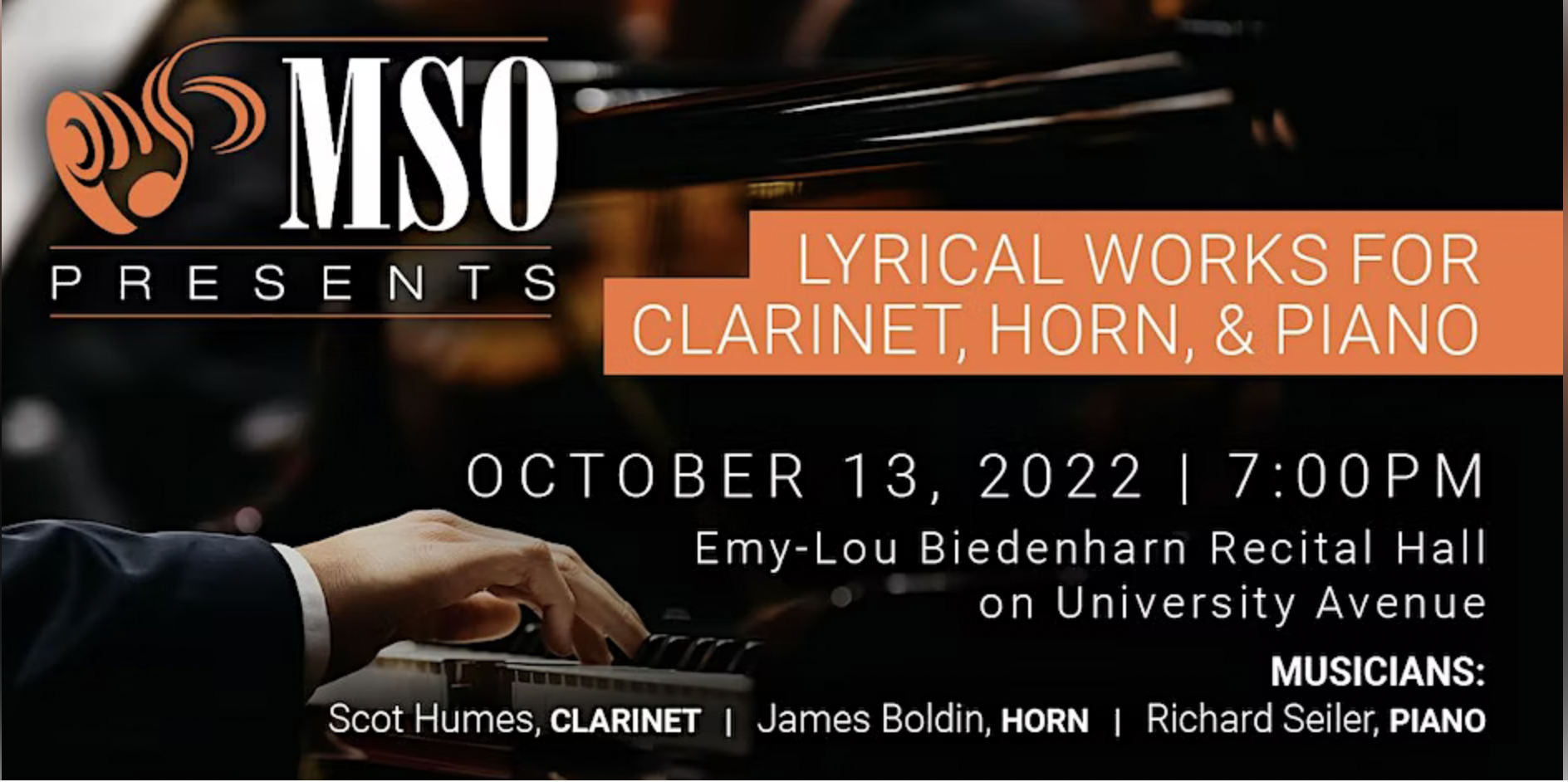
Here are some videos from a recital a few months ago, “Lyrical Works for Clarinet, Horn, and Piano” on October 13 on the ULM campus. Presented as part of our local orchestra’s chamber music series, this was a fun concert to program and put together with my colleagues Scot Humes on clarinet and Richard Seiler on piano.

Carl Reinecke, Trio in B flat-major Op. 274 for Clarinet, Horn, and Piano
Gina Gillie, Three Paintings for Clarinet, Horn, and Piano *World Premiere
George Rochberg, Trio for B-flat Clarinet, F Horn, and Piano

The only work I’d performed before was the Rochberg, way back in 2006 on a doctoral recital at the University of Wisconsin-Madison. Of particular interest is the world premiere of Gina Gillie’s trio, a work we commissioned. If you don’t know any of Gina’s music I highly recommend you check it out! Program notes for these works are included after each video. I hope you enjoy listening, and best wishes for peaceful conclusion to 2022 and a prosperous beginning to 2023!

Trio in B flat-major Op. 274 for Clarinet, Horn, and Piano, Carl Reinecke (1824-1910)
 
German composer, pianist, conductor, and music teacher Carl Reinecke directed the Leipzig Gewandhaus Orchestra, taught at the Leipzig Conservatory, and composed prolifically in a variety of genres. Edvard Grieg, Leoš Janáček, Isaac Albéniz, and Max Bruch were among his many successful students. Reinecke began his musical training on the violin, but soon turned his attention to the piano, and embarked on numerous concert tours across Europe. He held positions in Cologne and Copenhagen before settling in Leipzig in 1860 for the remainder of his career. Regarded as an extremely versatile and influential musician, Reinecke composed numerous operas, symphonies, concertos, and chamber works, including the charming Trio, Op. 274, which dates from around 1905. Having retired from his teaching position at the Leipzig Conservatory in 1902, Reinecke devoted his final years to composition. This four-movement work draws upon Reinecke’s lifetime of musical experiences, and is reminiscent of Mendelssohn, Brahms, and Schumann, all of whom he knew personally.

Three Paintings for Clarinet, Horn, and Piano, Gina Gillie (b. 1981) Commissioned in 2021 by James Boldin, Scot Humes, and Richard Seiler

This three-movement work is a programmatic piece that, while it is not based on any specific paintings, is meant to evoke images of what could be a classic painting in the mind of the listener. Each movement is set in a particularly distinct regional setting, the locations of which were chosen for stylistic contrast. The first movement, “Highland Castle,” sets the scene of an old Scottish castle standing stoically amongst a grey landscape. The castle is no longer occupied, but observers can imagine the revelry and energetic Celtic music that might have once animated the scene. The horn begins by playing into a piano with a depressed damper pedal, thus causing sympathetic vibrations to sound like an echo that can be heard across the landscape. The melody is set in the Dorian mode, a common tonality for Celtic folk tunes. While the melody is original, it is meant to sound like it could be an old tune from centuries ago. Recollections of festivities past are conjured as the tempo picks up into a dance with a lopsided meter (6+4/8).“Lavender Fields” evokes images of pastoral fields in France where the purple flowers stretch down puffy rows and the pace of life feels slower. Set in the style of French impressionist music, and specifically influenced by Fernande Decruck, this movement encourages the listener to bask in the wash of lovely sound and lush harmonies.“Conneaut Rag” is influenced by a very American style of music from the early 1900s –Ragtime. The movement was written while the composer was visiting her in-laws in Conneaut, Ohio. The feeling of Mid-western Americana inspired the style of this movement. Again, the melody is original, but it draws on the rich history of the tradition of ragtime in order to give the listener a sense that it could possibly be from a bygone era.

Trio for B-flat Clarinet, F Horn, and Piano George Rochberg (1918-2005)

After serving as Director of Publications for the Theodore Presser Company, American-born composer George Rochberg taught at the Curtis Institute and the University of Pennsylvania. He also held appointments as a guest composer at numerous universities and contemporary music festivals throughout the United States. His works for stage, orchestra, chamber ensemble, voice, and solo instruments earned him two Guggenheim fellowships, two grants from the National Endowment for the Arts, and several commissions from major American symphony orchestras, including the Pittsburgh Symphony and the New York Philharmonic. A well-known author on contemporary music, Rochberg’s writings were published in 1984 as The Aesthetics of Survival: A Composer’s View of Twentieth-Century Music. Initially a serialist composer, Rochberg rejected serialism in favor of a combination of chromatic and tonal elements after the death of his son. His Trio, originally published in 1948 and revised in 1980, is largely tonal and makes use of traditional sonata form elements in the first and third movements. The first movement begins with an extended horn cadenza, and presents all of the thematic material for the movement. A lively allegro follows this opening, with cadenzas for both piano and clarinet coming at various points in the movement. A slower second movement explores the color potentials of the horn, clarinet, and piano combination, gradually growing in intensity and tempo. Short cadenzas again feature each of the instruments, and the movement closes in much the same way as it began. The finale opens with alternating adagio and allegro sections, but eventually settles into a jaunty triple meter dance. As in the first movement, Rochberg demonstrates his skill at manipulating motivic material, treating motives in inversion and fugally. After reaching an almost unbearable level of tension, the Trio drives to its conclusion in a suddenly faster coda.

Behind the Scenes at The Horn Call: Frequently Asked Questions

This blog isn’t dead, just taking an extended hiatus! Since taking over as Publications Editor for the International Horn Society in the summer of 2020, my contributions on this site have been reduced considerably. However, the following material, given as a joint presentation with Marilyn Bone Kloss at the 54th International Horn Symposium, seemed like it might be of interest to readers of this blog, if there are any left! The impetus for this presentation came from learning just how much “behind the scenes” work takes place to produce a journal like The Horn Call. Though I had been a frequent contributor for several years, I had no idea how many moving parts go into each issue. If you’re working on something for the journal, or have ever thought about writing an article for The Horn Call, I hope the following FAQ is helpful to you.

Why should I write for The Horn Call?

Though not a peer-reviewed journal, The Horn Call is respected and enjoys an international following. Articles are painstakingly edited and proofread multiple times. Your article benefits the IHS by adding to our collective knowledge, and benefits you by getting ideas into public discourse and raising your profile. Your article may also inspire others to carry on further research and write their own articles, continuing the cycle.

When are submission deadlines?

August 1 for the October issue, December 1 for the February issue, and March 1 for the May issue, although we do accept submissions on a rolling basis.

Why didn’t my article get printed in the upcoming issue? I submitted it on time!

We are fortunate to have a queue of previously submitted articles, which we are working through as quickly as possible. Each issue has a page limit: October and May are 108 pages, and February is 96 pages (because of the extra weight of the Advisory Council Election Ballot Card). If we go over these limits, the printing and mailing costs grow exorbitantly. In the case of articles which are timely, we make every effort to get those out in the next issue, given our space constraints.

Do authors receive compensation? What about complimentary copies?

Our contributors are not compensated, but we will promote your published article via social media (Facebook, Instagram, and Twitter) and other outlets such as The Horn Call Podcast. IHS members already receive access to the full color PDF and EPUB versions of each issue, and if you are not an IHS member, we will provide you with a digital copy. Extra printed copies are in short supply, but can be purchased using the back issues order form: hornsociety.org/publications/horn-call/back-issues

What topics are suitable for publication in The Horn Call?

Our philosophy is that The Horn Call’s content should reflect the interests of IHS members. We welcome submissions from horn players of all backgrounds! Topics could include history, pedagogy, equipment, repertoire, acoustics, recording, technology, health/wellness, race, gender, entrepreneurship, and music business, but this list is not exhaustive. If you have a unique perspective on a horn-related topic but aren’t sure how to frame it, contact us at editor@hornsociety.org or mbkloss@comcast.net

Can I write an article for one of the recurring columns?

Submissions for columns are generally handled by our column editors. Current columns with their editors are as follows:
Student Corner, Lauren Antoniolli
Creative Hornist/Technique Tips, James Naigus and Drew Phillips
Military Matters, Erika Loke
Cor Values, Ellie Jenkins
Teacher Talk, Michelle Stebleton
Horn Tunes, Drew Phillips

If you have an idea for an article that fits with any of the above, please contact the appropriate column editors!

How should I format my article?

You don’t need to! We will take care of that in the editorial process before publication. If you have figures, images, or tables, please include those as separate files, and indicate approximately where they should appear in the text of your article. We prefer endnotes instead of footnotes, and we loosely follow the Chicago Manual of Style and the Associated Press Stylebooks. We accept MS Word, Apple Pages, and most other word processing files. Images should be at least 300DPI and can be in any file format. We currently use Adobe InDesign for layout, and generate B&W or color PDFs as necessary for printing and digital distribution.

Is there a preferred writing style?

No need to write in an overly academic style unless it comes naturally to you. We prefer clear, direct language.

Why is the print version of the journal not in full color?

Cost, in a word. The PDF and EPUB files are in full color, and we have plans to include even more images in future issues.

Does my article have to be in English?

No! We highly encourage submissions in all languages, and are committed to finding translators for this content so that it can be made available to as many readers as possible.

Where can I find more information?

Visit hornsociety.org/publications/horn-call/author-guidelines, or contact us at editor@hornsociety.org.
Follow the IHS online: linktr.ee/hornsociety.

Recent Performance Videos

It’s been a busy semester here in Louisiana, but things are starting to wind down. Final exams and juries remain, as well as a few holiday gigs for which I am very grateful! Best wishes to all of my colleagues as they finish up their teaching and performance obligations for this year.

In lieu of a full update from the past semester, here are some recent performance videos. The first two selections were originally submitted for the 53rd International Horn Symposium, which was 100% online. IHS 53 content is no longer available, so if you didn’t get a chance to hear these videos as part of the symposium you may find them interesting. They are both recent works by living American composers, Douglas Hill and Roger Parks Jones. Program notes for each work can be found in the video descriptions.

Haiku Readings for Solo Horn, by Douglas Hill (music available through the IHS Online Music Sales Library)

Sketchbook for Horn and Piano, by Roger Parks Jones

The next set is from a recent guest recital at the University of Oklahoma (Dr. Matthew Reynolds). This performance was the last in a brief recital tour that also took me to Henderson State University in Arkadelphia, AR (Dr. Heather Thayer), the University of North Texas in Denton, TX (Dr. Stacie Mickens), and the National Association of College Wind and Percussion Instructors Conference at Texas Woman’s University (also in Denton, TX). Huge THANK YOUS! to my kind and generous hosts! It was a fun and diverse program of music for unaccompanied horn and horn with various kinds of electronic accompaniment. If any of these works interest you I encourage you to buy the music and perform them yourself! Program information is in each video’s description.

Visions for Horn and Fixed Media, by James Naigus

Quiet Tears” for Solo Horn, by Douglas Hill

The Confessions of St. Augustine for Solo Horn, by Erika Raum

Gone to the Other Shore for Wagner tuba and electronics, by Nick Norton

Forces of Nature for Horn and CD with Optional Electric Horn, by Nicholas Fife