What Alec Wilder Thought of John Barrows

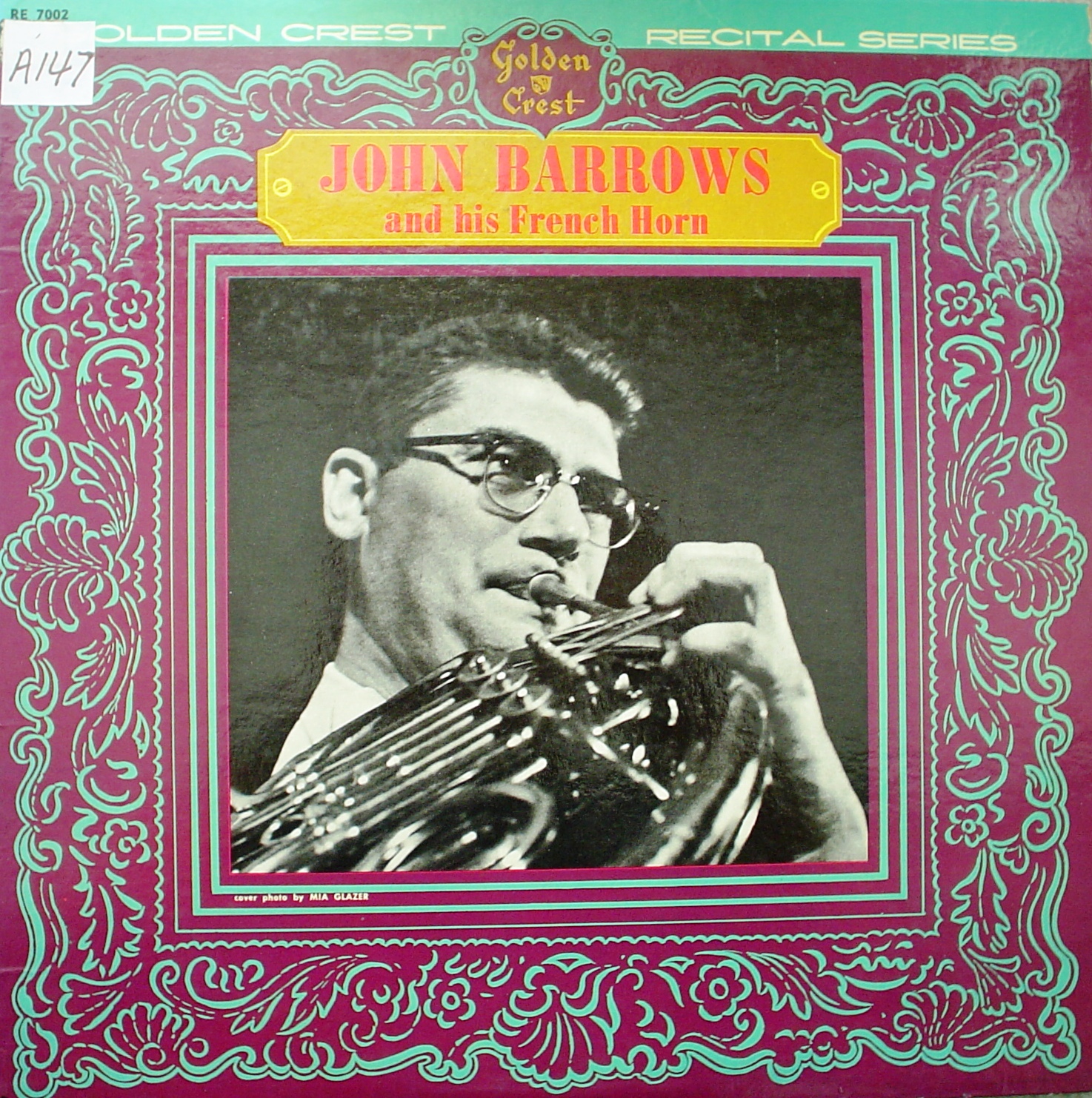
We have a number of classic horn recordings on LP in our music library, one of my favorites being John Barrows and His French Horn, recorded in 1960 (I think) by Golden Crest Records. To my knowledge this LP hasn’t been reissued on CD, although it really should be done.  The album is devoted to the music of Alec Wilder, and includes the First Sonata, Second Sonata, and Suite for Horn and Piano, with Milton Kaye, pianist. These are great recordings, and as close to a definitive interpretation of Wilder’s music as you can probably get. Barrows was a longtime champion of Wilder’s compositions, and they held each other in high esteem. Included on the back of the LP is a written tribute by Wilder praising Barrows for his artistry. Though brief, these paragraphs candidly explain Wilder’s immense respect for Barrows and his horn playing.

I’ve admired John Barrows since the day I met him all those years ago in the Eastman School. Intelligent, intuitive, witty, warm and a marvelous musician. My praise may sound suspect considering that it’s my music he has played so superbly on this record. But I swear that, had he never played a single note of mine, my respect would be the same.

He is the bane of all French Horn players, not only because he plays so brilliantly, but because he seldom, if ever, practices. This, I recall, considerably startled me when, after a rather rocky night, he rose with the dawn, wandered up a side hill with (for some mysterious reason) his horn under his arm and let loose, for the first note of the day, a high concert F. For those of you who aren’t familiar with the instrument, this is the top note of the horn.

The strong, intelligent, extremely sensitive playing of Milton Kaye is totally satisfying to me. And I feel that his extraordinary musical rapport with Mr. Barrows is not only constantly in evidence, but has made greater ease and fluidity possible for Mr. Barrows’ performance.

Mr. Barrows has always been excessively humble about his playing, sometimes becoming darkly depressed by the sounds made by a little known Russian horn player who is known in this country only by his recorded performance of a Gliere concerto. [Valeriy Polekh?]

The soloist, whose name escapes me, is obviously a technical marvel. But what Mr. Barrows cannot seem to comprehend is that the Russian’s capacity to produce subtle, mature, communicative playing is minimal in comparison.

Mr. Barrows is also an extremely talented composer, orchestrator and musicologist. He is an aspiring teacher, a great cook and a sports car enthusiast. He is a member of the New York Woodwind Quintet and the Casals Festival Orchestra. Without him, I promise you, none of the music on this album would have been written nor would dozens of other pieces. His faith in me is one of the few truly beautiful experiences of my life

ALEC WILDER

Up next…James Chambers plays the Ralph Hermann concerto.

Horn in B-flat Alto or Basso in Haydn’s Symphonies?

This is a question that comes up fairly often when looking at the horn parts in Haydn symphonies, because Haydn was notoriously unspecific as to which transposition he wanted.  Sometimes, the answers seem fairly clear cut – for example, if playing in B-flat alto would put the 1st horn in unison with the 1st trumpet all of the time, chances are that Haydn meant B-flat basso – but in other situations things are not so cut and dried. For an explanation of the problem and one possible solution, here’s an extended quote from H.C. Robbins Landon‘s The Symphonies of Joseph Haydn, NY: The Macmillan Company, 1956, p. 124-125.  I’ve put his suggestions to performers in boldface at the end of the quote.

One particular aspect of Haydn’s writing for the horns deserves attention, viz. the problem of horns in B flat. We have seen that Haydn used two types of horns in C, alto and basso. It appears that he also used B flat horns, in alto and basso, but, unlike Mozart, who was very careful to mark his parts ‘high’ or ‘low,’ not one single Haydn autograph specifies which type of B flat horn is to be used, nor do the contemporary parts usually go beyond Haydn’s typical nomenclature of ‘Corni in b Fa’. One MS., that of Symphony No. 35 in the monastery of Stams, and a few later prints, such as Simrock, add alto; otherwise we are left without any inkling of Haydn’s practice.

The fact that Haydn never bothered to write alto or basso over his B flat horn parts leads one to the inevitable conclusion that only one type of instrument was in common use; the question remains: which of the two was meant? An examination of the parts in question suggests that all the earlier symphonies, up to and including the ‘Paris’ symphonies, used alto horns, while as soon as trumpets and drums were used in B flat – which was never the case before the ‘Salomon’ symphonies – the horns dropped to basso. That it was as a rule alto horns which the eighteenth century understood by the term ‘Corni in b Fa’ is obvious from a glimpse at Beethoven’s scores, which continually specify ‘Corni in B basso…[Robbins Landon goes on to detail  more evidence to support his conclusion] Haydn must have begun using B flat basso horns during the London sojourns, as the big C major Symphony No. 97 apparently uses horns in C basso instead of the usual C alto found in his C major symphonies as late as 1788 (No. 90). It is impossible to perform Symphony No. 102 in B flat with alto horns; the technique shows quite clearly that basso is intended (cf. the end of the trio, where horn I enters on written g”). Whether No. 98 is to be performed with alto or basso horns is, however, not so clear; for the horn (and trumpet) writing admits either possibility. It will be safe to perform all the B flat symphonies before No. 98 with alto, Nos. 98 and 102 with basso horns. From this point onwards, especially in the late masses, it is the latter which must be used.(p. 124-125)

The passage ends with the following information concerning Haydn’s Creation. On a personal note, I’ve performed the work twice before, and in the editions we used the B flat horn parts were notated as alto or basso, following the practice Robbins Landon describes below.

An interesting tradition regarding The Creation (1798) has survived, that the arias in B flat major are to be executed with alto horns, the big chorus employing trumpets and drums with basso. Examination of Haydn’s own parts showed no trace of this differentiation; but as the above designations seem to have been added in pencil early in the nineteenth century, it may be assumed that the tradition is an authentic one, going back to a practice which, in Haydn’s day, must have been considered so obvious that no one bothered to write it down. Still, it is to be hoped that more concrete facts relating to this problem will be discovered. (p. 125)

Though Robbins Landon makes a compelling and logical case, to my knowledge there has still been no definitive proof discovered to confirm his conclusion. Paul R. Bryan notes the impact that Robbins Landon’s conclusion concerning alto/basso notation has had on scholars and performers. This passage is from Bryan’s article “Mozart’s Use of Horns in B-flat and the Question of Alto-Basso in the Eighteenth Century,” Historic Brass Society Journal, Volume 14, 2002, p. 165-192.

Twenty-five years ago I published an article comparing the use of horns by Wolfgang Amadeus Mozart and Joseph Haydn [“The Horn in the Works of Mozart and Haydn: Some Observations and Comparisons,” Haydn Jahrbuch IX (1975): 189-255.] Among the more specialized aspects addressed was the question of high (alto) versus low (basso) horns in B-flat. It had previously been raised by H.C. Robbins Landon, who had expressed his opinion that in Haydn’s early symphonies all B-flat horns were high, i.e., alto. He believed that Haydn’s pre-London-period horn parts in B-flat should, therefore, always be performed in the upper octave, a step below written pitch, rather than, as commonly accepted, a ninth below. Subsequently, Landon added “alto” to all the B-flat horn parts that he edited and published in such important series as the complete symphonies of Haydn – as well as those of other composers. My judgment at that time was that in such situations an editor’s opinion might be stated, but that only the composer’s designation should be published in the score.

Landon’s contention, the acceptance of which markedly impacts the sound of Haydn’s orchestra, also influenced the judgments and performances of other scholars and performers. Since 1955 his opinion has gradually been accepted even by a number of specialists on Mozart, with the result that editions of several works in the Neue Mozart-Ausgabe (NMA), as well as many performances and recordings of Mozart’s compositions, have been affected. (p. 165)

One other great resource on Haydn’s horn writing is a website by John MacDonald. His page “A Listing of the Degree of Difficulty of the Horn Parts in the Symphonies of F.J.Haydn,” is full of excellent information.  I’ll close this post with one other story concerning the B-flat alto/basso dilemma, the work in question this time being Haydn’s Symphonie concertante in B-flat major, Hob. I: 105.  We performed this work last season in the Monroe Symphony Orchestra, and the B-flat horn parts were not marked alto or basso. According to H.C. Robbins Landon’s conclusion, this work, which is also scored for B-flat trumpets and timpani, should be performed in B-flat basso.  We performed it that way, and everything worked out fine, but I was surprised to find this recording of the work on YouTube,  performed by the Slovak Chamber Orchestra, Bohdan Warchal, conductor.  To my ears it sounds like there are no trumpets, and the horns are playing in B-flat alto.  Perhaps there is another edition of the work which doesn’t include trumpets?

Brüchle and Janetzky’s “A Pictorial History of the Horn” Part 3

This is the third and final post in a series devoted to Kulturgeschichte des Horns (A Pictorial History of the Horn), by Bernhard Brüchle and Kurt Janetzky. You can view Part 1 and Part 2 by following the links. The first image is a set of horns from a Russian horn ensemble, a very unique type of horn choir.  Here’s some background from the text.

The “Russian horn music” was considered a kind of world wonder, and what is also wonderful, is what occurred to Johann Anton Maresch, the czarist court musician and leader of an (originally) sixteen-member horn group, when the Empress Elisabeth of Russia ordered him in 1751  to reform the imperial hunting music and to organize a new horn corps.

He hit upon the idea of having simple single-tone copper horns constructed, pitched like organ pipes, and of fitting out a larger team of musicians with them. Each one of these pitiable hornists had now nothing more to do, than to blow only the single tone of his horn whenever it was supposed to be sounded in the piece being played. The greatest difficulty naturally consisted in the razor-sharp attention to all of the rests. One can imagine how much patience and drill were necessary, in order to train 30 to 40 young huntsmen, until they were able to perform faultlessly difficult pieces with rhythmically complicated tone figures or fast passages. [p. 208]

“Twenty-one Russian Horns” (p. 209)

Next is a funny little caricature from the mid-19th century. According to the description, this picture is “Horn virtuoso Pohle, the first horn in the premier performance of Robert Schumann’s Concertpiece for Four Horns and Orchestra. Lithograph after a drawing by his cellist colleague C. Reimers, Leipzig, ca. 1845” (p. 230)

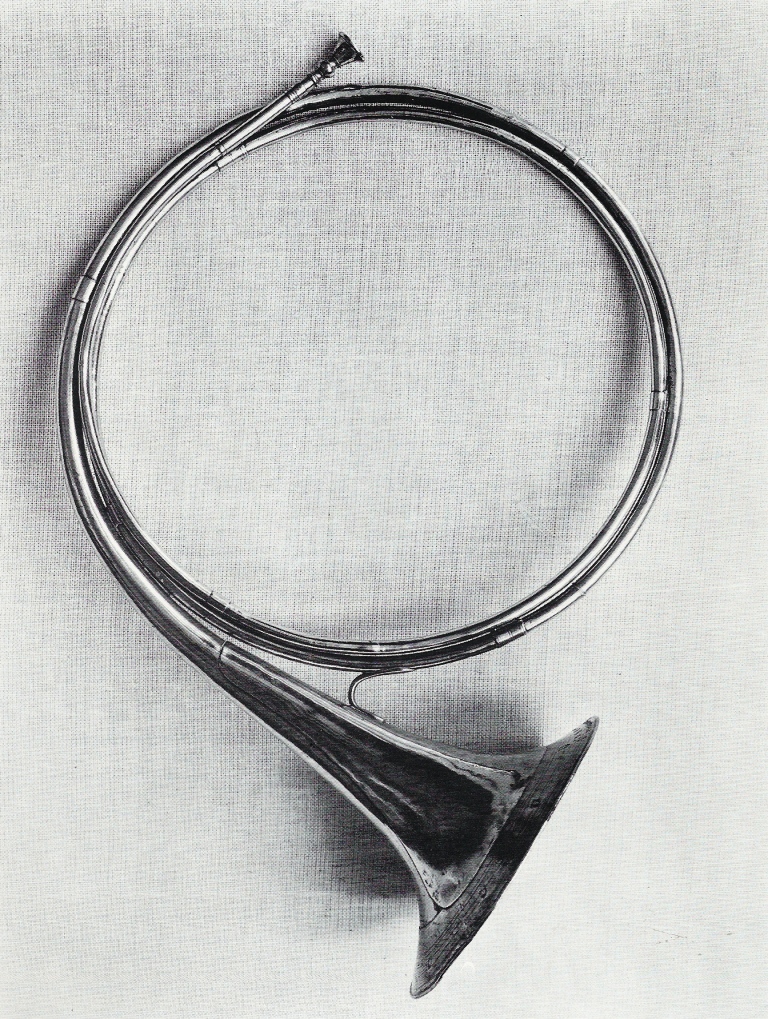
One of the most interesting photos in this collection is the “Radius French Horn.”

Radius French Horn by John Callcott (1801-1882), London

It is tuned to the key of B-flat. Through the selective connection of the pointer-shaped, telescopelike, extendable tube in the middle, the following additional keys can be produced (clockwise): C, B alto, F, D, A, B, A-flat, E, D-flat, G, E-flat, and G-flat.

Upon attaching the radius arm, a valve is depressed, which opens the new air passage. [p. 246]

To close out this series here is a mural from the late 19th century.

“Hans Thoma (1839-1924) Musical Ensemble, Oil mural in the beer-restaurant ‘Zum Kaiser Karl’ in Frankfurt am Main, 1887, detail” (p. 258)

The images in this series are only a fraction of those contained in A Pictorial History of the Horn, and any horn student or enthusiast could certainly learn quite a bit about the history of the instrument just by perusing this volume.  However, there are some weaknesses to the book, as the eminent musicologist Mary Rasmussen (1930-2008) notes in this review from the Music Library Association’s Notes, Second Series, Vol. 35, No. 2 (Dec., 1978), pp. 320-322.

I find two things disturbing about Briichle’s and Janetzky’s Kulturgeschichte des Horns: the price, which is currently about eighty dollars and, with the ever-faltering dollar, doubtless increasing daily; and the title, which, at least in its German version, implies interpretation, scholarship and breadth of inquiry which is in fact not present.  [p. 320]

Rasmussen goes on to point out some of the scholarly failings found in A Pictorial History of the Horn, namely a lack of depth in the authors’ research.

As for the authors’ claim (page 15) that “all of those sources were thoroughly exhausted which, in our estimation, contributed to the presentation of an objective picture of the horn down through the ages”-their search was apparently not as comprehensive as they thought it was. The iconography/iconology of the horn in western Europe from the Middle Ages on is much more varied than this collection of hunting, post horn, and Russian horn band pictures would lead one to believe. [ibid., p. 321]

Despite these criticisms, Rasmussen does have some praise for the book at the end of her review,  stating that “These reservations aside, Kulturgeschichte des Horns is an impressive volume, and one which should bring many hours of pleasure to those who can afford to own it.” (Ibid., p. 322)  For those interested in further iconography of the horn, I highly recommend Mary Rasmussen’s Musical Iconography, an excellent resource with tons of information on the horn and other instruments.

Brüchle and Janetzky’s “A Pictorial History of the Horn” Part 2

This is the second in a three-part series devoted to selections from Kulturgeschichte des Horns (“A Pictorial History of the Horn”) by Kurt Janetzky and Bernhard Brüchle (English translation by Cecilia Baumann).  You can check out the first part here. In this part we’ll be looking at images from the 18th and early 19th centuries.  As in Part 1, simply click on the images to view them up close.

First is a “Waldhorn of Adam Buchschwinder, Ellwangen, 1745 Key: ~A-flat” (p. 101)

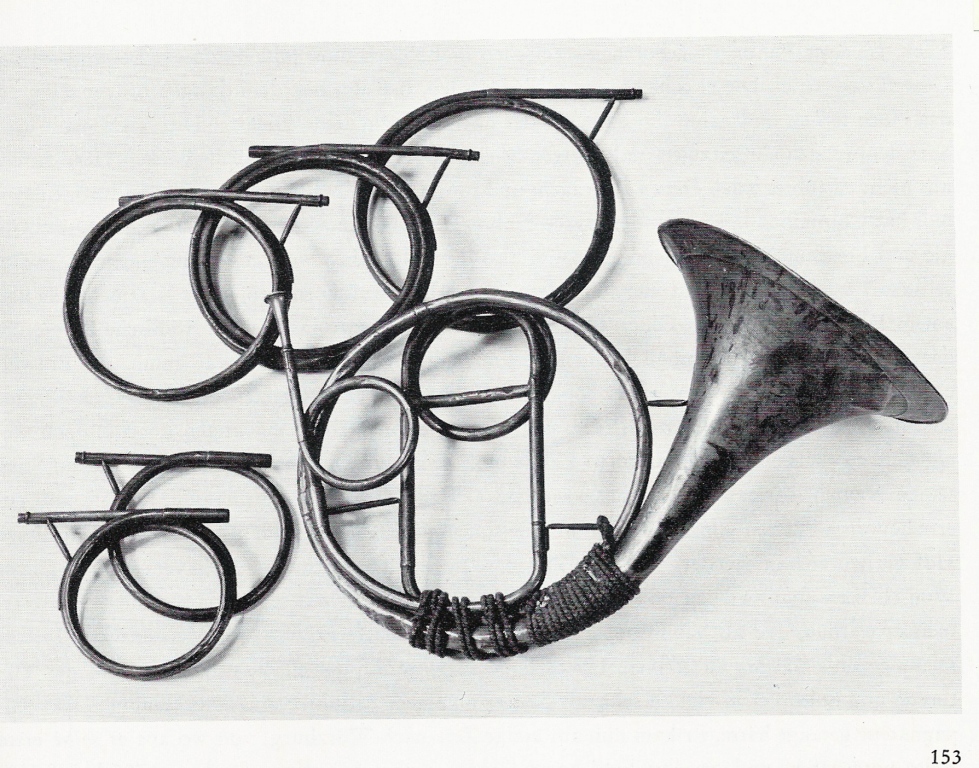
Next is an “Inventionshorn with six couplers by Carl Gottlob Schuster, Neukirchen ca. 1800” (p. 165)

Third is “‘Holding the Horn,’ a lithograph by Pointurier from an anonymous French method book for horn, ca. 1830” (p. 176) It is interesting to note how consistent (roughly) right hand position has remained in the last 180 years.

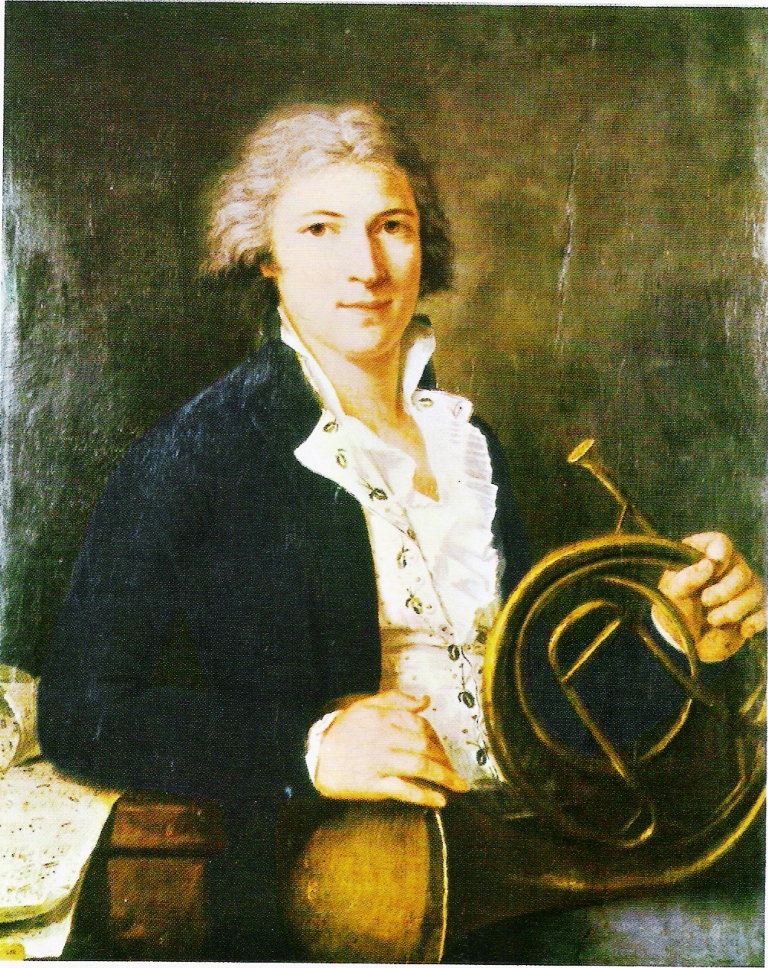
And finally here is a very nice color portrait of Frédéric-Nicolas Duvernoy (1765-1835)

Anonymous portrait, oil on canvas

Duvernoy was one of the most reknowned instrumental soloists of the Paris Opera, as well as professor and first solo hornist at the Conservatory [Plate VIII, between pp. 176-177]

That’s the end of part two.  In part three we’ll wrap things up with some images from the later 19th century,  as well as a review of the book by musicologist Mary Rasmussen.

Brüchle and Janetzky’s “A Pictorial History of the Horn” Part 1

As a visual learner, I really enjoy looking at pictures of various horn designs and images of horns throughout history.  Besides the internet, one of my favorite resources for these images is Kulturgeschichte des Horns (“A Pictorial History of the Horn”) by Kurt Janetzky and Bernhard Brüchle (English translation by Cecilia Baumann). Published by Hans Schneider in 1976, this unique book is now out of print, but occasionally a used copy will show up on Amazon. If you happen to see a copy for sale and it won’t bankrupt you, go ahead and buy it as it really is a neat book.  Fortunately, our university library owns a copy, as do many other libraries I’m sure. This three-part series of posts will be devoted to some of the images found in this book. As you read through this post, you can click on the images to view them at a larger size. In the Foreword, the authors spell out the purpose of this volume.

The sole purpose of a work such as this should be to present the horn in a clear and faithful manner through pictures and words, concentrating on that which is essential.

With this end in view, then, we have striven to make a judiciously limited, painstaking selection from among the countless pictures, reports, letters, and other documents collected over the years with the true zeal of the enthusiast. It is our intention that this book should serve to provide the reader with a practical, comprehensive, but above all visually impressive picture of the horn. No one should be forced in a didactic way to any preconceived view; rather, it should be left to the reader to experience the horn on his own and form his own image of it. [p. 13]

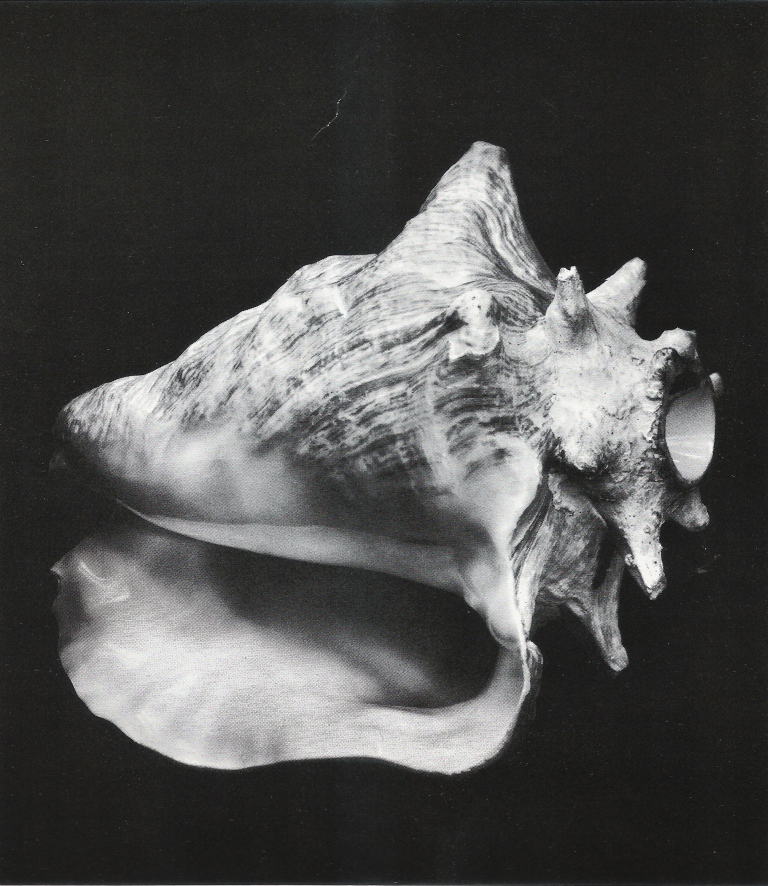
In this first post we’ll look at images from ancient times up through the Renaissance.  First is the ubiquitous conch horn.

Quoting from the text, this is a “Shell of a tropical marine gastropod (genus Murex). The tip is broken off to form a crude blowing hole. Length: 17cm. Found in the Antilles (Hatiti)” (p. 21) Check out the website Lark in the Morning for details on purchasing your own conch horn.

Next is the Scandinavian luur.  Here’s some more information on the Luur, again quoting from A Pictorial History of the Horn.

During the past century a number of horn-like instruments, which usually belonged together in pairs, were found in the western Baltic area, especially in Denmark, but also in Iceland, Sweden, Mecklenburg, Pomerania, and Hannover. These were the lurrs of the Nordic Bronze Age, which, perhaps as early as the second millennium B.C. (possibly, however, not until more recent times), sank into the bog and were amazingly well preserved. All have in common a perfectly conoidal S or question-mark form curing either to the left or to the right. The slightly conical, thin-walled tube, three to four meters long, was cast out of bronze in separate pieces with admirable craftsmanship and artistically fitted together with decorative ring clamps. [p. 32]

“One of the two luurs of Tellerup on the island of Fyn (Denmark), a horn from the Nordic Bronze Age (5th period)” (p. 33)

Next is the oliphant.  Here is a brief description of this ancient type of horn, courtesy of Brüchle and Janetzky.

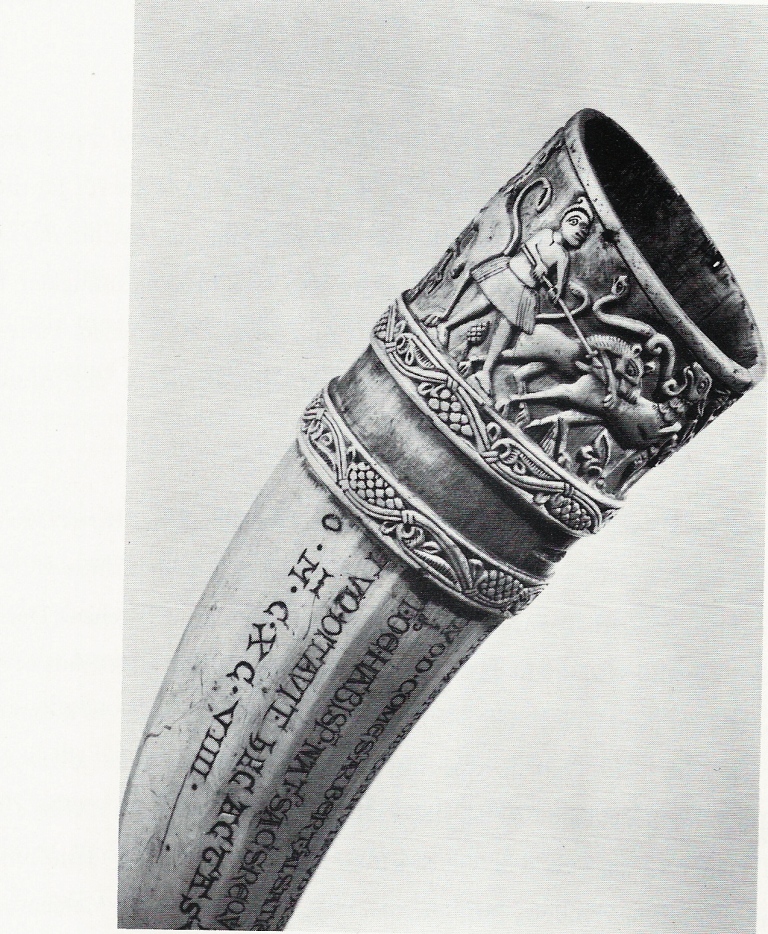
The oliphants, which were artistically carved from hollowed-out elephant tusks, were the hunting horns of medieval knighthood. The first pieces came to Europe from Byzantium at the end of the tenth century, and their ownership or use was for centuries the unlimited privilege of the high nobility. As [sic] signalling instruments their capability was modest; usually they produced only a single tone, but sometimes two, or in rare cases, at most three tones. The legendary range of its sound was usually greatly exaggerated with the intention of making the strength of the blower seem more heroic. [p. 65]

“Oliphant from Southern Italy (Salerno), ivory, 11th century.” (p. 63)

The last image for part one of this series is by the Renaissance artist Albrecht Dürer (1471-1528).

“Albrecht Dürer (1471-1528) ‘Battle between Tritons and Nereids’ Pen-and-ink drawing, 29.2 x 38.2 cm” (p. 22)

If you enjoyed these excerpts from A Pictorial History of the Horn, see if your local library has a copy – it really is a fun read. Check back soon for Parts 2 and 3.

Franz Strauss Nocturno with Band

If you play regularly in a band at the college, community, or high school level, or if you are a college teacher looking for solo opportunities, consider performing an original or transcribed solo with band. There are some great resources out there for tracking down these pieces, one of the most recent being a new website by Dr. Brent Shires, Assistant Professor of Horn at the University of Central Arkansas. Dr. Shires gives the following introduction to his website, located at http://www.horn-and-band.info/.

My Doctor of Musical Arts degree from the University of Illinois (2008)focused on the lack of academic treatment of solo horn with wind band. I sought to briefly chronicle the genre, analyze a handful of benchmark original works, and create a selected bibliography. This was a labor of love completed in November 2008.  The doctoral project is entitled “An Analysis of Three Original Works for Solo Horn with Wind Band Accompaniment.”

Most band directors and horn players aren’t aware of the history and the great amount of repertoire available. Since about 1993 I have spent a considerable amount of time trying to locate and centralize information about the music in order to make it more publicly accessible. I hope that this website makes it easy for you to gather useful information as you plan performances, undergo research, or just learn some of the fascinating history of the genre.

I am just getting started, so pages and information will be added as they are ready. Thanks for your patience!

The main portion of the site focuses on “original works for solo horn and band,” and includes an annotated list. There is a page for transcriptions, but that particular resource is under construction. The site is full of excellent information, and I look forward to using it more in the future.

Getting back to the Nocturno by Franz Strauss, this piece seems to work particularly well with band, and there are at least a couple of arrangements out there. I had the opportunity to perform it several times with the University of Louisiana at Monroe’s Wind Ensemble, during a tour this past spring to Little Rock, Arkansas, and the surrounding area. This transcription by Burton Hardin was done in such a way that balance for the most part didn’t become an issue. Being overshadowed by the band can be a concern for the horn soloist, but with a sensitive conductor and a responsive ensemble, most balance problems can be worked out nicely. I will say that I never felt like I needed to play too softly, and I stood in a position which hopefully maximized my projection.  For more on this topic, check out my post titled “Solo Performances: Where do you Stand?” In all of the Nocturno performances on this tour I stood with my bell facing the audience, as shown in Example 2  in the link above. Included below is a link to one of those performances, which I recorded on my Edirol R-09HR. Of all the performances I was probably the most happy with this one in terms of phrasing and overall musicality. The recording is unedited, and I placed the Edirol in the back of the auditorium where we performed.  The conductor is Dr. Derle Long, Director of Bands and Head of the Division of Music at the University of Louisiana at Monroe.

If you are interested in other horn and band transcriptions, visit Thompson Edition’s online catalog; they have several works from the standard repertoire.

Faculty Recital Program

On Tuesday, August 31 at 7:30pm, pianist Richard Seiler and I will be presenting an international program as part of the Faculty Artist Concert series here at the University of Louisiana at Monroe.  Preparing these works has been a lot of fun, and I’m looking forward to the performance.  In choosing repertoire for this recital I tried to find a balance between pieces I had previously performed and works that were new to me.  At this point in my career I am primarily working on lots of new and/or unfamiliar works as well as going back over some of the repertoire I performed as a college student.  I think having a theme for a recital is a good way to structure things, as it gives both the players and the audience a thread or train of thought to follow for the entire program.  As I mentioned before, this recital is built around an international theme, primarily featuring works for horn and piano by various Europeans and one American.

Alec Wilder (1907-1980) Sonata No.3 for Horn and Piano, edited by John Barrows In his article in The New Grove Dictionary of Music and Musicians, Gunther Schuller describes Alec Wilder as “an ‘unclassifiable’ American original,” and indeed Wilder’s compositions often seem to be balanced perfectly somewhere between popular and art music.  His three sonatas for horn and piano as well as the Suite for Horn and Piano hold a special place in the repertoire, due both to the high quality and uniqueness of the writing as well as the championing of these works by the legendary John Barrows.  I considered a number of American composers to begin the recital, but since I only had room on the program for one American I went with Wilder.  I am familiar with Wilder’s music, but the third sonata was a new one for me.  As with his other horn writing, this sonata is lyrical, jazzy at times, and always idiomatic.

Olivier Messiaen (1908-1992) Appel interstellaire, from Des Canyons aux Etoiles Although Messiaen was a French composer, I chose the “Interstellar Call” because of the various international influences found in it, and because it showcases so many different timbres and technical possibilities on the horn.  For a bit of background on the work, I’ll quote from Daniel Bourgue‘s wonderful collection of essays, Conversations About the Horn, published in 1996 by International Music Diffusion (I.M.D.), and translated into English by Nancy Jordan Fako.

The Horn and Messiaen: “Des Canyons Aux Etoiles”

A short history:

This grand orchestral work was composed between 1971 and 1974. As with many of Messiaen’s compositions, this is a mystical work. Des Canyons aux Etoiles [From the Canyons to the Stars] refers to rising from canyons of the earth up to the stars and beyond to paradise, to the glory of God in all of His creation: the wonders of the earth, the land, the song of birds, the magnificence of both material and spiritual heaven. This is a work of praise and contemplation. It uses only a single horn which plays a long solo entitled “Appel interstellaire” [“Interstellar Call]. This solo was probably the first part of the work that was written. In 1971 composer Jean-Pierre Guezec died prematurely. To pay him tribute, nine French composers, friends, or teachers wrote a collective work composed of short pieces for different solo instruments. This work was entitled Le Tombeau de J.P. Guezec [The Tomb of J.P. Guezec].  The first (and only) performance was given at the 8th Annual Royan Contemporary Music Festival [Royan is a small coastal city near Bordeaux] on April 6, 1971 for a radio broadcast. Olivier Messiaen was one of the nine composers. He decided to write a piece for horn alone, and I was chosen to perform it. p. 89.

The rest of the chapter deals with various performance issues related to the “Interstellar Call”, and I highly recommend it. One other topic that sometimes comes up with this work is that Messiaen did not wish the “Interstellar Call” to be performed or recorded out of context.  I have mixed feelings about this, because while I think it is extremely important to respect the composer’s wishes, realistically the “Interstellar Call” would rarely be heard – if at all – if it were necessary to mount a full performance of Des Canyons aux Etoiles each time a horn player wished to play the work.  Instead I prefer to think of performing it as an orchestral excerpt, and as a way to demonstrate some extended techniques on the horn.  Perhaps the full effect of the piece is lost by performing it out of context, but in my opinion that is better than not hearing it at all.  Numerous other horn soloists have performed and/or recorded the work as an independent solo piece, and I would love to hear other opinions/rationalizations about the subject.

Luigi Cherubini (1760-1842) Sonata No. 2 Representing Italy is this well known sonata by Cherubini, a prominent composer of opera and sacred music in the late eighteenth and early nineteenth centuries.  Written in 1804 as a test piece for the Paris Conservatory, this sonata belongs to a group of two works composed for examination purposes.  I first performed this piece as an undergraduate, and pulling it back out after several years has been great fun.  Perhaps the next time around I’ll work it up on the natural horn, the instrument for which it was originally intended.

Charles Gounod (1818-1893) Six Melodies, edited by Daniel Bourgue Gounod is probably most well known for his lyric opera Faust, along with various other operas, sacred works, and around 200 songs.  Though not a major part of his compositional output, the Six Melodies for Horn and Piano are nevertheless charming, and I think a great way to open the second half of a recital.  Because I didn’t want the recital to get too long, we’ll only be performing the first three melodies.  As you might expect for a composer steeped in opera and song, the writing is very lyrical, along with some clear folk influences.

Franz Strauss (1822-1905) Fantasie, Op. 2 Among the earliest works published by the composer, this quasi theme and variations is very popular on recitals and at horn workshop/symposiums.  Though straightforward harmonically and melodically, the piece  has some very nice lyrical writing as well as some tricky technical passages to work out.  For a number of the technical passages I ended up staying on the B-flat side of the horn quite a bit.  For an excellent recording, check out John Ericson’s CD Les Adieux.

Arnold Cooke (b. 1906) Rondo in B-flat We’ll end the recital with this short work by a British composer.  I like closing programs with a fun, less serious work, and the Rondo fits the bill nicely. This piece, along with the Strauss, Wilder, and Gounod, were new to me for this recital, and I’m glad that they are now in my repertoire.
Rethinking the Re-Warmup

I posted a while back on tweaking the daily routine, but neglected to mention that experimenting and modifying your re-warmup patterns can also be a very useful exercise.  Here’s a case in point.  I usually begin my practice day with a fairly involved routine, Douglas Hill’s Warm-ups and Maintenance Sessions for the Horn Player, which usually takes about an hour or so.  This is followed by several minutes of rest – 20 to 30 min. – then another hour or so of practice. At this point my mind and face need a substantial break, so I like to rest for a least a couple of hours or more before doing any further practicing that day.  After this extended break I need at least a 5-10 minute re-warmup to get things going again.  In the past I’ve approached this re-warmup session a little haphazardly, and looking back I realize now that I probably wasn’t doing the right kinds of things to wake up my embouchure, namely too much upper register, loud playing right away.  Consequently, while I could make it through the third hour or more of playing, I wasn’t always in the best shape by the end.  I’ve found lately that by taking a little extra care in the re-warmup session – some middle register long tones and gentle air flow/flexibility studies – I’m in much better shape for the entire third hour of practice, right up to the end, and my chops feel much better the next day. Sounds like a no-brainer, doesn’t it?  I suppose I just expected to be warmed up already for that final practice session, and didn’t want to take the time to warm up again properly.  Take it from me, it makes a difference!

Music for Brass Ensemble by Richard Strauss

As horn players, we are all familiar with the epic brass writing of Richard Strauss in his operas, tone poems, and solo horn concertos, but Strauss also wrote some great brass ensemble music as well.  Selections from this handful of works are performed fairly often in various brass ensembles, but everyone may not be familiar with all of the works and the circumstances under which they were composed.  Recently I found a great online resource, Classical Archives, which has tons of free information on composers and their works.  Some of the content is accessible for a subscription fee, but I was able to view for free a very substantial works list for Richard Strauss, complete with information on his brass ensemble pieces.  The information on each work is quoted (in italics) from Classical Archives, but I’ll also include the individual links so you can view the pages themselves.

Festmusik der Stadt Wien, for brass and timpani, TrV286

An important work among late Strauss pieces, this work has remained unpublished and is only known for a shortened version made later by the composer himself. During the 2nd World War, Strauss used to spend the winters in Vienna. In 1942, the Trompetenchor der Stadt Wien (Brass Choir from the City of Vienna) asked him to write a piece for them. This was a famous ensemble made up from the brass players of the three symphony orchestras in Vienna, and comprised twelve trumpets, eight trombones, two tubas, timpani and percussion. Strauss divided these forces almost evenly into two choirs for his piece, but excluded the percussion. The work opens with the main motive intermingled with a fanfare-like call, with both choirs responding to one another. Then, the opening motive takes a lyrical and extended appearance in the voice of a solo trumpet and the first choir. The second choir gives a more martial version of the theme, which is further developed in their dialogue. A second subject with a nostalgic air reminiscent of Der Rosenkavalier leads to a brilliant section in semiquavers, which is followed by a more subdued one with a tint of melancholy. A brief crescendo leads to a recapitulation of the first motive. There is a pause, followed by an allegro proclamation that includes a key intervention of the timpani. The final section presents both choirs united in a chorale recapitulation of the themes, culminating with an exciting coda. © All Music Guide

Feierlicher Einzug der Ritter des Johanniter-Ordens, for brass ensemble, TrV224

Written in 1909, the Solemn Entrance of the Knights of the Order of Saint-John is scored for 15 trumpets, 4 horns, 4 trombones, 2 tubas and timpani. It is a majestic piece marked Slow and Solemn. The opening motive is a distant call underscored by a timpani roll, concluding with what sounds like a reference to Wagner’s Siegfried. The introductory phrase is repeated, but this time it culminates in a climax. After a pause, a solemn chorale-like melody carried by the trumpets develops slowly. A second and a third long-winded phrases, separated by repeats of the introductory calls, make up the body of the work. In the final climactic section, the intensity grows all the way to the end. This work has been described by Robert Matthew Walker as “almost Brucknerian in its simplicity and power”. © All Music Guide

Wiener Philharmonic Fanfare, for brass and timpani, TrV 248

The Fanfare für die Wiener Philarmoniker was written in 1924. It is a short and celebratory piece with no discernible sections, scored for 6 trumpets, 8 horns, 6 trombones, 2 tubas and 2 sets of timpani. A trumpet opens and its call is replied by other instruments. The texture builds up to a chorale-like passage. The antiphonal calls of the opening return, and after a brief and more subdued passage comes the ending which closely resembles the beginning. © All Music Guide

Fanfare zur Eröffnung der Musikwoche der Stadt Wien im September 1924, for brass and timpani, TrV250

The Fanfare zu Eröffnung der Musikwoche der Stadt Wien was written to celebrate the opening of the Music Week in Vienna toward the end of 1924. This work is scored for 6 trumpets, 8 horns, 6 trombones, 2 tubas and 2 sets of timpani. It is a solemn and slow piece made up with long-breathed themes. It opens ecstatically with a succession of soft horn chords. A series of trumpet calls in fourths precedes another quiet passage that slowly builds up to a restrained climax and then subsides once more. The last section, announced by the motive in fourths, is a crescendo, which reaches its climax at the very end, underlined by the marching rhythm of the timpani. The last chord lingers while fading away. © All Music Guide

Though they are not among Strauss’s most famous works, the writing is thrilling, as one would expect, and I think every brass player should be at least familiar with these works.  Looking at the instrumentation, you can see that the forces they call for are at times massive (15 trumpets on Feierlicher Einzug ). If you don’t know them, check out the following recordings.

Richard Strauss: Complete Music for Brass Ensemble, Royal Academy Symphonic Brass, James Watson, conductor

Richard Strauss: Music for Symphonic Brass, Locke Brass Consort, James Stobart, conductor

CD Review: Symphonic Brass

If I had to pick one brass band recording to add to my collection, I would choose this 2007 release by the world famous Black Dyke (formerly Black Dyke Mills) Band, conducted by Nicholas Childs. Entitled Symphonic Brass, this CD contains brass band arrangements of popular symphonic works, as well as a few other pops concert type pieces.  Here’s a complete track listing.

Verdi, Grand March from Aida; Brahms, Academic Festival Overture; Bizet, Pearl Fishers: Deep Inside the Sacred Temple; Bizet, Carmen Suite; Holst, The Planets: Jupiter; Bizet, Farandole from L’arlesienne; Elgar, Enigma Variations: Nimrod; Walton, Spitfire Fugue; Gershwin, Porgy and Bess Suite; Williams, Saving Private Ryan: Hymn to the Fallen; Tchaikovsky, 1812 Overture

The arrangements are, as far as I can tell, literal, and they play every note!  If you haven’t heard of the Black Dyke Band, see a brief history of the band here. They have won a number of awards and competitions over the years, including multiple national championships in Great Britain, as well as Grammy and Oscar nominations. For a taste of what’s in store on the rest of the CD, here’s a brief clip of “Jupiter” from Gustav Holst’s The Planets, arranged by Stephen Roberts.

As expected, the technique and overall virtuosity on this recording are outstanding, but I think what impresses me the most is the lyrical quality of the playing, and the variety of colors they produce.  In the “Nimrod” movement from Elgar’s Enigma Variations, the entire ensemble plays with a sustained quality that many orchestral string sections would be envious of, especially at softer dynamic levels.  The louder sections also deliver, particularly the low brass, whose sound I can only describe as extraordinarily healthy.

If you are a fan of great brass playing, check out Symphonic Brass – this recording is both technically impressive and musically satisfying.