Why More Upper Lip in the Mouthpiece

David Wilken of Wilktone and I have been having a great conversation about horn embouchures, specifically the ratio of top to bottom lip in the mouthpiece.  He has raised some interesting points, and this kind of informed debate is one reason why I love what I do.  Dr. Wilken has done extensive research into the function of brass embouchures, with lots of great videos, articles, and commentary – be sure to check out his blog!  For the full story, check out my post, and David’s reply.  In short, I do agree with Dr. Wilken that the horn, along with the other brass instruments, can be played proficiently with more lower than upper lip in the mouthpiece, but I maintain that for a majority of horn players, more upper lip in the mouthpiece seems to work better.  That being said, I think Dr. Wilken and I are in agreement that it is the individual player’s lip, jaw, and teeth structure that ultimately determines the finer points of mouthpiece placement. What works for other players or teachers might not necessarily work for someone else, and we should approach the study of the brass embouchure with an open mind and careful analysis.  Our discussion also raised the question of why so many horn players use more upper lip in the mouthpiece, a question I don’t think I sufficiently answered in my previous post. So, I started looking back through the literature, and have got a few more (I think) answers.  In terms of my own teaching, I don’t think of these quotations as representing hard and fast rules, but rather guidelines developed over many years of teaching and playing.

Philip Farkas, The Art of Brass Playing, Rochester, NY: Wind Music, Inc., 1962, p. 32-33.

Let me sum up the evidence which leads me to conclude that two-thirds upper and one-third lower lip in the mouthpiece are a prerequisite for the French horn player who wishes to attain his maximum ability.

First, most of the fine French horn teachers of the past two hundred years have advocated this position. Many of these teachers have written instruction books which substantiate this statement.  Second, all of the many fine horn players that I know personally (perhaps one hundred or more) use this predominantly upper lip setting…Third, believing and preaching this theory for years has resulted in a number of my students becoming professional players in many of our finest symphony orchestras.

There is good reason why the successful French horn player finds it necessary to adopt this two-thirds upper, one-third lower lip position. Of all the brass instrument embouchures, the horn player’s is probably the softest, most relaxed and most puckered. This tends to emphasize the heavy, fleshy mound in the center of the upper lip. With this mound as pronounced as it is, it is logical for the French horn player to place the mouthpiece above it rather than try to perch the rim precariously upon it. The thicker condition of the upper lip, when it is the dominating lip in the mouthpiece, seems to give the tone a more mellow, less strident quality. And, of course, this velvety quality is much to be desired in the French horn tone.

Regarding the above passage, although Philip Farkas continues to hold a revered place in the world of horn playing and teaching, the art has continued to develop over the years, with many other valid ideas coming to the fore.  For more information, check out Dr. John Ericson’s excellent post on the subject at Horn Matters.  However, on this particular subject, other more recent books on horn performance and pedagogy continue to advocate a similar idea as Farkas.

Randy C. Gardner, Mastering the Horn’s Low Register, Richmond, VA: International Opus, 2002, p. 17.

Many people are taught to anchor their mouthpiece into the bottom lip and lighten pressure on the top lip when playing in the high register. This is essential in the upper tessitura to ensure that the top lip remains free to vibrate.

Wendell Rider, Real World Horn Playing, San Jose, CA: Wendell Rider Publications, 2006, p. 16.

Although it is possible to play with the mouthpiece digging into the upper lip, it is not desirable for a number of reasons. If nothing else, it will decrease your potential endurance. The red part of the lip is just not meant for that kind of punishment. As you get older, serious injury is possible. “Setting in” also tends to pin the upper lip muscles, forcing the use of pressure to compensate for the fact that you can’t work these muscles to help you move around on the horn, especially in the upper register and when doing lip trills. The upper lip muscles must be free to move. These are the “finesse” muscles of your embouchure. Many people with thicker lips who try to play on small or seemingly “normal” inside diameter mouthpieces will end up with the rim digging into their upper lip. They will try to play on these mouthpieces, thinking that everyone else can or some great player is able to do it, and will experience much pain and frustration. I know this because I was one of those people. When you take your mouthpiece off after playing, look to see where the “mark” is on your upper lip. It should be up on the skin part.

In this passage Mr. Rider brings up the very important issue of equipment choice (mouthpiece inner diameter), and how it can affect the ratio of upper to lower lip.  Many players simply play on a mouthpiece which is not suited to their lips, whether that means one that is too wide/too narrow, too shallow/too deep, etc.

John Ericson, Introducing the Horn: Essentials for New Hornists and their Teachers, Tempe, AZ: Horn Notes Edition, 2007, p. 4.

For as long as horn method books have been written –300 years!–horn teachers have advocated a mouthpiece placement of 2/3 upper lip and 1/3 lower lip. Examination of the embouchures of professional hornists will quickly confirm that this general rule is the standard, with only slight variation.

The horn embouchure is the most relaxed and puckered of all the brass embouchures. This fact tends to emphasize the fleshy mound at the center of the lip, and this in turn favors a higher mouthpiece placement. A higher proportion of upper lip is also beneficial in playing the entire range of the horn, which is almost four octaves. Too little upper lip will not allow for production of the lowest notes of the horn. While it is possible to perform the horn on a fairly high level with a 50/50 or lower embouchure, a basic placement of more upper lip than lower is generally recommended.

Richard Deane, The Efficient Approach: Accelerated Development for the Horn, Atlanta, GA: Atlanta Brass Society Press, 2009, p. 10-11.

Finally, the setup that is the most viable and flexible for many players could be described as a hybrid of the above two setups. With our goal of achieving the best possible resonance, sound quality and intonation in all ranges, it seems clear that with normal sized lips, in order to allow our aperture to be the “correct” size for a given note, the lower lip will need to be partially outside the mouthpiece in the low range (einsetzen) and tucked into the cup in the high range (ansetzen). Most of the time, that is to say in the middle part of the range, the mouthpiece will be placed with 2/3 upper-1/3 lower ratio (einsetzen). As we move from here to the low range, it will be necessary to enlarge the aperture by moving the jaw and its concurrent muscles down and forward slightly. When we go into the upper range, it will be necessary to tuck the lower lip completely into the cup.

Let me take this opportunity to restate an unwavering fact: the upper lip, being the primary vibrating surface of the embouchure, should never be constricted by placing the rim of the mouthpiece directly on it. The flesh of the upper lip should always be completely inside the cup, except for extremely rare cases where the rim is set “into” the upper lip for the low range. Never, never for the high range!

As you can see, professional horn players and teachers from several generations seem to believe that in general, more upper than lower lip is best.  But, I want to stress again that this doesn’t necessarily mean this prescription will work for everyone all of the time.  There are always exceptions to any principle, and it is up to the individual students, under the guidance of a knowledgeable and understanding teacher, to find what will suit them best.
Parts of the Horn: Cylindrical Section and First Branch

This post is a continuation of a series based on a circa 1980 clinic handout from Lawson Brass Instruments, Inc. (now Lawson Horns).  The first post dealt with the importance of the leadpipe in determining the playing characteristics of a horn, while this one considers the role of those sections between the leadpipe and the bell tail. (Italics indicate direct quotations from the handout, annotations are non-italicized and in brackets [] ).

THE CYLINDRICAL SECTION: This section includes the valves, slides and connecting tubing:

1) Bore – Inside diameters vary in the cylindrical section, but in the U.S. they are usually .468″ ID.  Some European instruments are larger, up to .476″ ID. [In the case of Paxman’s “Dual Bore” system, the ID of the F side is .500″]. The size of the bore has an effect on the performance of the instrument. Manufacturers can control this, however, in other areas.

2) Valves and slides – If these leak, the instrument will not play in an efficient manner and the pitch and center of the sound will be affected. If they do not operate properly, playing technique is hindered.

3) Length of the slides and connecting tubing – The overall pitch of the instrument and the relationship between the various harmonic series are controlled by these lengths.

4) Design of the bends in the tubing or wrap of the instrument – Sharp bends have some effect on the resistance of the instrument and removal of water should be considered in the placement of the bends.

5) Assembly – The parts should be fitted carefully so that the bore is as smooth as possible, the slides are parallel and the soldered joints are strong.

6) Artistic consideration – An instrument can be beautiful or ugly depending on the design of the curves, placement of slides, design of the braces, attention to ornamentation and finish of the metal service.

FIRST BRANCH

The taper of this connection between the cylindrical section and the bell tail controls:

1) Slurs – The ability of the instrument to slur easily or with difficulty in different registers and dynamics.

2) Stability – The pitch should remain stable, not float up and down while holding notes.

3) Attack – The notes in all registers should not bounce when started at high dynamic levels.

4) Register – First branch tapers control the ease of playing in the different registers.

5) Sound – The sound should have no roughness and should not growl at high dynamics, but should have the same quality throughout the dynamic range in all registers.

6) Intonation – The pitches of the harmonic series are affected by the first branch taper.

I like this handout because the language is plain and practical, and it is full of tons of great information, rather than being a glorified advertisement for Lawson horns.  In fact the characteristics listed would make an excellent checklist when trying new horns or various modifications to your current horn.  Check back soon for the final post in this series: the bell tail and bell flare.

WolframAlpha

Despite the dominance of search engine giant Google, newer alternative search engines such as Cuil, Bing, and others have cropped up in an attempt to grab a share of the market. One very interesting new player is WolframAlpha, the “computational knowledge engine.” Here’s a small blurb from their About page, which explains exactly what the search engine does, and how it differs from Google.

Wolfram|Alpha’s long-term goal is to make all systematic knowledge immediately computable and accessible to everyone. We aim to collect and curate all objective data; implement every known model, method, and algorithm; and make it possible to compute whatever can be computed about anything. Our goal is to build on the achievements of science and other systematizations of knowledge to provide a single source that can be relied on by everyone for definitive answers to factual queries.

Sounds pretty ambitious, doesn’t it?  And before you begin to wonder just exactly what this has to do with music or horn playing, check out the Examples page.  Just like Google and other search engines, there is a learning curve when first using WolframAlpha, and this  page contains several helpful examples of how to use the database.  For example, looking at the Music Examples page, there are some pretty interesting applications.  Not only can you plug in various pitches, chord names, scales, or frequencies, but you can also have WolframAlpha generate audio waveforms according to the frequency or frequencies you enter.  In addition, you can query the engine for information on various song titles and composers.

Other applications under People and History include comparing several people.  So, I entered the first three composers that popped into my head, Mozart, Bela Bartok, and Tan Dun. Pretty neat, isn’t it?  You can also enter various materials, like red brass, which brings up lots of interesting information.  For an application very practical to horn playing, try checking out the Acoustics examples.  You can compute the perceived loudness of a given frequency and decibel level.  So, lets do A (440Hz) at 85 decibels, which gives us a perceived loudness of 88 phons (unit of measurement for perceived loudness).  Now, do the A one octave below, 220Hz at the same 85 decibels. The perceived loudness is different, which provides scientific evidence for why teachers and conductors ask you to bring out the lower parts – they sound softer, even though they may be at exactly the same measured volume.

I know I’m only scratching the tip of the iceberg here.  Play around with WolframAlpha, and I’m sure you’ll find lots of other uses; music and non-music related.  Let me know if you come across anything really cool!  By the way, I am not being compensated, coerced, or otherwise persuaded in this endorsement of WolframAlpha – I just thought it was a nice change from some of the inane things Google and other similar search engines generate.  Google is a tremendous tool, but even it has limitations.

Practice Journals

On a recent trip back home to NC I found an old practice journal from my first year in college.  Looking back through this notebook was really kind of fun, and got me thinking about the importance of keeping a practice log, journal, blog, etc.  Over the years keeping these kinds of records has helped me in a number of ways, and the college years are a great time to start.  Here are some of the reasons I would strongly recommend keeping some kind of written record about your playing.

Organization/Motivation: Keeping a record of what and how long you practice, along with your personal thoughts and ideas, helps develop organization and time management skills – two factors which I believe are extremely important in succeeding in college and beyond.  Getting organized should be one of the first steps in approaching any challenge – an audition, a recital, and so on.  How can you practice effectively if you don’t know what you want/need to practice?  At first, try to be as detailed as possible in your journal, even keeping track of things right down to the minute.  Many players, me included, have the tendency to waste time during a practice session, and keeping track of how long you really practice can do wonders for your efficiency.  Once the minutes, hours, and days start to add up, a journal can become a source of motivation as well.  If you are trying to build up your endurance, try adding five minutes of practice time every two or three days.  When you look back at your journal, you can see just how much work you’ve put in over a period of time, which helps build confidence along with the motivation to keep practicing.

Language Skills: I would wager that most teachers along the way have been faced with a situation in which they know basically what point they want to communicate, but can’t quite find the words to say it.  Along with our horn playing, language is one of the most useful skills we can have as teachers.  Start developing that language now. For example, how would you describe in words the sensations, technique, etc. required to play stopped horn? What words most clearly describe your concept of the ideal tone?  Practice saying the same things in different ways, because one explanation doesn’t always cut it when working with diverse groups of students with varying backgrounds and skill levels.  A good command of language can help you in your own playing as well.  Trying to get back in shape after a vacation?  Try reading back over your journal/log for inspiration or practice strategies.  Stuck on a thorny technical problem?  You might have worked on it before, but can’t remember exactly what worked – that’s where your journal comes in.

“Ah-hah!”/Lightbulb Moments: I rarely get them, but every once in a while something I’ve been struggling with will click and become easy.  At that exact moment I try to stop for just a minute or two and really think about what I was doing, and try as best as possible to put the sensation or idea into words.  I keep the best ideas on a little 3X5 inch note card, which I stick between the cover and first page of my routine.  I think I got this idea from Doug Hill, but I remember reading somewhere that Philip Farkas also did the same kind of thing with ideas about the embouchure and air stream.

To close out this post I’ll include a transcription of one of the pages from that old journal, along with a list of goals I wrote out for my first semester in college.  At the time I was still working on an embouchure change I’d started in high school – my low register was pretty strong, but range and endurance were a big priority for me.

Goals: 1) Be able to play a G above the staff consistently and confidently. 2) Develop internal pulse. 3) Increase volume of air intake. 4) Work on transposition. 5) Physical exercise.

Warm-up: 30 minutes

Lip trills: 5 minutes

Minor scales: 10 minutes

High range exercise (Farkas): 5 minutes

Double tonguing: 5 minutes

-Break-

Long tones: 10 minutes

Maxime-Alphonse Etudes: 40 minutes

-Break-

Haydn, Concerto No. 2: 30 minutes

-Break-

Re warm-up (Stamp): 5 minutes

Beethoven, Symphony No. 9: 30 minutes

Beethoven, Fidelio Overture: 10 minutes

Beethoven, Symphony No. 8: 15 minutes

Low Horn Etudes (McCoy): 10 minutes

New Blog and Dennis Brain’s Embouchure

One great brass resource I only recently became aware of is Wilktone, the blog of Dr. David Wilken.  According to his bio, “David Wilken is a trombonist, composer, and music educator living in western North Carolina.  He earned a B.M in Composition from Illinois Wesleyan University, a M.M. in Jazz Studies from DePaul University and a D.A. in Trombone Performance from Ball State University.  He has taught music at Indiana Wesleyan University, Adams State College, and the University of North Carolina at Asheville.  Dr. Wilken currently teaches music at Western Carolina University.”

Dr. Wilken’s blog is full of great essays and videos on brass playing, with a particular focus on embouchure function.   His most recent video is titled “Embouchure Misconceptions: Five Myths About Brass Embouchures,” and it has got some really intriguing points.  The entire video is definitely worth watching, but I was particularly interested in Misconception No. 5, “The best mouthpiece placement is centered on the lips, with more top lip inside the mouthpiece. You shouldn’t place the mouthpiece rim on the red of the upper lip.”  This particular part of the video begins at 6:06.  Dr. Wilken goes on to explain that although a good many brass players do play with more top than bottom lip in the mouthpiece, there are plenty of others who actually play better with more bottom lip inside the mouthpiece.  He backs this up with video footage of a number of famous brass players, among them Dennis Brain, who “seem to place the mouthpiece lower on the lips, some right on the red of the upper lip.”  While I don’t necessarily disagree completely with this statement, I think in the case of the horn, the tolerances in terms of mouthpiece placement are much smaller due to the small size of the mouthpiece and the length of the instrument.  It is true that the horn can be played – and played quite well – with more lower than upper lip in the mouthpiece, but I think for a majority of horn players (more so than the other brass instruments), more top lip in the mouthpiece is necessary.  That being said, I never encourage students to change mouthpiece placement if their current setup allows them to negotiate the full range of the instrument with characteristic tone and articulation.  Regardless of my own personal views, videos and studies such as these are wonderful teaching tools, and I thank Dr. Wilken for his hard work and scholarship in this area.

One thing this video did for me was raise the question of Dennis Brain’s embouchure and how it differs from the more often used setup of more upper than lower lip in the mouthpiece.  Looking at my own resources, one of the few descriptions of Brain’s embouchure in the literature that I could find is in Milan Yancich‘s An Orchestra Musician’s Odyssey. His autobiography is full of practical and anecdotal information, including this brief description of meeting Dennis Brain and exchanging horns for a few minutes.

When I first held his horn in my hands it was of feather weight compared to my own Geyer horn. The horn was very easy to play; it responded quickly and the high register was superb in its response. When Brain played on my Geyer, he struggled to attain the high C. He had an embouchure where he set his mouthpiece into the lip (einsetzt embouchure) rather than the customary on the lip setting (annsetzt embouchure).  The rim of his mouthpiece was quite thin. He stated that the placement and setting of his embouchure was almost the exact opposite of his father’s and that when he articulated it was different from the customary technique of most horn players. [p. 208]

Another great resource we have for studying Dennis Brain’s embouchure is the video footage of the Beethoven Sonata, Op. 17 with Denis Matthews, originally produced by Anvil Film in 1952.  This video has recently been converted to DVD format by Hans Pizka Edition, and is available in the U.S. from Pope Instrument Repair.  In the following still images from the video, you can see Dennis Brain’s embouchure while playing first a low c, then b’ in the staff, and then g” above the staff.  These images are all Copyright 2007 by Hans Pizka Edition, and are reproduced here for educational purposes under the auspices of Fair Use.

In the last image especially you can see that Brain’s embouchure is one in which the mouthpiece is set into the top lip (einsetzen), rather than against it (ansetzen).  It is difficult to tell exactly the proportion of upper to lower lip, but it does look like there is more lower lip in the mouthpiece.  Needless to say, this setup worked fabulously for Dennis Brain – but that is no guarantee that it would (or wouldn’t) work for someone else.

For students I think the main thing to take away from all this is that everyone’s embouchure is unique in terms of form and function.  There are definitely principles of embouchure formation and mouthpiece placement which need to be seriously considered, but when it comes down to it what really matters is the result.  The most beautiful-looking embouchure in the world doesn’t really mean that much if it can’t produce the characteristic sound and range required by the instrument.  Likewise, there are other less conventional setups out there which get the job done.

In Tune Chords

One resource I had intended to include with my earlier posts on intonation here and here was a great one page handout showing exactly where each note of a chord needs to be in order to be perfectly in tune according to just intonation.  I picked up this handout several years ago while attending the Round Top Festival Institute.  I plan to post more in the future about Round Top, but in short it is a great summer music festival set up in a similar way to Aspen, Music Academy of the West, and various other programs.  When I attended, all participants received free room and board for the entire six week festival.

Getting back to the handout, it is constructed to show all possible triads and seventh chords, with indications beside each chord tone showing how many cents that tone needs to be adjusted.  All of the chords are constructed with “C” as the root, but the same principles would apply regardless of transposition.  For example, the first chord is a major triad.

Notice that the third must be lowered 14 cents, which is further than many students are willing to go, and the fifth needs to be just a shade higher (2 cents).  Looking at a minor triad, you can see that the third must be quite high (16 cents), with the fifth in the same place as in the major triad.

Looking at seventh chords, a problematic sonority for many groups is the dominant seventh.

In this case, the third needs to be where it was in the major triad, and the seventh needs to be quite low (31 cents).  Although in practice you wouldn’t necessarily need to think, “ok, I have the third of a major chord, so now I am lowering my pitch by exactly 14 cents,” I think this chart is very useful because it helps you visualize just how much some of these chord tones need to be maneuvered around in order to ring true.  Try playing each pitch of these chords against a drone and see just how much you need to bend things around on your particular horn, mouthpiece, etc. for things to really be in tune – you might be surprised!

If you are interested in the complete handout you can download it here. In Tune Chords

One word about copyright issues – I would love to be able to give credit to whomever produced this wonderful handout, but I have not been able to find any information on the creators.  The handout lists Mr. Ward Widener and his AccuTone tuner as the responsible party, but the only information I can find on him is this old HTML webpage which lists him as the manufacturer of the tuner mentioned and lists his company as Widener Engineering in Austin, TX.  The bottom line of the handout also names “Jack Holland Productions” in St. Louis, MO, but it is unclear what connection they have to either Ward Widener or the handout itself.  If anyone out there has any additional information I’d love to hear about it.

For now, feel free to download and use this handy reference; I hope you find it as useful as I have.

Horn Solo Collections

Looking to build your library of solo music?  Instead of buying pieces individually, consider purchasing collections of horn solos with piano accompaniment.  These are a great way to obtain many of the major solo works, as well as some nice shorter pieces to include on recitals.  Collections are great for teachers too because they give students some flexibility in choosing repertoire while remaining within certain limits as far as difficulty, range, etc.  For example, rather than suggesting one particular work, a teacher can instead ask a student to pick one or more solos from a collection.  See the descriptions below for some of my favorites.  Additional details are included where appropriate.

Solos for the Horn Player, Selected and Edited by Mason Jones, G. Schirmer, 1962. No more need be said about this collection of original and arranged works.  It is a must-have for every serious hornist’s library.  Also check out Gregory Miller’s excellent recording of all of the pieces.

First Solos for the Horn Player, Transcribed and Arranged for Horn and Piano by Mason Jones, G. Schirmer, 1971. This collection isn’t as well known as the earlier one listed above, but it is also a great buy, especially for teachers of younger students.  It contains twenty-four shorter, mostly arranged works which tend to be a bit easier in difficulty than the pieces in Solos for the Horn Player. However there is still plenty of great musical material to keep even the most talented younger students interested.

Contents: Folksong Suite (Traditional); “No More, I have Heard Everything,” from Scene with Rondo and Orchestra, K. 490 (W.A. Mozart); Horn Quintet in E-flat, K. 407, Second Movement (W.A. Mozart); Air from Rosamunde (Schubert); “The Picture of a Rose” (J.F. Reichardt); “A Favorite Place” (Mendelssohn); Love Song (Mendelssohn); Andante Espressivo, from Piano Sonata, Op. 109 (Beethoven); “Marmotte” (Beethoven); “Farewell Song to Vienna’s Citizens at the Departure of the Viennese Volunteers” (Beethoven); “The Heavens are Telling” (Beethoven); “Ich Liebe Dich” (Beethoven); German Dance (Beethoven); Theme and March (Beethoven); Brazilian Set (Louis Gordon); Sweet Reverie (Tchaikovsky); Song of April (Bizet); “I Hear as in a Dream” (Bizet); Romance (Scriabin); Misty Silvery Moon (Bellini); Juliet’s Song (Bellini); The Song of Khivria (Mussorgsky); Bessie Bobtail (Barber); Song (Edward MacDowell)

The Boosey & Hawkes Horn Anthology, Boosey & Hawkes, 2009. I just recently picked up this collection because it had a number of interesting looking pieces that I was not really that familiar with, and also because it was relatively inexpensive.  Two works in particular I have heard of but never really worked on are the horn concertos by Benjamin Lees and Othmar Schoeck.  The Schoeck was especially worth looking at because it often appears on solo competition lists.  A few of the pieces are arrangements from the standard 20th-century repertoire, and the rest are a mix of standard and lesser known original solos.  The difficulty level is in general intermediate to advanced.

Contents: Sonata, Op. 17 (Beethoven); Elegy for Mippy I (Bernstein); Psalm 23, from Chichester Psalms (Bernstein/arr. Elliot); A Simple Song, from Mass (Bernstein/arr. Elliot); Billy and his Sweetheart, from Billy the Kid (Copland/arr. Hilliard); “The Little Horses” and “Zion’s Walls,” from Old American Songs, Set 2 (Copland/arr. Hilliard); Concerto for French Horn and Orchestra (Benjamin Lees); Concerto No. 4 for Horn and Orchestra, K. 495 (Mozart/arr. W. Salomon); Andante (Richard Strauss); Concerto No. 2 in E-flat, First Movement (Richard Strauss/arr. Perry); Concerto for Horn and String Orchestra, Op. 65 (Othmar Schoeck); Hunter’s Moon (Gilbert Vinter)

Twenty Encore and Recital Pieces, arranged by Daniel Kelley. As noted in the title, this collection is great for finding shorter pieces to close either or both halves of a recital, as well as providing a chance to play some famous melodies.  The difficulty level is intermediate, although many of the pieces could be quite challenging in terms of getting the phrasing and musicality right.

Contents: Air from Suite No. 3 in D major (J.S. Bach); Waltz in A-flat Major, Op. 39, No. 15 (Brahms); Nocturne, Op. 9, No. 2 (Chopin); Claire de Lune (Debussy); Humoresque, Op. 10, No. 7 (Dvorak); Tambourin (Gossec); Waltz from Faust (Gounod); Rag-Time Dance (Joplin); Le Basque (Marais); Rondeau (Mouret); O mio babbino caro from Gianni Schicchi (Puccini); Rondeau (Purcell); Piano Concerto No. 3 – Theme from 1st movement (Rachmaninov); Menuet from Le Tombeau de Couperin (Ravel); Pavane pour une Infante Defunte (Ravel); Gymnopedie No. 1 (Satie); Adagio from Octet in F Major (Schubert); Serenade from Schwanengesang No. 4 (Schubert); Serenata from Pulcinella (Stravinsky); Adagio from Concerto Grosso in D Minor, Op. 33, No. 11 (Vivaldi)

The G. Schirmer Instrumental Library, G. Schirmer, 2009. The last in my short list of recommended solo collections, this publication is available in three volumes, Easy to Intermediate (14 pieces), Intermediate (12 pieces), and Intermediate to Advanced (9 pieces).  Check out the links above for a list of the contents. One of the selling points for these collections is an included CD containing full performances as well as performances of just the piano accompaniment.  I was very interested in this collection because it features two fabulous musicians I worked with quite a bit in graduate school, Bernhard Scully on horn, and Vincent Fuh on piano.  The players sound terrific on all of the recordings, and at around $20 per volume these publications are an economical way to stock up on a good bit of the standard solo repertoire.  Each volume also includes brief biographical information on the composers and historical background on the pieces.

Scales, Scales, Scales

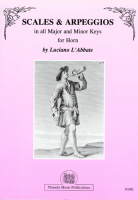
In my experience, simply telling students to practice their scales doesn’t really work.  Without some sort of a framework, deadline, goal, etc., this valuable part of the routine is often neglected, resulting in sluggish technique, diminished range, and various other issues.  There are a number of great methods for systematically working on all the major and minor scales, like Arban’s Complete Conservatory Method for Trumpet, and Schantl’s Grand Theoretical & Practical Method for the Valve Horn, to name a few.  Another excellent resource that I recently became aware of is Luciano L’Abbate’s Scales and Arpeggios for horn, published in 1995 by Phoenix Music Publications.  This is the same company that publishes – among other things – all of Kerry Turner’s music.  I couldn’t find much information about the author, although the website of the Italian Horn Club lists Mr. L’Abbate as one of two principal horns in the Orchestra Sinfonica Siciliana.  Perhaps someone out there has further biographical and career information on him.

Getting back to the scales book, it is very well organized and would make a great tool to ensure that students are fluent in all of their major and minor scales with arpeggios over a three octave range.  According to the editor, whose name is unfortunately not included in the text, “The book is divided into four main sections. The first and third sections contain (respectively) basic scale and arpeggio progressions in all of the Major and Minor Keys. The second section contains scale progressions which can be played in all of the Major Keys. The final section lists variations of arpeggios in chromatic progression, again through all of the Major Keys” p. 2.  Most of the scale exercises are quite standard, although dynamic, tempo, and articulation markings have been intentionally omitted so that the student can vary these parameters for a more thorough workout.  The arpeggio exercises include interesting rhythmic patterns – like quintuplets – which should keep even advanced students on their toes. One possible framework for using the book would be to cover one major key (with relative minor) from the first section and the corresponding arpeggios from the third section each week.  Each major/minor scale “unit” should be easily manageable, and every key could be covered by the end of a fifteen-week semester, with room to spare.  This schedule could also be extended over two semesters by alternating work on major and minor keys (with arpeggios).  Additionally, the second section – which is to be played in all of the major keys – could be used very effectively as a tool for teaching transposition.  All in all, this 84 page text is a very nice resource, and at around $25 is a real bargain – I purchased my copy from Pope Instrument Repair.

New Brass Trio CD

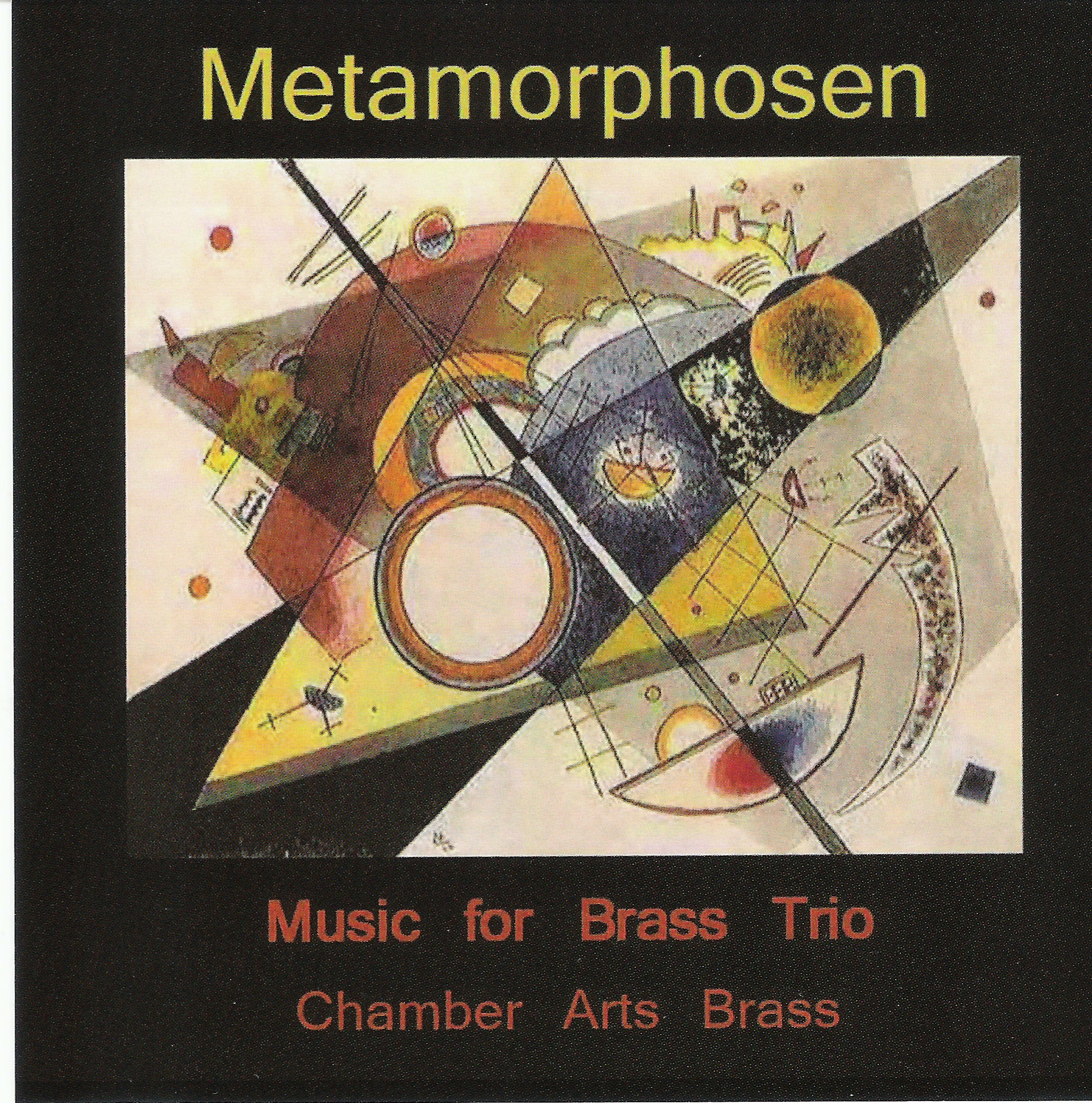
One long term project I’ve been involved with is a CD recording of brass trio music, featuring the Chamber Arts Brass, the resident faculty brass trio here at the University of Louisiana at Monroe.  The project actually began in the fall of 2008 with a written proposal for funding from the College of Arts and Sciences at ULM.  We were fortunate in that our proposal was funded, and we were able to proceed with recording the CD.  We recorded over four days in April of 2009, averaging about three hours per session.  After the recording sessions, we spent several hours editing and mastering with the recording engineer, and now have a nice final product to show for it.  It should be said up front that this recording is strictly for promotional/educational purposes, and is not for sale. However, if you are interested in hearing the entire CD I’ll include a link to the files at the end of this post.  As many of you probably know, producing a commercial CD is quite expensive, and unfortunately we were not able to afford the mechanical licensing costs for this particular project.  As such we cannot legally sell the recording for a profit, but I do believe that we are within the law by making these recordings available for free to prospective students and other interested parties for educational purposes.

The title of the CD is Metamorphosen, and includes a number of standard as well as newer compositions for brass trio.  One of the strengths of our proposal I believe was that many of these works had to my knowledge never been recorded, although some of them have become quite popular in the repertoire.  Check out the image below for a complete listing of the contents.  The personnel for this recording were as follows:

Marilynn Gibson, trumpet; James Boldin, horn; Micah Everett, trombone; Trenton Dick, recording engineer (recording/editing/mastering); Jason Rinehart, producer

Of the works we recorded, the Beethoven Trio, Op. 87 is definitely the most substantial.  It is one of the more frequently performed brass trio arrangements, but surprisingly I was unable to find very many recordings of it. Originally composed for two oboes and English horn, the Trio works quite well for the trumpet/horn/trombone combination.  Another particularly interesting work is Figaro Metamorphosen, by the Dutch composer Jan Koetsier. Koetsier has a number of very nice works for brass, and a handful of solo horn compositions.  His style is tonal and often lighthearted, but quite challenging at times.  His Figaro Metamorphosen is of course where we got the title for CD, and is an extended (9+ minutes) single movement composition based on themes from Mozart’s comic opera The Marriage of Figaro. To my knowledge this work has not been previously recorded, making ours the debut recording.  Here’s the link to the recording if you’d like to take a listen.

I will most likely post in the future about the recording process, but those who have done some recording know how grueling it can be.  Things must be in effect “perfect,” or as perfect as they can be on a given day under a particular set of conditions.  For this recording we decided to use our recital hall here at ULM as it would help cut down on some of the recording costs and also because the space is really quite good acoustically.  However, for a number of reasons we were unable to have the air handlers turned off in the hall so you can hear a low pitched hum on every track.  In addition, recording in a hall creates more variables acoustically, so at times it was difficult to splice the takes we wanted because of excess reverb from a previous section bleeding over into our splice.  In the controlled environment of a recording studio this would not have been an issue.  But, in general I am very pleased with the final product and I am excited about sharing it.

If you liked the sample included above you can listen to all of the tracks from the CD by visiting the following link. http://www.ulm.edu/~boldin/sound.html

Favorite High Range Exercises

Horn teachers normally keep a running list – mental, physical, or both – of their favorite exercises for tackling various areas of horn technique, and the high range is no exception.  There are dozens and dozens of great exercises, methods, and approaches for working on this range, and over time teachers develop their own approach to working on it with students.  So why can the high register be challenging on the horn?  One of the best explanations I’ve read is in Douglas Hill’s High Range for the Horn Player, published in 2005 by Really Good Music, LLC.  He notes the following in the introduction.

The high range on the horn is often a problematic register for large numbers of young as well as for many advanced performers. The overall length of the instrument, the deep cup of the typical horn mouthpiece, and the necessity for the player to eventually administer a full four to four and a half octaves often causes younger players to seek and discover shortcuts to the high notes. These unfortunate shortcuts are often found by forcing: using too much facial tension and/or pinching at the aperture, or through too much mouthpiece pressure, especially against the top lip. Short-term results often become long-term problems!

While some players do experience quantum leaps in their high range – vast improvement in a short period of time -I think more often a good high range is developed over time by consistent practice.  I like to vary my materials, as students can often get frustrated by working on the same exercise(s) day in and day out.  The following list describes a few of my favorites – meaning those exercises that I keep coming back to both in my own playing and in lessons.  They are quite simple, but really do seem to get at the specific technique required in the high range.  In my opinion the best high range exercises are those that trick you into playing higher than you think you can play.  Once you develop the technique, it doesn’t really feel like you have to work at all to play these.

William Brophy, Technical Studies for Solving Special Problems on the Horn, p. 16, Exercise No. 5 and Exercise No. 6 According to the author, Exercise No. 5  “utilizes the half-step approach to the upper notes but in major arpeggio form rather than scale-wise. In this exercise “ride” the tone on a healthy, steady, mezzo-forte air stream.”  I use this exercise primarily as a way to check on my air and tongue placement in the high range.  If things aren’t working right I can tell immediately and make adjustments if necessary.  Exercise No. 6 is a classic pattern familiar to many players, and uses the harmonic series to develop high range.  I like to add crescendos and diminuendos as appropriate to help work on the necessary air speed for high playing.

James Stamp, Warm-Ups and Studies for Trumpet and Other Brass Instruments, p. 9, No. 5 This pattern is great for working on air speed and power in the high range.  For more information on James Stamp and his routine, check out the series of articles at LivMusic.  This blog is maintained by Craig Morris, Professor of Trumpet at the University of Miami.

The last exercise is one I developed a few years ago, and I use portions of it everyday in my own routine.  The idea behind this exercise is once again to trick yourself into playing higher than you think possible and with only the minimum amount of effort required.  The “flick” concept is of course borrowed from Philip Farkas in The Art of French Horn Playing. As with many other high range exercises, this one starts in a comfortable register to establish the proper habits without any unnecessary tension.  Brief instructions are included, and you can download the complete exercise here: High Register Exercise – Horn World

As with just about anything, the key to developing a high range on the horn is to keep a good attitude and to go about things in a logical and informed way.  I realize that I’ve only scratched the surface in terms of the excellent materials out there, and I would love to hear about your own favorite high range exercises.