Developing Rhythm

Kyle Hayes, editor of the International Horn Society’s Horn Zone and a graduate student in Switzerland, recently wrote in with the following question.

Have you written anything on your blog with advice/aids in developing rock-solid timing?…Timing as in accuracy in rhythm, subdivision, and the like. Basically seeing the music and having the subdivision just happen naturally so there’s no guessing when it comes to the rhythm.

Kyle’s question prompted me to go back through my materials, and I discovered that while the topic comes up several times, I’ve never really covered it directly. Here is an attempt (or at least the beginning of one) to address the issue. A teacher once told me that rhythm was one of the most difficult things to teach, and in my experience there are plenty of students who can play the notes, but far fewer who can play the notes with correct rhythm. For me, there wasn’t really a breakthrough moment when rhythm just seemed to click; rather developing an internal pulse and subdivisions happened slowly over several years. I still work on rhythmic accuracy every day, particularly as it applies to the timing of attacks. I find that my pitch accuracy (especially on first attacks) is directly related to how well the attack is set up rhythmically. Here are a few ways I work on rhythm.

1. Use a metronome 80-90% of the time. This may seem like an excessive amount, but it really makes a difference, especially with orchestral excerpts. Use the subdivision feature on your metronome to hear exactly how triplets, eighths, and sixteenths sound, especially in slower tempos. Often rhythms are learned as approximates, rather than mathematical divisions. One of the biggest offenders is the quarter-note triplet, where the final quarter is played too short. Only by hearing the internal subdivision can this rhythm be felt (and played) correctly.

2. Play the subdivisions. This is a particularly effective technique for developing accuracy on the dotted-eighth/sixteenth rhythm and its variants. By taking this extra step in the process, this rhythm becomes much more precise.

3. Subdivide before an entrance. We all know we’re supposed to subdivide while playing, but it really helps to get the subdivisions going several measures before an entrance. One excerpt that I struggle with beginning is the opening of Tchaikovsky’s Fourth Symphony. My tendency – especially when playing the lower octave – is to scoop or stutter into the first note, which is not the desired effect. The entrance must be solid and forte from the very beginning. Just thinking simple eighth-notes, or even sixteenths, wasn’t really that helpful, and what ended up working was thinking of a “real” rhythm as in the example below.

For whatever reason this made all the difference in timing the breath and tongue for the first note.

4. Metronome on, metronome off. I’ll often practice a difficult rhythm or entrance by alternating practice with and without the metronome in a short period of time. I play it several times with the metronome, then turn it off and immediately play the passage again, striving to keep the feel going internally. This kind of practice seems to help bridge the gap between following the metronome and developing an internal pulse.

5. Rhythm is physical. It may seem like a no-brainer, but rhythm is built right into our bodies. Tapping a foot (as in Caruso exercises) and other kinds of movement are critical to understanding rhythm. Marching around the practice room or studio while singing an excerpt can do wonders for your approach, or for other kinds of passages creating a dance of some kind might be more appropriate.

This is just a start, and feel free to alter and/or create your own exercises for working on rhythm. Here are a few resources with particularly good sections on rhythm.

Robert Starer, Rhythmic Training Hal Leonard, 1969 A staple in sight-singing classes, this book contains progressive rhythmic exercises.

Nicholas Smith, Don’t Miss: Ideas, Concepts, and Exercises Designed to Increase Accuracy on an Inaccurate Instrument Hornsmith Publishing, 2010 (See p. 56-57 for exercises to help correct a hesitation or stutter attack.)

Milan Yancich, A Practical Guide to French Horn Playing Wind Music Inc., 1971 (See p. 46 for another exercise for stutter attacks.)
Kopprasch Project continued, No. 37

Here’s the latest installment in my Kopprasch video project. It’s been a while since the last video, but I am hoping to pick things up in the next few months and record more frequently. The Cornopub edition suggests a tempo range of quarter note=72-112, and my tempo settled around quarter=88. As always, consider using some B-flat horn fingerings below the staff for better clarity.

Semester Project: Intonation

In Monday’s Fall 2012 preview, I neglected to mention one other long-term project, working on intonation. In general I have fairly good intonation, but noticed my pitch starting to creep up this summer. It was particularly noticeable during a recording session with organ at the beginning of August. The organ was tuned to A=440, and I was consistently higher than it through most of the day. I was able to compensate by simply pulling the slides a bit more than their normal settings, but it bugged me that I wasn’t settling right into the pitch already. Whether this was due to not playing regularly in an ensemble for several weeks, or somehow altering my practice habits which resulted in playing sharp, I’m not sure (although I have some suspicions, posted below). At any rate, I’ve been working steadily over the last week and will continue to do so in coming weeks to get the pitch down into the center of each note. If you have encountered a similar issue in your playing, perhaps some of these ideas will be of use to you. First, here are some possible reasons for the rise in pitch.

1. Excess tension, particularly at beginnings of notes: I have noticed that it is very easy to work yourself up into a tense state just prior to an entrance, especially if it requires a delicate articulation. I find that if I do that the note begins sharp and then I have to bring the pitch down after the initial attack.

2. Stretching/over-tightening the embouchure in the middle register: Obviously this issue is related to the first one, and probably has the same root cause-too much tension.

3. Too high a vowel sound/tongue position for the middle register: Probably caused by excess tension as well, though it is a little difficult for me to pinpoint exactly where the tension is. Ideally the tongue should probably be in a fairly neutral position for the middle register, as when saying the syllable “ahh.”

4. A false sense of where the center of each note is: As many players will attest, if you play sharp (or flat) for long enough, your ear will begin to hear the out of tune pitch as being in tune, and the embouchure will react accordingly. The problem hasn’t gotten too severe for me (yet), and thankfully after only a week of re-focusing on intonation I can already tell a difference in where I place certain notes.

There are certainly more reasons for less than acceptable intonation, but these seem to be the main ones I’m confronting right now. Ok, so what steps am I taking to improve upon it?

For Number 1 (and 2), breathing and relaxation work have been helpful, paying careful attention to avoid any hesitation between the inhale and attack. Air attacks are useful as well. For Number 3, I am working to reinforce a relaxed tongue and vowel sound for the mid-range (ahh, not eee). Number 4 is a work in progress, just like the rest, but is already showing some improvement after regular work with drones. I have worked with drones in the past, but not as intensely as in recent days. Right now I am spending more time playing with a tonic drone than without! I think drones (like those included with the Tune Up Intonation System) are much more beneficial than tuners, as they train the ear and not the eye. Do you have any other techniques for improving intonation? Feel free to comment below.

Fall 2012 Preview

The fall semester is swiftly approaching, and I for one am very excited to get started! I’m looking forward to reconnecting with my colleagues and students, and continuing with several projects from the summer. Here’s a brief list of some of the activities coming up this fall.

NACWPI/CMS Conference: Black Bayou Brass will be performing in November at the national conference of the National Association of College Wind and Percussion Instructors. This year the conference will be held in San Diego, CA, in conjunction with the College Music Society‘s national conference. We’re still narrowing down our program at this point, but our focus will be on American composers, including music by Jan Bach and David Sampson.

New Students: We’ll be welcoming two new freshmen into the growing ULM Horn Studio, and I look forward to getting to know them better during our work together. Required materials for freshmen horn players this year include Daily Routines for the Student Horn Player by Marian Hesse, and Ultimate Horn Technique, ed. by John Ericson. They are both great publications, and cover a number of essential techniques for horn playing.

New Faculty: Beginning this fall we will welcome a new member to the ULM brass faculty, Dr. James Layfield. Dr. Layfield will be taking over the low brass studios from Dr. Micah Everett, who recently accepted a position at the University of Mississippi. We wish both of them well in their new positions!

Orchestra Concerts: I’ll be playing in the horn sections of several orchestras this fall, including the Monroe Symphony andRapides Symphony. Repertoire for these orchestras will include Copland’s Appalachian Spring, Rossini’s Overture to Semiramide, Beethoven’s Eroica Symphony, and more. Another orchestra concert I’m looking forward to is with the Shreveport Symphony, where I’ll be subbing on third horn for a program including Brahms’s Academic Festival Overture and Dvorak’s Symphony No. 8.

More Recording, and a Recital: In December I’ll be recording the rest of the material for my Koetsier CD, including several pieces for horn and piano (Richard Seiler, pianist). In addition, I am planning a recital (date TBA) to feature a majority of the works from the recording (Horn/Piano Works, Sonata for Horn and Harp, etc.). Though the project is far from complete, it has been, and will continue to be, very exciting to watch it take shape.

As always, I am thankful to be teaching and performing alongside some wonderful students and colleagues. Here’s to a great semester!

Review: A Hornist’s Handbook, by Randall Faust

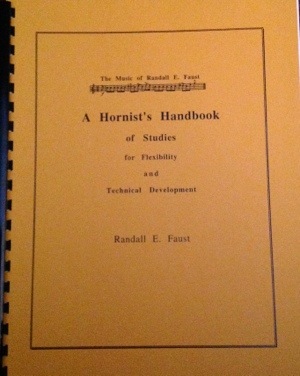
Here’s another review I meant to write earlier this summer but am just now getting around to, Randall Faust’s A Hornist’s Handbook of Studies for Flexibility and Technical Development. I purchased this book along with Christopher Leuba’s The Rules of the Game at IHS 44 in Denton. Simply put, this is one of the most comprehensive single-volume collections of technical exercises I’ve ever seen. At 137 pages, this is much more than a daily warm-up or routine, but rather a compendium of exercises from which to select multiple warm-ups and/or routines. The exercises cover long tones, scales (major, minor, chromatic, modal) intervals (3rds through 7ths), flexibility (numerous lip trill and lip slur studies), articulation, arpeggios (two and three octaves), stopped horn, dynamic range, and sample warm-up patterns. Each section is prefaced by concise instructions from Dr. Faust which, if followed, will ensure that the player gets the maximum benefit from the exercises. The arpeggio studies included near the end of the book are an excellent example of the thoroughness with which the author approaches his subject. The customary two and three octave patterns normally found in similar publications are here, but in addition there are studies based on the diminished 7th chord, Neapolitan chord, and German and French 6th chords. The major scale exercises also go beyond the usual patterns, with exercises in diatonic 3rds through 7ths.

Dr. Faust’s preface provides some great overarching principles to be applied throughout all of the studies. Here are a few:

Aural skills and sight singing skills are important. The hornist should train his ear to lead his fingers.

Tone production should be led by the airstream. I believe that Horn playing at its best is merely an extension of the natural breathing process.

To summarize, A Hornist’s Handbook is one of the most complete collections of technical studies (by a single author) out there, and is highly recommended for both students and teachers. Although I probably won’t be replacing my normal warm-up and maintenance routine with it, I will definitely be incorporating several exercises from its pages into my daily practice, as well as making assignments for my students. For more information on other collections of technical studies, check out these posts.

“More Warm-ups and Routines for Horn”

“A Review of Ultimate Horn Technique

Thursday Review: Instructional Videos for Horn

Since our spring break begins tomorrow, I’m posting this week’s review a day early. I’ll be taking the next week off from blogging, but will resume after the break.

Today we’ll look at an assortment of instructional videos for horn, one collection from YouTube, and another from the website Banddirector.com. With thousands of horn-related videos out there, why choose these for discussion here? One reason is that because of the sheer number of videos online, it can be difficult sometimes to separate the credible sources from the not-so-credible ones. In the case of these videos, they all come from reliable sources – professional players and university professors. Another reason, related to the first one, is that all of these videos have been produced by fellow UW-Madison alumni. They’re well done, and backed up by lots of playing and teaching experience.

The first set of videos is found on the YouTube Channel UNCWindEnsemble, and covers a variety of important topics. Although I couldn’t find an indication in any of the videos, the clinician here is Dr. Abigail Pack, Associate Professor of Horn at the University of North Carolina at Greensboro. In addition to the lack of production credits on the videos, the YouTube channel name is a little misleading, as it doesn’t specify which UNC campus is being represented. The video and audio quality are quite good, and Dr. Pack does a fine job explaining her chosen topics. The intended audience seems to be music educators and horn players, although other brass players could certainly benefit from watching as well. Here are titles and links to the videos.

The next several videos come from Banddirector.com, which claims to be “The #1 Online Resource for Band Directors.” The site was new to me, but they do have a nice archive of video and print resources related to brass instruments. One video which immediately caught my attention is titled “Stopped Horn – Techniques for French Horn,” presented by Dr. Lin Foulk, who is an Associate Professor of Music at Western Michigan University. Having put together my own video on stopped horn, I was really interested in Dr. Foulk’s take on things. She does a great job explaining the essential stopped horn basics in a short amount of time, and I highly recommend her video to both students and band directors. The video quality is a little grainy, but the overall effect is still good.

Next from Banddirector.com are a couple of videos featuring Bernhard Scully, formerly of the St. Paul Chamber Orchestra and Canadian Brass, and now an Assistant Professor at the University of Illinois at Urbana-Champaign. Recorded during his time with the Canadian Brass, the videos are titled “French Horn Breathing Tips,” and “The Hand & French Horn Bell.” As you might expect, Professor Scully has some great advice on these topics, and in addition to being a top level player he has clearly thought out the pedagogical side of things. The audio quality is a little distorted during the playing segments of the videos, but otherwise the presentation is quite effective.

One other highly recommended resource found on Banddirector.com is a reprint of an article by IHS Honorary Member Louis Stout (1924-2005) titled “Choosing an Artist French Horn.” In addition to describing the qualities that an artist level instrument must have, he provides an annotated list of orchestral excerpts which can be used to test out new horns.

Friday Review: Lip Flexibilities by Bai Lin and Lip Slurs for Horn by Howard Hilliard

For today’s review we’ll consider two excellent resources for practicing lip slurs.  Though ubiquitous in method and etude books for brass instruments, these two publications really cover the topic in a progressive, systematic way. Briefly, some of the benefits of practicing lip slurs include:

  • Improved flexibility and control of the air stream
  • Better tone quality
  • Greater endurance and range
  • Better understanding of the harmonic series

There are more benefits than these I’m sure, but these alone should be enough to get any serious player interested in a lip slur regimen. The first book up for review is Bai Lin’s Lip Flexibilities for All Brass Instruments, published by Balquhidder Music (image linked from Balquhidder Music’s website). Bai Lin is Professor Emeritus of Trumpet at the Central Conservatory of Music in Beijing, China, and is well known as a performer and pedagogue. Special thanks go to Michael Helman for pointing out this publication to me. Though written by a trumpet player, as the title suggests the exercises contained here are beneficial on all brass instruments. One caveat though is that the book is geared towards treble clef  instruments (trumpet, horn, treble-clef euphonium), although I’m sure the patterns could easily be adapted for bass clef instruments. In his Preface, Professor Lin offers some excellent words of advice for practicing lip slurs – or anything else.

During practice sessions your embouchure, throat and tongue should be naturally relaxed and flexible. The air should be fluent and steady (consistent). Always try to produce your most beautiful tone.

If you feel your embouchure is tiring or is uncomfortable, you should choose an easier section to practice. Do not attempt to play in too high a register. This will avoid hurting your embouchure or learning to play incorrectly. [p.  5]

The exercises begin simply with half-note and quarter note slurs, beginning on open notes and moving downward through the harmonic series. Subsequent patterns expand both in range and rhythmic complexity, and the final exercises are truly virtuosic. For horn players, the book would make a fine supplement for developing accuracy and flexibility in the high range (the lowest pitch is an f-sharp below the staff).   Dynamic and tempo markings are not included, but I would assume that these should be added and freely altered depending upon your own needs and capabilities.]

Next is Howard Hilliard’s Lip Slurs for Horn: A Progressive Method of Flexibility Exercises, newly revised and published by Meredith Music (cover image linked from http://cornocopiapress.com/). Dr. Hilliard is an active performer and teacher in the Dallas/Ft. Worth area, and has published numerous articles in The Horn Call.  He also has a very informative website about the history of horn playing in Los Angeles. Like Bai Lin’s book, Hilliard’s begins very simply, but with even more attention towards a progressive system for studying lip slurs.  Lip Slurs for Horn is divided into six chapters, each with several exercises for developing a particular skill or skills. The chapters are titled “A Progressive Foundation,” “Large Intervals,” Adjacent and Out-of-Tune Harmonics,” “Memorizable Warm-Ups,” “Range,” and “Hybrid Lip Trill Precursors.” Most chapters include helpful text and instructions for proper execution at the beginning. In his introduction, Hilliard provides some valuable insight into the art of playing beautiful slurs.

A balance between variety and accessibility has been used to challenge the ear and combat the monotony of the typical lip slur exercise while maintaining a logical and musical shape to the phrase. As with all lip slurs, the level of difficulty varies widely depending on the level of execution. Manipulating the air stream is key, not only in hitting the pitch but also in voicing each note with a full and ringing sound. It is in this context that the irony of the term “lip slurs” needs to be appreciated. Among the more advanced exercises, there is a wide variety of lip slurs that focus on very specific skills. Discovering the right approach to the peculiarities of each exercise will maximize both the enjoyment and benefits of this book. [p.3]

Overall these are both great books, and well worth studying. Combined with effective practice and thoughtful instruction, lip slurs can be used to develop tone, technique, range, and more!

Looking for Some New Etudes?

While perusing the amazing resource that is the University of Iowa Horn Studio Site, I came across a recent dissertation by Brett Miller.  Dr. Miller is a member of the U.S. Air Force Band, Ceremonial Brass, and also a composer of music for winds and brass.  His D.M.A. dissertation from the University of Maryland is titled 45 Concert Etudes on the Themes of Richard Strauss, Gustav Mahler, and Johannes Brahms, 2007 (follow the link to download the entire dissertation). The passage below, quoted from Dr. Miller’s abstract, provides an excellent summary of the goals and methods behind this substantial project.

The composition of these etudes was influenced by Franz Strauss’ pedagogical study, 17 Concert Studies for Valve-horn after themes from Beethoven. Strauss’ etudes were designed as pedagogical tools to enhance his students’ abilities on the horn as well as to enable greater ease in the performance of the works of Beethoven. Strauss borrows themes from Beethoven, each of which is woven into an etude designed around specific technical goals. Each etude is designed as a concert piece, rather than a repetitive technical etude…Following Franz Strauss’ example, this project involves the creation of 45 concert etudes that are based on themes from the works of Richard Strauss, Gustav Mahler, and Johannes Brahms. Each etude focuses on particularly demanding technical or musical challenges that horn players encounter in preparing these works for performance or audition.

In the first part of the document, the author provides a brief biography of Franz Strauss, as well as an analysis of etudes 10, 11, and 13 from his 17 Concert Studies on the Themes of Beethoven. The rest of the dissertation presents Miller’s new compositions, picking up where Franz Strauss left off and going quite a bit further. Each etude is prefaced with a technical and musical analysis, and a detailed discussion of the excerpt on which it is based. As promised, Miller’s etudes go beyond the difficulty of the actual excerpts, with the goal being a more efficient, accurate, and musically convincing performance of the excerpts in an audition or performance. All of the major works by each composer are covered, and in fact this document serves very well as an introduction to several of the major orchestral excerpts by three of the greatest composers for the horn. Here are a few highlights from Miller’s collection.  Many of the more challenging works include multiple etudes dealing with different excerpts from the same piece.

Richard Strauss

  • Don Juan
  • Sinfonia Domestica
  • Salome
  • Till Eulenspiegel
  • Don Quixote
  • Death and Transfiguration
  • Ein Heldenleben
  • Horn Concertos 1 and 2
  • Alpine Symphony

Gustav Mahler

  • Symphony Nos. 1, 3, 4, 5, 7, 9

Johannes Brahms

  • Symphony Nos. 1-4
  • Academic Festival Overture
  • Concerto for Piano No. 2
  • Serenade No. 1
  • Trio, Op. 40

Though I haven’t spent much time with these etudes yet, I can certainly see their value for teachers, students, and professionals alike. They fill a gap in the horn’s pedagogical literature, and have the potential to become standard fare along with etudes by Kopprasch, Maxime-Alphonse, and others. Bravo to Brett Miller for a job well done!  N.B. As of this post, I have not been able to find a publisher for the 45 Concert Etudes, but I do hope to see them in print in the future.  [REVISED: The etudes are published and  available at http://www.brettmillermusic.com/horn_dog_publishing.htm and http://hornsociety.org/marketplace/online-library#ecwid:category=0&mode=product&product=6996941  Thanks to Ricardo Matosinhos for sharing this link!]

Friday Review: How to Stop a Horn DVD

The topic for this week’s review is an excellent resource for learning to play stopped horn – How to Stop a Horn – produced by Dr. Randall Faust, Professor of Horn at Western Illinois University. I had the opportunity to speak with Dr. Faust at the 2011 Midwest Clinic, and he generously passed along this DVD as well as several of his other publications. Along with instructional videos by Douglas Hill, Wendell Rider, and others, this DVD belongs in the library of any serious student or teacher. In this 30 minute “virtual lesson,” Professor Faust covers the topic of stopped horn comprehensively, from a historical as well as practical perspective. The video is divided into several chapters, listed below.

  • How to Stop a Horn
  • Historical Considerations
  • Excerpts from Musical Examples
  • Acoustical Considerations
  • An Introduction to Marvin Howe’s Treatise Stopped Horn
  • Practical Considerations
  • Exercises to Practice with this DVD
  • Fingerings
  • Resistance
  • Muted Horn Applications
  • Transposing Brass Stopping Mute
  • Bibliography

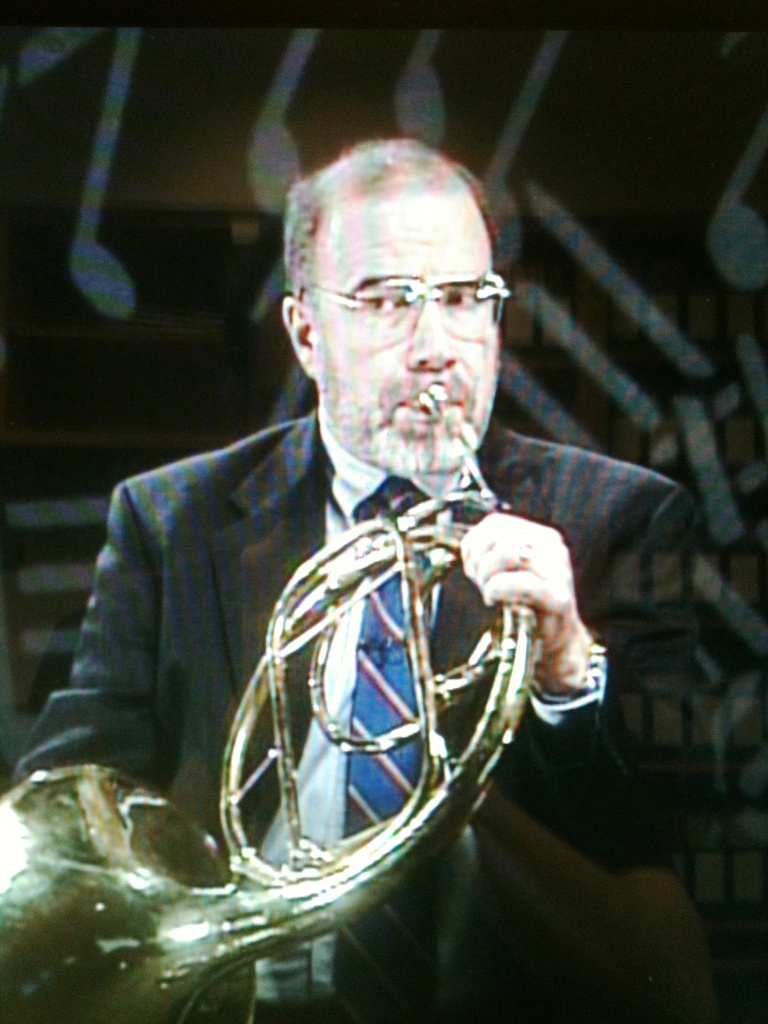
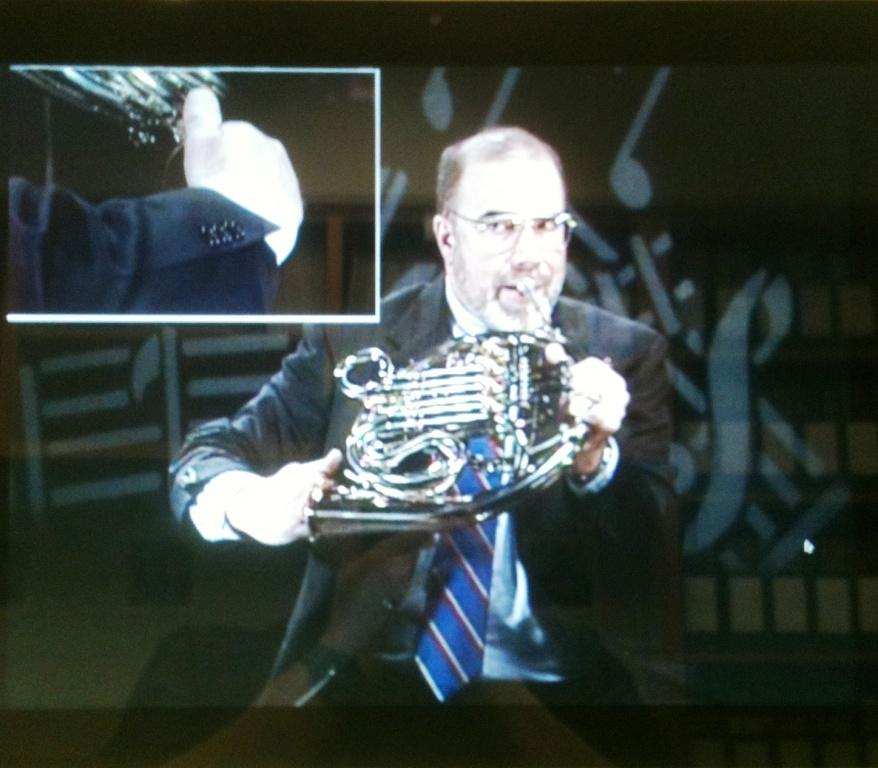
Professor Faust’s commentary is informed by years of experience as a performer and teacher of the horn, and he concisely – but accurately – explains the acoustical phenomena behind hand stopping. All of his lecture material is accompanied by expertly played demonstrations, including musical excerpts by Beethoven and Saint-Saëns (performed on the natural horn, as shown in the above image), and a thorough demonstration of the overtone series. One innovative technique he uses is demonstrating stopped technique on a detachable-bell horn with its bell removed (see image below). The purpose being to show students just how much the bell must actually be closed in order to produce a characteristic stopped horn sound. He also includes several effective exercises for developing and improving stopped horn playing. It’s also worth noting that many of Faust’s musical compositions make extensive use of stopped horn – check them out by visiting www.faustmusic.com. Though I’ve not yet performed any of his music, thanks to Dr. Faust I now have the scores to several of his compositions, and I plan to program them on future recitals. (One idea I’ve been thinking about is a recital of music “for horn players by horn players.” There are several very fine works out there that fit this category, especially by 20th and 21st century composers.)

Be sure to check out this DVD – it’s very well done!  (Read another review of this DVD at HornMatters.com) Having put together my own video resources on stopped horn and other topics, I can say that it is quite time consuming and takes a great deal of work both in the recording and editing process.  Bravo and thank you to Randall Faust for putting together a fine resource.  [All screen images from How to Stop a Horn used by permission.]

Thoughts on The Randy Gardner Accuracy Challenge

Several months ago, I stumbled across the Facebook page for the horn studio at the Cincinnati Conservatory of Music. Under the expert tutelage of Randy Gardner, the studio consistently produces  great horn players and teachers.  One post on their Facebook page that caught my eye mentioned the “Randy Gardner Accuracy Challenge.”  Intrigued, I followed the link to the blog of Rachel Hockenberry, a horn studio graduate assistant at CCM. On her blog she explains how the challenge came to exist, and how to execute it.

Never forgetting about his students during the summer, one of a few summer projects Mr. Gardner assigned us is what I will refer to as the Randy Gardner Accuracy Challenge, or simply The Challenge. Mr. Gardner created and subjected himself to this exercise over the course of a summer during his college years. The Challenge requires the participant to own book 1 of the Maxime-Alphonse 200 Etudes nouvelles melodies et progressives pour cor. Here’s how you play:

1. Open your Maxime-Alphonse to the first page.
2. Play the first etude PERFECTLY three times IN A ROW. Do not miss a note. Do not even let so much as an unclean attack make its way into your performance. Follow all articulations, dynamics, phrasing and tempi.
3. If you miss a note, DO NOT STOP. Finish the etude, then start over.
4. If you mess up in your second or third repetition, you must complete the repetition and then start over again at performance #1. For example: if you miss a note in the middle of your second repetition, you must play to the end of the etude, and then start over with attempt #1.
5. You guessed it: even if you miss the very last note of your third repetition, you must start the cycle over again. You must play the etude perfectly three times IN A ROW before you can move on to the next etude.
6. Repeat this process for all 70 etudes.
Rachel goes on to explain that for the sake of one’s sanity the challenge should not be attempted for more than 10-15 minutes a day. I think this kind of competition with oneself is a great idea, provided that it is approached in a healthy, positive way (as Rachel is doing). Though I haven’t tried this with the first Maxime-Alphonse book (perhaps another summer project?), I have done something very similar in the past when preparing excerpts for auditions, or solo passages in orchestral and chamber music. As Rachel mentions later, challenges like this are “predominately an exercise in concentration,” though a certain amount of physical stamina is also required to be successful.  I also think that a good preparatory activity to tackling extended accuracy exercises is to try just one line of the etude or solo you’re working on. Once that line is mastered to the “three times perfectly” point, then add the next line, and so on.  For more difficult music, the accuracy drills may have to begin with only a few measures at a time.  Whatever shape your own accuracy challenge takes, the important point is to spend a few minutes every day focusing on it. If Maxime-Alphonse Book 1 isn’t your idea of a good time,  go with folk tunes, pop music, or whatever you like. Another resource for accuracy exercises is Dr. Nicholas Smith’s Don’t Miss: Ideas, Concepts, and Exercises  Designed to Increase Accuracy on an Inaccurate Instrument.  It’s a very well thought-out book, and to my knowledge the only resource out there dedicated solely to accuracy on the horn.
Do you or your students use a variation on the “Randy Gardner Accuracy Challenge?”  If so, what materials do you use? [Image above linked from www.wpclipart.com.]