Performing Tamusuza’s Okukoowoola Kw’Ekkondeere

The sounds of the vuvuzela (see the great post on this topic from Horn Matters) emanating from our living room television got me thinking about Justinian Tamusuza’s Okukoowoola Kw’Ekkondeere (Horn Call), a piece I performed a while back at the 2009 Southeast Horn Workshop at Western Carolina University.  Tamusuza is a Ugandan composer, and this piece for solo horn was premiered in 2006 by Adam Lesnick at the 38th IHS Symposium in Cape Town, South Africa.  As an introduction to the piece, I’ll quote from Mr. Lesnick’s performance notes, which are included in the score.

Okukoowoola Kw’Ekkondeere is an expanded version of the unaccompanied horn call that serves as the introduction to an ensemble piece scored for horn, string quartet, and maracas. This unaccompanied horn introduction works very well as a colorful stand-alone recital piece that includes sounds that are unexpected from a solo horn, even for those of us who play the instrument.  In just over four minutes the horn opens with dissonant quartertone calls, followed by sections with rhythmic African pentatonic melodies, and then becomes increasingly more percussive, finally fading into the distance with a unique muted drumming passage.  It is very audience-accessible, fun to perform for both professional and advanced student hornists, and adds some interesting diversity to the existing horn repertoire.

This piece was very fun to prepare, and I was able to perform it several times – three performances including the Southeast Horn Workshop. The work is filled with extended techniques, which took some detailed working out.  Two of the most interesting effects called for are tubular tones and percussive tapping on an inserted straight mute.  Quoting Adam Lesnick again:

In the rest at 96, the mute is inserted (for the remainder of the piece) and the second F and first Bb tuning slides are removed from the horn (also for the remainder of the piece).  From bar 97 to 131 the horn plays percussive African ostinato figures that are common in Kigandan music.  With the tuning slides removed from the valve section of the horn, the notes are played with the unusual harmonic series that is created by the open slide tubes.  Because this sound does not come out of the bell it is much smaller than the usual horn tone and, if played with strong articulation, should sound more like African percussion than a classical wind instrument.

Mr. Lesnick goes on to explain that performers should experiment with removing other slides in order to achieve the correct pitches and transposition.  I ended up removing my first and second Bb slides, which I notated in the part.  The final section of the piece stretched my meager coordination, because it requires playing the horn and tapping on a straight mute simultaneously.  For this technique I followed Mr. Lesnick’s suggestion and used a plastic shaker egg instead of my finger to tap on the mute.  If you’re curious about how all these techniques actually sound, I’ve included below the recording of my performance at the 2009 Southeast Horn Workshop.  Overall I was pleased with the performance, and I think the piece came off well.  I owe a big thank you to Dr. Travis Bennett,  Assistant Professor of Horn at WCU, for kindly sending me a copy of the recording.  He also was an excellent workshop host!  Anyway, on to my performance.

If you enjoyed Okukoowoola Kw’Ekkondeere, consider programming it on a recital or other concert in the future.  The piece is published by International Opus, and you can find much more information on it and Justinian Tamusuza in Adam Lesnick’s excellent article “New African Music for Horn,” published in the February 2007 issue of The Horn Call.
Program Notes

Most music students will at one time or another need to write their own program notes, but this useful skill often goes overlooked in an undergraduate curriculum.  The ability to write and speak engagingly about performance and repertoire is important in every musical career I can imagine.  As with anything, practice and preparation are crucial.  You don’t want your opening band or choir concert during a first year teaching job to be your inaugural experience with written (or spoken) program notes.  Take every opportunity you can during your college years to refine your abilities – draft program notes for studio class performances, chamber music concerts, and of course recitals.  Even if your studio teachers don’t require program notes for recitals, take it upon yourself to create them.  Trust me, you’ll be glad you did.  Here are a few tips for writing program notes, as well as some resources to get you started.

Read! The best way to become a better writer is to read a lot (and write a lot).  Read anything and everything you can about music – journal articles, recording reviews, CD liner notes, blogs, program notes from other recitals, etc.  Keep mental notes of the writers you enjoy the most, and try to figure out what it is about their style that you like.  Don’t worry about consciously imitating, or trying to avoid imitating, their style.  Just let your brain absorb all of this information.

Find your voice. This will take some time, but eventually you won’t feel like you’re copying the language your teachers and textbooks use.  You have to start somewhere, so if you like the rhythms and patterns of another author or authors, try incorporating small parts of them (without plagiarizing!) into your own writing.  Your growing reading experience (see above) will tell you when things work or don’t work on the page, and you can adjust or tweak things as necessary.

Know your audience. Program notes for an informal summer recital at a church should be different than the notes for a degree recital.  Are you writing for an audience composed mainly of musicians, non musicians, or a mix?  Will lots of music appreciation students be attending your concert/recital?  These are all questions to take into account before and during the writing process.  If your studio teacher or music school has specific requirements for content or format, make sure you follow those.  Ask your professors for help whenever necessary – they won’t write your notes for you, but they can give you helpful advice and let you know if what you’ve written makes sense to them.

Stick to the basics. I think program notes should have some essential information – the composer’s dates and nationality (unless widely known), a few general comments about the composer’s overall style, and how the work being performed fits, or doesn’t fit, with those trends.  It’s also nice to include when and where the piece was originally performed, especially if it makes for a good story.  Consult a thematic catalog if necessary to find this information.  If the work is programmatic, include some background on those extra-musical associations, and any other information you think your target audience will find interesting.

Avoid jargon. Unless writing specifically for an audience of trained musicians, avoid overusing technical terms related to form, phrasing, harmony, etc.  It’s best to try to put descriptions in your own terms, unless you wish to include a brief but pertinent quote from an eminent scholar or performer.

Make it personal. The audience not only wants to know something about the pieces you’re performing, but they also want to know a little bit about you.  Lots of information on composers and dates can easily be found on the internet today, so your program notes should go beyond that in some way.  Briefly explain what it is about the piece that inspires and provokes you, and why you think it belongs, or has remained, in the repertoire.  This works for both new pieces and warhorses.  If there are specific passages that you feel the audience should pay particular attention to, point those out, or even demonstrate them, making sure that you plan/practice any excerpt demonstrations in advance.

Edit/revise as often as necessary. Practice your delivery often if giving spoken notes, then record yourself and listen back to it.  You can use the recording to adjust pacing and content as needed.  Prepare written notes well in advance of the performance so that you have plenty of time to edit and revise, taking into account input from studio teachers and any other professors who are willing to read over your program.  Save electronic and hard copies of your program notes – you’ll want to refer to them again when you program those pieces in the future.

Selected Resources

Online

W.W. Norton Essentials of Music: Excellent all-around site.

Classical Score: Timelines of music history.

Dolmetsch Online: Music history and theory resources.

University of Washington Music Library: Several free resources and handy research guides.

Virginia Tech Multimedia Music Dictionary: Hear pronunciations for musical terms.

Program Notes Wiki: Online collection of program notes for multiple genres.

Iowa Public Radio Pronouncing Music Dictionary

In Print

Theodore Baker, Baker’s Biographical Dictionary of Musicians edited by Nicolas Slonimsky: Excellent biographical information, including many lesser known composers and musicians.

New Grove Dictionary of Music and Musicians: Available in print and online – a standard resource for all types of music research.

William Strunk and E.B. White, The Elements of Style: Full of excellent tips for improving your writing.  The original 1918 edition is also available online.

Stephen King, On Writing: Not music-related, and definitely not PG rated, but nevertheless an excellent book on writing from one of today’s masters.


Stainless Steel Mouthpieces

I’ve noticed some colleagues over the past couple of years trying out stainless steel mouthpieces, and I’m getting kind of curious about them.  It’s a bit difficult sorting out promotional material from factual information about new products, but stainless steel (and also titanium) horn mouthpieces do seem to have a few potential benefits.  Quoting from the Wikipedia article titled “Mouthpiece (brass)”

Two more recent additions to the mouthpiece world are stainless steel and titanium. They are relatively rare, being produced by very few manufacturers. Stainless steel and titanium mouthpieces hold many advantages to the classic brass mouthpiece, including, anecdotally, a much more centered feel and sound,[citation needed] as stainless steel and titanium do not absorb as many vibrations as brass;[citation needed] they require much less care; etc., but they are much more expensive (titanium mouthpieces run up to about $400 each).

As you can see, there isn’t a lot of documented information on how and why exactly these mouthpieces differ from their traditional counterparts, but apparently the density of the material has something to do with making the vibrations more efficient, as well as feeling more comfortable on the embouchure.  Going even further, Houser Mouthpieces, a well known manufacturer, makes the following statement on their website.

The next best solution is to consider a stainless steel rim, top, or complete mouthpiece. Stainless has excellent wetting properties and doesn’t grab or stick to the skin like silver. Arguably, it allows for freer lip vibration than gold plate. The H-Kote coatings enhance these properties and have about 1/2 the coefficient of friction of polished stainless. Endurance  degrades far less quickly after long hours of playing because you are not “fighting” the metal or shifting the embouchure. Swelling, bruising and tenderness are vastly reduced.

This material gets into the science of things a little bit, which I like, and goes on to mention some of the other potential benefits.

Clarity/Core: When you A/B [not sure what this abbreviation means] stainless and brass mouthpieces, there is noticeable clarity and core to the sound with the stainless piece. Stainless is an efficient transmitter of vibration into the instrument. Notes center more easily than on brass mouthpieces and do not brake up or lose center when playing loud. Stainless is an ideal solution when you need to project or cut through.

Durability/Hypo-allergenic: Much harder than brass-superior resistance to scratches and dents. Unlike plated brass, stainless has nothing to wear off. The player can’t be exposed to zinc which is responsible for many allergic reactions to brass even with the plating in tact.

Sounds pretty good, doesn’t it?  The stainless steel option would certainly be a good choice for players with metal allergies, but I would like to get some more reviews from other players.  One low brass player I spoke to liked the stainless steel, but mentioned that the mouthpiece did “stick” a bit more than his normal equipment, especially in slurred passages.  Notice that this is contrary to one of the advertised advantages of stainless steel.  Giddings and Webster also manufactures stainless steel horn mouthpieces, but they take a slightly different marketing angle.

Why is naked better?

Faster response!
Plays the extremes (loud, quiet, high, and low) with ease
Improves endurance
No dangerous chemicals
No plating to wear out
No lead exposure
No zinc exposure
No Nickel exposure

Naked mouthpieces have no plating to wear through, meaning they will last forever

The ease of playability of stainless steel improves endurance, response, and feels great while you are playing

The longevity of our mouthpieces means less waste in land fills, and less pollution in the environment

Naked mouthpieces are better for the environment. No dangerous chemicals are used unlike gold and silver plated mouthpieces. The chemicals in the plating process can be very harmful to the environment

Stainless steel is about three times harder than brass making the extremes (loud, soft, high low) easier

Solid stainless steel means you are never exposed to nickel, lead, or zinc. All three are present in raw brass mouthpieces. All of the materials we use have been approved by the nickel institute, and are used in the medical and food preparation industries

Do yourself and the environment a favor…
PLAY NAKED!!!

They have a number of endorsements from low brass players, but none yet from horn players.  Looking further at their website, they have a variety of horn mouthpieces, and the prices are actually quite comparable to custom mouthpieces made from traditional materials.  One drawback however is their numbering system – it doesn’t really give a clear picture of bore size, inner diameter, and cup depth – pretty important information as far as I’m concerned when looking at mouthpieces.  Despite some unanswered questions, I would still be interested in talking more with horn players who use stainless steel mouthpieces, and possibly trying one out in the future.  If I do, I’ll be sure to write up some sort of a review for this blog.

Alexander Technique and Horn Playing

The Alexander Technique is just one among several mind/body disciplines which can be of great benefit to performing musicians.  Having had personal experience with Alexander Technique, I thought it would make a good blog topic.  I’ll give a bit of informal background, and relate my experiences with Alexander Technique as a performer.

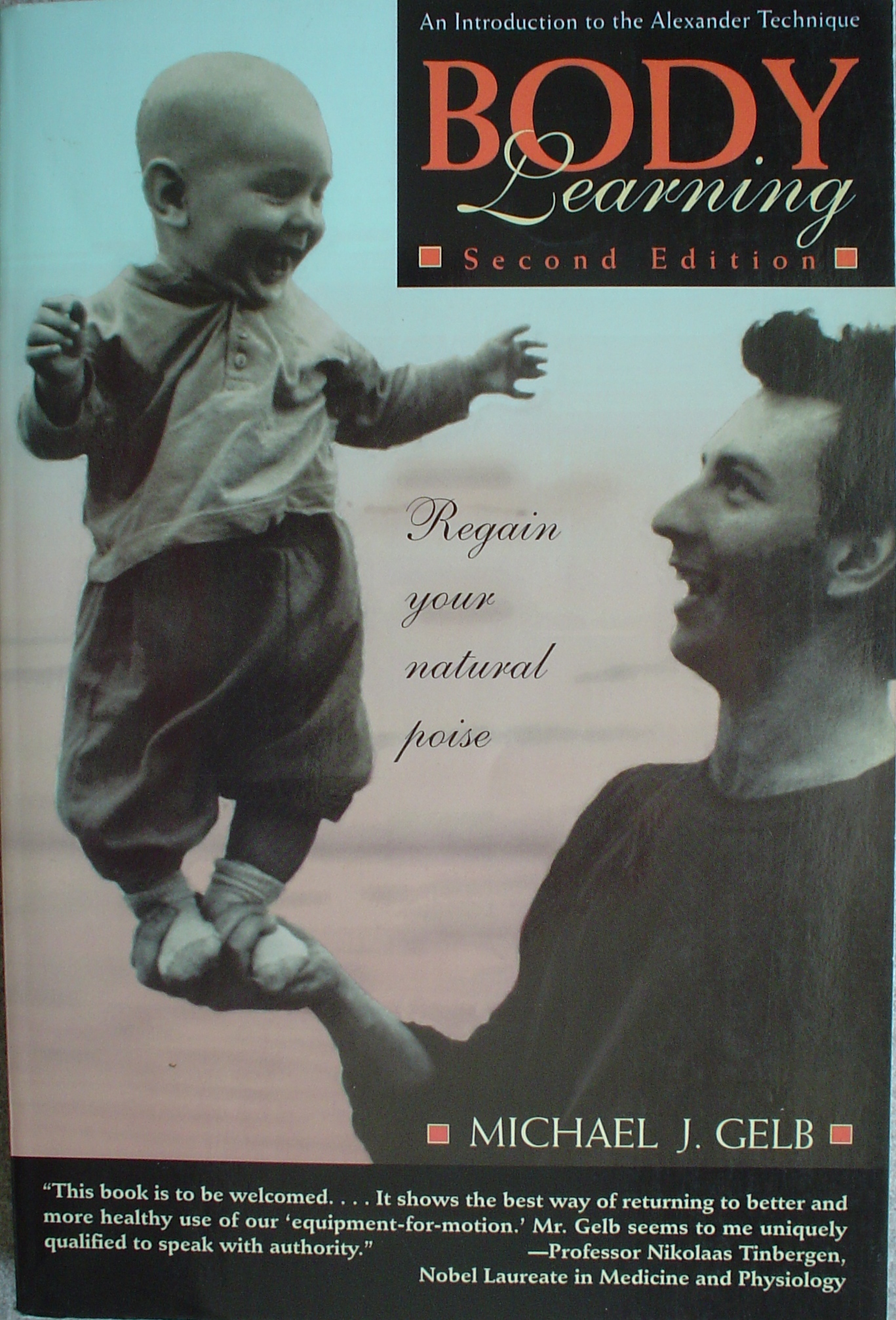
The captivating photo to the left is from the cover of Michael J. Gelb’s book Body Learning: An Introduction to the Alexander Technique, which we used in Alexander Technique classes at Appalachian State University during my undergraduate degree.  While these classes were not required for music majors, they were extremely popular among all concentrations, and I ended up taking the course and private Alexander Technique [referred to from now on as A.T.] lessons for seven consecutive semesters.  This does not make me an expert in A.T. by any means, but I do feel like I have enough background to talk about its benefits (and limitations).  There are lots of definitions of the A.T., but I think the following, taken from the website The Complete Guide to the Alexander Technique, is straightforward and easy to understand. 

“The Alexander Technique is a method that works to change (movement) habits in our everyday activities. It is a simple and practical method for improving ease and freedom of movement, balance, support and coordination. The technique teaches the use of the appropriate amount of effort for a particular activity, giving you more energy for all your activities. It is not a series of treatments or exercises, but rather a reeducation of the mind and body. The Alexander Technique is a method which helps a person discover a new balance in the body by releasing unnecessary tension. It can be applied to sitting, lying down, standing, walking, lifting, and other daily activities…”

Based on that definition, it does seem that the A.T. would have several applications for performing artists, as we rely in many ways on balance, coordination, and efficiency to do what we do.  Experiences among musicians who have studied Alexander Technique differ because of the different approaches that the teachers take.  Just like horn teachers, A.T. teachers can be direct/indirect, active/passive, demanding/undemanding, and the whole range of possibilities in between.  Some  teachers are very hands on, while others prefer to coach students through subtle physical guidance and verbal prompting.  In my classes at Appalachian State, we met once a week for a master class of sorts, with students either performing on their instruments or doing some sort of other physical task under the guidance of the instructor.  Students could also set up private lessons with the teacher (Jane Comfort Brown) during the rest of the week to focus on specific things.   One thread that ran through all of these experiences was the idea of replacing undesirable responses with more desirable ones.  For instance, lets say that every time you get up from a chair your head has the tendency to drop back onto your neck, collapsing your vertebrae and causing unnecessary tension.  A trained A.T. teacher would be able to notice this habit and help you retrain your response to the “getting up” impulse.  As most teachers in any discipline will agree, it is much easier to stop an undesirable habit when you replace it with a desirable one, rather than just thinking “o.k., when I get up I shouldn’t drop my head down and back.”  Likewise, if you have the same tendency when you begin an upward slur on the horn, A.T. lessons could help you replace that response with a more efficient, less tense action.  This is just an arbitrary example, and as I said, different A.T. teachers can have very different approaches for achieving the same goal – namely the use of the whole body in as efficient a manner as possible in everyday tasks, and extending to more complex ones like horn playing.

Reflecting back on all those master-classes and private lessons, I can say that A.T. had some very positive effects for my playing, many of which I am still discovering even several years later.  Of course, the idea of approaching the horn with a minimum amount of tension has been very important, and although I am not a certified A.T. teacher, I do try to communicate this concept to all of my students.  In my personal experience, and I can’t speak for anyone else, A.T. did not suddenly make me a better player – it didn’t increase my range or make my technique lightning fast – but it did help me improve upon those things I could already do.  I still use A.T. every day, both in horn playing and in the everyday tasks I mentioned above, and I highly recommend it to all performing artists.

To close out this post I’ll leave you with a few A.T. resources specifically for musicians.  Also, I’d love to hear about your own experiences with the Alexander Technique, or other disciplines like Feldenkrais Method, Aston Patterning, etc.

David Nesmith, “What Every Musician Needs to Know about the Body,” published in The Horn Call: Journal of the International Horn Society,” Aug. 1999.

Barbara Conable, What Every Musician Needs to Know about the Body: The Application of Body Mapping to Music

A.T. Resources for Musicans at http://www.alexandercenter.com

More Resources for Musicians at http://www.alexandertechnique.com

Joan Arnold, Poise in Performance: Alexander Technique for Musicians posted on http://performancepage.com/

Joffrey Ballet: The Rite of Spring

While Igor Stravinsky’s monumental work Le Sacre du Printemps (The Rite of Spring) is most often performed today as an orchestral concert work, he originally conceived it as a ballet, with sets and costumes designed by Nicholas Roerich, and choreography by Vaslav Nijinsky.  The following YouTube videos are from a full production by the Joffrey Ballet, and is an attempt to recreate the original choreography and scenery from the premier in 1913.  The video quality is not great, as I’m sure this digital version was transferred from a public television broadcast.  To my knowledge, a commercial recording is not available for purchase.  Horn players are familiar with the demanding orchestral parts, but this video highlights the incredible demands placed on the dancers as well.  The soloist in the “Sacrificial Dance” is particularly amazing.  It’s also very informative to see what’s supposed to be going on onstage during Stravinsky’s music.    Enjoy!

Brass Quintet Excerpts, Part III

This is the third and final part of a series of posts on the horn in brass quintet music, and I thought to wrap things up it would be good to talk about a few different topics.

1) Other resources: In addition to the Guide to the Brass Quintet there are many other websites, dissertations, and articles devoted to this type of ensemble.  Check out the Additional Resources page on my website for links to brass quintet websites, videos, and a brief listing of books and dissertations on the subject.  Two highly recommended websites are the  American Brass Quintet‘s , which contains a search-able database of brass quintet compositions, and the British website The Internet Bandsman’s Everything Within (IBEW), which has links to brass ensemble websites worldwide – click on “Bands” then “Brass Ensembles” in the top menu bar.  Two dissertations that I read in detail while working on mine are Marta Jean Hofacre’s The Use of Tenor Trombone in Twentieth-Century Brass Quintet Music: A Brief Historical Overview with a Comprehensive Listing of Original Published Twentieth-century Quintets and a Discussion of Tenor Trombone Excerpts from Selected  Compositions, D.M.A. dissertation, University of Oklahoma, 1986, and Daniel Wayne Kiser’s A Musical and Pedagogical Classification of Selected Brass Quintet Literature, D.M.A. dissertation, University of Illinois at Urbana Champaign, 1987.  Both of these excellent documents are available through ProQuest Dissertations and Theses.

2) Transcriptions and Arrangements: This is one area of brass quintet repertoire I chose not to consider in my dissertation, but these works are as important as original compositions in brass quintet performance – think of all the wedding gigs that wouldn’t be possible without arrangements!  The main reason for omitting transcriptions and arrangements in my project was to keep the size and scope within manageable limits.  However, there are definitely standard arrangements and transcriptions that every serious horn player in a brass quintet should know – one that comes to mind right away is Jack Gale’s arrangement of selections from West Side Story by Leonard Bernstein.

3) Copyright: This was an area I considered very carefully before proceeding with the project, and contacting publishers was one of the first steps.  I included the following statement about copyright in both my dissertation and on the Copyright Information page of the website.

Because all of the works included in this collection are protected by copyright law, obtaining adequate permission from publishers to reproduce these excerpts became another important consideration.  Every attempt was made to contact the publishers of these works to obtain permission to reprint short excerpts for inclusion in this site.  The presentation of short sections of only the horn parts to these compositions prevents this project from being used as a substitute for actual performing parts, and will hopefully provide greater exposure for these compositions.  In all cases, both publisher and copyright information are included at the end of each group of excerpts from a specific composition.  It is my sincere wish that the presentation of these excerpts will encourage brass musicians to seek out the complete parts and purchase them for study and performance.

For the most part, publishers and composers happily granted me permission to reproduce short excerpts, for which I am very thankful.  Although I do believe that the use of these excerpts falls under the “Fair Use” clause of U.S. Copyright Code, I wanted to avoid any potential conflicts.

That does it for this series on the brass quintet – happy practicing!

Brass Quintet Excerpts, Part II

Continuing the post from Part I of this series, we should consider some of the other reasons why it is beneficial to study, or least be familiar with, brass quintet excerpts.  Quoting again from the Guide to the Brass Quintet:

Many of these works are performed frequently by student and professional brass quintets.  Being aware of the important horn solos and other prominent passages in these pieces will keep you from being caught off guard at your next reading session or rehearsal.

Because the brass quintet is the most popular medium for those instruments in chamber music, and because it has a tradition extending back to the 19th century (Ewald, etc.), there is now a more or less standard repertory, similar, though not as large, to what we find in symphonic music.  Even if you are not currently active in a brass quintet, it would still be a good idea to familiarize yourself with the major works and passages in the literature.  (Quoting myself again from the Guide to the Brass Quintet)

Although professional brass quintet auditions are not standardized in this country the way orchestral auditions are, players interested in pursuing a career in chamber music for brass should definitely know this repertoire.  Players auditioning for teaching positions at institutions  which have a faculty brass quintet would also need to be familiar with these works, since a reading session with the quintet would be very likely during the audition/interview process.  In addition, some full time and regional orchestras also have a woodwind or brass quintet made up of principal players – I know of at least one audition list that stated “Auditionee for Principal Horn may be asked to participate in a reading session with woodwind and/or brass quintet.” (Cedar Rapids, Principal/3rd horn, 1997)

If you’re looking for a place to start your study of brass quintet music, consult the list below.  These are all pieces – in no particular order – that I think most would agree are more or less standard in the literature, meaning they are performed and recorded quite often.  There are certainly others equal in popularity, but these are as good as any for a point of departure.  Clicking the links will take you to a specific movement from that work located in the Guide to the Brass Quintet website.  Return to the Excerpts homepage to see passages from additional movements.

Malcolm Arnold, Brass Quintet No. 1, Op. 73

Victor Ewald, Brass Quintet No. 1, Op. 5

Andre Previn, Four Outings for Brass Quintet

Morley Calvert, Suite from the Monteregian Hills

Eugene Bozza, Sonatine

John Cheetham, A Brass Menagerie

John Cheetham, Scherzo

Ingolf Dahl, Music for Brass Instruments [Brass Sextet]

Anthony Plog, Four Sketches

Eric Ewazen, Colchester Fantasy

Brass Quintet Excerpts, Part I

This will be the first of three installments devoted to important horn parts in brass quintet music, which was also the subject of my doctoral dissertation at the University of Wisconsin-Madison.  As part of the project, I created a website, the Guide to the Brass Quintet, as a way to make the information in my dissertation more accessible and user friendly.  As a bit of background, I’ll quote from the homepage to this website.

The initial idea and inspiration for this project came from reading the “Afterthoughts” section of Douglas Hill’s book Collected Thoughts on Teaching and Learning, Creativity and Horn Performance.  In this section, Professor Hill lists a number of intriguing research topics, including the creation of excerpt books focusing on repertoire other than standard orchestral excerpts.  I am very interested in the wonderful music being written for the brass quintet, so this project proved to be an excellent choice given my own research interests and performing background.

What is Contained in this Site?

Hopefully, horn players and other interested musicians will find the following resources contained in these pages useful.

A collection of printable excerpts of important horn passages from some of the most frequently performed and recorded original brass quintet compositions. The excerpts are formatted and edited with additional performance instructions for horn players.

A Discography showing the names of the ensembles, titles of compositions, and information on the specific recordings where each work is found.  The discography lists, at times, multiple recordings of each major work, so that players can study and listen to multiple interpretations.

Supplemental information such as an excerpt classification system, which organizes the excerpts according to their technical requirements, as well as the Range Requirements for 55 standard brass quintet compositions.

A bibliography of additional resources, both print and electronic, for further study of the brass quintet and its repertoire.

If this stuff sounds interesting to you, then stick around!  One way to use this information, which I mention in my dissertation and on the website, is as an alternative/supplementary etude collection, complete with excerpt classifications for solo passages, high horn, low horn, technical, and extended techniques.  For example, if you’re working on extended techniques and want some extra material to practice, you can consult the Extended Techniques section of the website for a list of composers, works, and measure numbers.  All of the excerpts listed are available in the Excerpts portion of the site.  Here are a couple of particularly interesting passages.

Georges Barboteu (b. 1924),  Astral, 1 mm.  after reh. G-7 mm.  after reh. G, Lento (quarter note=50) [With metronome playing at quarter note=50]

All excerpts from Astral by Georges Barboteu used by permission. Copyright © 1971 by Edition Choudens.  C. F. Peters Corporation, sole selling agents.  All Rights Reserved.

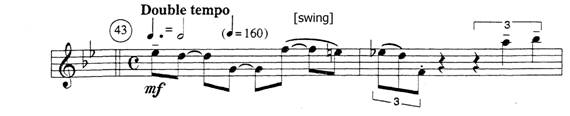
Douglas Hill (b. 1946), Timepieces for Brass Quintet, Movement I, “Good Times” mm.  43-56, Double tempo (quarter note=160)

All excerpts from Timepieces for Brass Quintet by Douglas Hill used by permission.  Copyright © 1997 Douglas Hill. Really Good Music, LLC, Sole Selling Agent.

For twenty-three of the fifty-five works, I recorded the horn parts and included them along with the printed music.  Although it’s no substitute for a full ensemble recording, it hopefully gives you an idea of the excerpt.  You can listen to the above excerpt from Douglas Hill’s Timepieces here:

If you enjoyed this post, check out the full website, it has much more information.  Much of this material can also be found in my article “Why the Brass Quintet?” published in the May 2009 issue of The Horn Call.

The Capriccios of Zelenka

Jan Dismas Zelenka (1679-1745), a Bohemian born composer who held positions at the Royal Court in Dresden during the first half of the 18th century, wrote a number of works titled “Capriccio” with amazing horn parts.  I was first introduced to his music in a Baroque era seminar during graduate school, and like most horn players, I was awed by the virtuosic writing, especially in the high register.  Dresden during the 17th and 18th centuries had an incredibly rich musical establishment, with well known virtuosos on nearly every instrument residing there.  Among these were the horn players J.A. Fischer, F.A. Samm, the brothers Johann Adam Schindler and Andreas Schindler, and Anton Hampel.  For more detailed information on horn players and horn music at Dresden, I highly recommend Thomas Hiebert’s dissertation,”The Horn in Early Eighteenth-Century Dresden: The Players and Their Repertory,” available from the IHS Thesis Lending Library.

Getting back to Zelenka’s Capriccios, one of my favorite recordings is by the Camerata Bern, with Barry Tuckwell and Robert Routch on horn.  Here are a few clips from that recording to whet your appetite.  They are from the first and third movements of the Capriccio in D Major, ZWV 182.

The range demands of these works are so extreme that I have heard that Barry Tuckwell had Paxman build him a descant in B-flat and high B-flat to use on this recording.  At any rate, these are great pieces – check them out.

A Busy Week and The Horn in Opera

Last week I had the privilege of playing principal horn for a production of Donizetti’s L’elisir D’amore (The Elixir of Love) by Opera East Texas. The performances went very well, and the conductor, orchestra, cast, and crew were all fantastic.  Special thanks to Susan Rogers, the other half of the horn section, for an outstanding job.  Although the horn writing isn’t anything spectacular, the opera as a whole has some beautiful music in it, and there are also quite a few solo/soli sections interspersed between the upper middle register off beats and long tones.  I got an opportunity to focus on my piano attacks and transposition, as well.

Not surprisingly, I had opera on the brain last week, and got thinking about the resources available for horn players taking auditions for, or currently playing in, opera orchestras.  One great resource is The Horn in Opera: Important Excerpts from the Operatic Repertoire, recorded by Dr. Richard Chenoweth of the University of Dayton.

A longtime opera veteran, Professor Chenoweth has recorded major solo and section passages from twenty of the most frequently performed operas, with narration by Charles Wendelken-Wilson.  The insightful comments offer performance tips, and Professor Chenoweth masterfully demonstrates all of the technical and musical nuances required in this repertoire.  Of special interest is the recording of the “Long Call” from Wagner’s Siegfried, which is performed (or miked to sound that way) from offstage, just as it would be in the actual opera.  In addition to the recordings – available on CD and by digital download – the website contains a more complete list of essential opera excerpts.  This is a must have item for any serious horn player, especially those who might be taking opera auditions now or in the future.  Other important contributions from Professor Chenoweth include his doctoral dissertation, “The Horn in Opera: A Study in Orchestration with a Focus on Selected Operas by Britten and Strauss,” available from the IHS Thesis Lending Library, and his many articles on opera-related issues published in The Horn Call.

Another essential is the Hornist’s Opera and Ballet Handbook, compiled and edited by Arthur Labar, with commentary by Howard T. Howard.  Although less well known than his other publication the Horn Player’s Audition Handbook, this collection is worth having in your library as well.

While it would be a mammoth task, it seems that another useful tool would be a collection of complete, or near complete, parts for the most frequently requested works on opera auditions, similar to The Orchestral Audition Repertoire for Horn, published by Thompson Edition.  Anyone looking for a dissertation topic?